Chapter 1 (2nd part): Cell membrane and transport
Cell membrane:
Function:
● Transport raw materials
● Transport manufactured products and wastes out of the cell
● Prevent the entry of unwanted matter
● Prevent escape of matters needed for cellular functions
Composition:
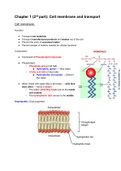
● Composed of Phospholipid molecules
● Phospholipid:
○ Phosphate group (red ball)
■ Hydrophilic (polar) → likes water
○ 2 fatty acid tails (2 blue tails)
■ Hydrophobic (non-polar) → Doesn’t
like water
● When mixed with water (like in the body) → tails face
each other → forms a bilayer
○ The water attracting heads are on the inside
and outside
○ The hydrophobic tails remain in the middle
Amphipathic: Dual properties
, False model, Danielle and Davson:
● Danielle and Davson proposed a model with two layers of protein and in between a
phospholipid bilayer: “Lipo-Protein Sandwich”
● Problems:
○ Assumed all membranes were of a uniform thickness with a constant lipid-protein
ratio
○ Assumed all membranes would have symmetrical internal and external surfaces
○ It did not account for the permeability of certain substances (i.e need for
hydrophilic pores)
○ The temperatures at which membranes solidified did not correlate with those
expected under the proposed model
● Falsification:
○ Membrane proteins were discovered to be insoluble in water (indicating
hydrophobic surfaces) and varied in size
■ Such proteins would not be able to form a uniform and continuous layer
around the outer surface of a membrane
○ Fluorescent antibody tagging (keep track of them) of membrane proteins showed
they were mobile and not fixed in place
■ Membrane proteins from two different cells were tagged with red and
green fluorescent markers respectively
■ When the two cells were fused, the markers became mixed throughout
the membrane of the fused cell
■ This demonstrated that the membrane proteins could move and did not
form a static layer (as per Davson-Danielli)
○ Freeze fracturing was used to split open the membrane and revealed irregular
rough surfaces within the membrane
■ These rough surfaces were interpreted as being transmembrane proteins,
demonstrating that proteins were not solely localised to the outside of the
membrane structure
Cell membrane:
Function:
● Transport raw materials
● Transport manufactured products and wastes out of the cell
● Prevent the entry of unwanted matter
● Prevent escape of matters needed for cellular functions
Composition:
● Composed of Phospholipid molecules
● Phospholipid:
○ Phosphate group (red ball)
■ Hydrophilic (polar) → likes water
○ 2 fatty acid tails (2 blue tails)
■ Hydrophobic (non-polar) → Doesn’t
like water
● When mixed with water (like in the body) → tails face
each other → forms a bilayer
○ The water attracting heads are on the inside
and outside
○ The hydrophobic tails remain in the middle
Amphipathic: Dual properties
, False model, Danielle and Davson:
● Danielle and Davson proposed a model with two layers of protein and in between a
phospholipid bilayer: “Lipo-Protein Sandwich”
● Problems:
○ Assumed all membranes were of a uniform thickness with a constant lipid-protein
ratio
○ Assumed all membranes would have symmetrical internal and external surfaces
○ It did not account for the permeability of certain substances (i.e need for
hydrophilic pores)
○ The temperatures at which membranes solidified did not correlate with those
expected under the proposed model
● Falsification:
○ Membrane proteins were discovered to be insoluble in water (indicating
hydrophobic surfaces) and varied in size
■ Such proteins would not be able to form a uniform and continuous layer
around the outer surface of a membrane
○ Fluorescent antibody tagging (keep track of them) of membrane proteins showed
they were mobile and not fixed in place
■ Membrane proteins from two different cells were tagged with red and
green fluorescent markers respectively
■ When the two cells were fused, the markers became mixed throughout
the membrane of the fused cell
■ This demonstrated that the membrane proteins could move and did not
form a static layer (as per Davson-Danielli)
○ Freeze fracturing was used to split open the membrane and revealed irregular
rough surfaces within the membrane
■ These rough surfaces were interpreted as being transmembrane proteins,
demonstrating that proteins were not solely localised to the outside of the
membrane structure