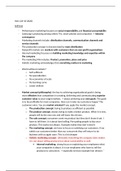
United Kingdom France Germany
Unitary state; parliamentary model Semi-presidential system Federal Republic
Prototype of a parliamentary system Division of executive powers between Parliamentary system
president and prime-minister
Prime minister = head of government Dominant position of the directly elected Strong position of the head of government
president (domaine réservé) (Federal Chancellor), ‘chancellor democracy’
Domaine reserve: president has the power for Chancellor directly elected -> very powerful,
these domains but has to take into account the positions of
the different landers (constitutionally)
first pas the post system in parliament
Monarch = head of state Head of state is elected
Cohabitation: Head of state and head of
government belong to different political
parties, ‘obligation to compromise’
Power concentration in the parliament Government is dependent on the parliament
Type of government
Majority rule, competitive democracy (2 parties Mixed system = combining elements of the Mixed system: both competitive (party
are fighting for the vote) ‘competitive democracy’ (gauche-droite competition) and consensus democracy-based
polarization) and the ‘consensus democracy’ (federal state structure) elements
(compromise between 2 heads of state)
No written Constitution, Common Law Continental European rule-of-law culture
(‘Rechtsstaat’)
Separation of central state and local 16 Landers (regions) that are very powerful,
government level (‘dual polity’) decision-making competences
Regional and local authorities may carry out
only such tasks that have been expressly
assigned to them by parliamentary law (‘ultra
vires rule’)
High politics: external affairs, budget, defense
Low politics: social policy, more soft policy
domains -> competence of local government
State structure No vertical dispersion of powers: unitary and Unitary state Two-layer federal system: federal government
centralized state & 16 states (‘Länder’)
Asymmetric evolution: Scotland has more Centralized administrative system Highly decentralized system
competences than the others because of the
spoken nationalist opinions ( Wales and NI)
Unitary state; parliamentary model Semi-presidential system Federal Republic
Prototype of a parliamentary system Division of executive powers between Parliamentary system
president and prime-minister
Prime minister = head of government Dominant position of the directly elected Strong position of the head of government
president (domaine réservé) (Federal Chancellor), ‘chancellor democracy’
Domaine reserve: president has the power for Chancellor directly elected -> very powerful,
these domains but has to take into account the positions of
the different landers (constitutionally)
first pas the post system in parliament
Monarch = head of state Head of state is elected
Cohabitation: Head of state and head of
government belong to different political
parties, ‘obligation to compromise’
Power concentration in the parliament Government is dependent on the parliament
Type of government
Majority rule, competitive democracy (2 parties Mixed system = combining elements of the Mixed system: both competitive (party
are fighting for the vote) ‘competitive democracy’ (gauche-droite competition) and consensus democracy-based
polarization) and the ‘consensus democracy’ (federal state structure) elements
(compromise between 2 heads of state)
No written Constitution, Common Law Continental European rule-of-law culture
(‘Rechtsstaat’)
Separation of central state and local 16 Landers (regions) that are very powerful,
government level (‘dual polity’) decision-making competences
Regional and local authorities may carry out
only such tasks that have been expressly
assigned to them by parliamentary law (‘ultra
vires rule’)
High politics: external affairs, budget, defense
Low politics: social policy, more soft policy
domains -> competence of local government
State structure No vertical dispersion of powers: unitary and Unitary state Two-layer federal system: federal government
centralized state & 16 states (‘Länder’)
Asymmetric evolution: Scotland has more Centralized administrative system Highly decentralized system
competences than the others because of the
spoken nationalist opinions ( Wales and NI)