English Grammar
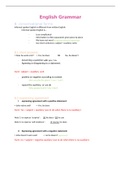
8. conversational forms
Informal spoken English is different from written English:
Informal spoken English is…
- Less complicated
- Information is often separated: given piece by piece
- We leave out word (dropping sentence-beginnings)
- Use short sentences: subject + auxiliary verbs
8.1 short answers
= Does he work a lot? -> Yes, he does OR No, he doesn’t
- Answering a question with yes / no.
- Agreeing or disagreeing to a statement.
Form: subject + auxiliary verb
- positive or negative according to context
who can play the piano? I can / I can’t
- repeat the auxiliary, or use do
Who speaks Dutch? I do/ I don’t
8.2 expressing agreement
I expressing agreement with a positive statement:
= John swims well -> Yes, he does
Form: Yes + subject + auxiliary (use to do when there is no auxiliary)
Note 1: to express ‘surprise’: SO he does / SO he can
Note 2: to express ‘self-evidence’: of course, he does
II Expressing agreement with a negative statement:
= John doesn’t swim well -> no he doesn’t (agreement)
Form: no + subject + negative auxiliary (use to do when there is no auxiliary)
,8.3 expressing disagreement
I Expressing disagreement with a positive statement:
= John swims fast -> No, he doesn’t
Form: no + subject + negative auxiliary (use to do when there is no auxiliary)
Note 1: to react in a STRONGER way: But he doesn’t
II Expressing disagreement with a negative statement:
= John doesn’t swim fast -> Yes, he does
Form: yes + subject + negative auxiliary (use to do when there is no auxiliary)
Note 1: to react in a STRONGER way: But he does
don’t say yes, but he does -> choose between yes or but
8.4 questions tags
= He can dance well -> can’t he?
= He doesn’t work hard -> does he?
A question tag is an expression like, isn’t it? -> to check understanding, ask for agreement
Form: negative or positive auxiliary + subject (use to do when there is no auxiliary)
- Negative question tags after a positive statement
- Positive question tags after a negative statement
Use: after a real question or asking the other person to agree.
Note 1: the question tag for I am is, aren’t I?
Note 2: after imperatives, we use the question tags:
- Will you?
- Would you?
- Can you?
- Could you?
after negative imperatives
- Will you?
Question tag after let’s: shall we?
, Note 3: use “they” to refer to:
- Nobody/ no one
- Somebody/ someone
- Everybody/ everyone
- Anybody/ anyone
Note 4: use non – negative tags after words with a negative meaning like:
- Never
- Nobody
- Hardly
- Scarcely
- Little
-> she never smiles, does she?
Use it in question tags to refer to nothing or to that.
-> nothing can happen, can it?
Note 5: if a tag is a real question, it has a rising intonation: voice goes up.
-> you don’t know where my wallet is, do you?
if a tag asks only for agreement, falling intonation: voice goes down.
-> it’s a beautiful view, isn’t it?
8.5 reply questions
= you work a lot. -> Do I?
Answer with short ‘reply questions’ to:
- Confirm that you are listening
- Expressing reaction like interest, delight, sympathy, concern…
Form: auxiliary/ do + subject (= inversion)
- Positive reply question to answer a positive statement
- Negative reply question to answer a negative statement
8. conversational forms
Informal spoken English is different from written English:
Informal spoken English is…
- Less complicated
- Information is often separated: given piece by piece
- We leave out word (dropping sentence-beginnings)
- Use short sentences: subject + auxiliary verbs
8.1 short answers
= Does he work a lot? -> Yes, he does OR No, he doesn’t
- Answering a question with yes / no.
- Agreeing or disagreeing to a statement.
Form: subject + auxiliary verb
- positive or negative according to context
who can play the piano? I can / I can’t
- repeat the auxiliary, or use do
Who speaks Dutch? I do/ I don’t
8.2 expressing agreement
I expressing agreement with a positive statement:
= John swims well -> Yes, he does
Form: Yes + subject + auxiliary (use to do when there is no auxiliary)
Note 1: to express ‘surprise’: SO he does / SO he can
Note 2: to express ‘self-evidence’: of course, he does
II Expressing agreement with a negative statement:
= John doesn’t swim well -> no he doesn’t (agreement)
Form: no + subject + negative auxiliary (use to do when there is no auxiliary)
,8.3 expressing disagreement
I Expressing disagreement with a positive statement:
= John swims fast -> No, he doesn’t
Form: no + subject + negative auxiliary (use to do when there is no auxiliary)
Note 1: to react in a STRONGER way: But he doesn’t
II Expressing disagreement with a negative statement:
= John doesn’t swim fast -> Yes, he does
Form: yes + subject + negative auxiliary (use to do when there is no auxiliary)
Note 1: to react in a STRONGER way: But he does
don’t say yes, but he does -> choose between yes or but
8.4 questions tags
= He can dance well -> can’t he?
= He doesn’t work hard -> does he?
A question tag is an expression like, isn’t it? -> to check understanding, ask for agreement
Form: negative or positive auxiliary + subject (use to do when there is no auxiliary)
- Negative question tags after a positive statement
- Positive question tags after a negative statement
Use: after a real question or asking the other person to agree.
Note 1: the question tag for I am is, aren’t I?
Note 2: after imperatives, we use the question tags:
- Will you?
- Would you?
- Can you?
- Could you?
after negative imperatives
- Will you?
Question tag after let’s: shall we?
, Note 3: use “they” to refer to:
- Nobody/ no one
- Somebody/ someone
- Everybody/ everyone
- Anybody/ anyone
Note 4: use non – negative tags after words with a negative meaning like:
- Never
- Nobody
- Hardly
- Scarcely
- Little
-> she never smiles, does she?
Use it in question tags to refer to nothing or to that.
-> nothing can happen, can it?
Note 5: if a tag is a real question, it has a rising intonation: voice goes up.
-> you don’t know where my wallet is, do you?
if a tag asks only for agreement, falling intonation: voice goes down.
-> it’s a beautiful view, isn’t it?
8.5 reply questions
= you work a lot. -> Do I?
Answer with short ‘reply questions’ to:
- Confirm that you are listening
- Expressing reaction like interest, delight, sympathy, concern…
Form: auxiliary/ do + subject (= inversion)
- Positive reply question to answer a positive statement
- Negative reply question to answer a negative statement