Section 1 – Electrical symbols, units and definitions
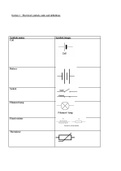
Symbols names Symbols images
Cell
Battery
Switch
Filament lamp
Fixed resistor
Thermistor
,Light emitting diode (LED)
Light dependent resistor (LDR)
Rheostat
Capacitor
Voltmeter
potential difference (volt)
This is a unit that of electromotive force and
this is the electrical potential that is needed to
produce at least one ampere of the current that
is needed with a resistance of at least one ohm,
the potential difference and is measured in
volts.
Ammeter
current (ampere)
The movement of electrons in a conductor
measured in amperes
Produce a ‘Glossary of Terms’ that defines and gives a brief explanation of each of the following:
electrical charge (coulomb)
This the unit that is of electric charge of the unit and the coulomb is the quantity that is needed of the electric
charge that passes through the cross section of the conductor in at least one second and the current is kept
at constant for at least one ampere.
resistance (ohm)
This unit of the electrical resistance that is the resistance of the circuit with the needed voltage of at least
one volt and with the current flow of at least one ampere, measured in ohms.
conductance (siemen)
This is the potential for substance that is needed to conduct electricity and this measures how easily the
electrical current can pass through a material.
, electrical power (watt)
This is the electrical energy that is transferred by an electric circuit and the unit of it is watt, for one joule
per second, and is measured in watt.
capacitance (farad and sub-units)
This is the amount of the separated of the electric charge that can be stored on per unit change that is in the
electrical potential.
current in terms of rate of flow of mobile charge carriers
This is when the current of the rate where charge flows past a point of the circuit, since the current of the 1
ampere tends to be in at least 1 coulomb of the charge that is passing through the cross section of the wire
for at least every one second.
electromotive force (EMF) as a measure of ratio of energy supplied per unit of charge
This tends to be measured in volts, in this case where its equivalent of the metre-kilogram-second system
to at least one joule per coulomb of the needed electric charge and then for the electrostatic units of the
centimetre-gram-system of the unit that is of the electromotive force of the statvolt.
conductance and resistance in relation to density of mobile charge carriers.
This is when the J is proportional to the density of the charge carriers and the drift speed of the carriers
through the material and the resistance R which is measured in ohms, W, that this is the proportionality
between voltage, V and current, I and for that Ohm’s law for this the R is then constant.
Section 2 - Electrical formulae and relationships
Draw diagrams of theoretical circuits and use the following electrical formulae to accurately calculate
a range of electrical quantities. As part of your working, explain the following equations and how
you have applied them:
Energy supplied: W = VIt
Energy is measured E or W as this can equivalent to the work done, since it can be measured in Joules.
The energy supplied for this is 12,420J
Symbols names Symbols images
Cell
Battery
Switch
Filament lamp
Fixed resistor
Thermistor
,Light emitting diode (LED)
Light dependent resistor (LDR)
Rheostat
Capacitor
Voltmeter
potential difference (volt)
This is a unit that of electromotive force and
this is the electrical potential that is needed to
produce at least one ampere of the current that
is needed with a resistance of at least one ohm,
the potential difference and is measured in
volts.
Ammeter
current (ampere)
The movement of electrons in a conductor
measured in amperes
Produce a ‘Glossary of Terms’ that defines and gives a brief explanation of each of the following:
electrical charge (coulomb)
This the unit that is of electric charge of the unit and the coulomb is the quantity that is needed of the electric
charge that passes through the cross section of the conductor in at least one second and the current is kept
at constant for at least one ampere.
resistance (ohm)
This unit of the electrical resistance that is the resistance of the circuit with the needed voltage of at least
one volt and with the current flow of at least one ampere, measured in ohms.
conductance (siemen)
This is the potential for substance that is needed to conduct electricity and this measures how easily the
electrical current can pass through a material.
, electrical power (watt)
This is the electrical energy that is transferred by an electric circuit and the unit of it is watt, for one joule
per second, and is measured in watt.
capacitance (farad and sub-units)
This is the amount of the separated of the electric charge that can be stored on per unit change that is in the
electrical potential.
current in terms of rate of flow of mobile charge carriers
This is when the current of the rate where charge flows past a point of the circuit, since the current of the 1
ampere tends to be in at least 1 coulomb of the charge that is passing through the cross section of the wire
for at least every one second.
electromotive force (EMF) as a measure of ratio of energy supplied per unit of charge
This tends to be measured in volts, in this case where its equivalent of the metre-kilogram-second system
to at least one joule per coulomb of the needed electric charge and then for the electrostatic units of the
centimetre-gram-system of the unit that is of the electromotive force of the statvolt.
conductance and resistance in relation to density of mobile charge carriers.
This is when the J is proportional to the density of the charge carriers and the drift speed of the carriers
through the material and the resistance R which is measured in ohms, W, that this is the proportionality
between voltage, V and current, I and for that Ohm’s law for this the R is then constant.
Section 2 - Electrical formulae and relationships
Draw diagrams of theoretical circuits and use the following electrical formulae to accurately calculate
a range of electrical quantities. As part of your working, explain the following equations and how
you have applied them:
Energy supplied: W = VIt
Energy is measured E or W as this can equivalent to the work done, since it can be measured in Joules.
The energy supplied for this is 12,420J