Theory of Recapitulation
- Development of the embryo goes through stages that represent evolution of ancestors
o Starts from embryo and development in more difficult organisms
- Occurrence in an individual organism's development of successive stages resembling the
series of ancestral types from which it has descended so that the ontogeny of the individual
retraces the phylogeny of its group
- Ontogeny recapitulates Phylogeny
o Ontogeny = Embryonic Development
o Phylogeny = History of Evolution
- All vertebrate embryos follow a common developmental plan due to having a set of genes
that gives the same instructions for development.
o Species look the same in the beginning
- As each organism grows, it diverges according to its species way of life.
o Human embryonic development is similar to that of other vertebrates, more like that
of other mammals than nonmammals, and most similar to that of other primates.
o From the study of ontogeny, we discover clues about the transformation of species
through evolutionary change.
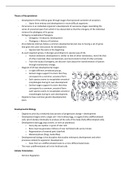
- Diagram of (three) developmental stages
o in eight different vertebrate groups.
o Earliest stages support his claim that they
correspond to a common, ancestral form
o Each species seems to recapitulate ancestral
morphologies during its own development.
o Earliest stages support his claim that they
correspond to a common, ancestral form
each species seems to recapitulate ancestral
morphologies during its own development.
- Organisms have common genetic developmental
plans
Developmental Biology
- Organisms arise by a relatively slow process of progressive change = development
- Development begins with a single cell—the fertilized egg, or zygote (fully undifferentiated
cell), which divides mitotically to produce all the cells of the body (fully differentiated cells).
- Development does not stop at birth, or even at adulthood.
o Every day we replace >1 gram of skin cells
o Bone marrow generates millions of new red blood cells every minute.
o Regeneration of severed parts (starfish)
o Metamorphosis (frogs, butterflies)
- Developmental biology is the discipline that studies embryonic development and other
processes related to organisms’ development
o Goes from an undifferentiated state to a more differentiated state
- The most undifferentiated cell is the fertilised cells
Cellular Polarization
- Extrinsic Regulation
, o cell is in close contact with an external niche (external signal)
▪ The environment plays a role
▪ Niche is a sertain substance of cells that surround the cells that need to get
the signal
o only one daughter cell can maintain contact with the niche
o By orienting its mitotic spindle perpendicularly to the niche surface, it ensures that
only one daughter cell can maintain contact with the stem cell niche and retain the
ability to self-renew
o This contact maintains the potential to self-renew
o Spindle orientation
o
- Intrinsic Regulation
o Regulators of self-renewal within the cell are localized asymmetrically
o They are inherited by only one of the two daughter cells
o Signal inside the cell
Symmetry breaking in the early C. elegans embryo
- C. elegans zygote - one cell stage
o C.elegans embryo
o Green and red signal (in the cell)
o This are different proteins
▪ There is a strong difference in proteins
- All of the PAR proteins are enriched to some degree at or near
the cell cortex, and most of the proteins adopt asymmetric
localization patterns as cell polarization develops
- Deuterostome -> 2 hole that have assymertry
- PAR-3 and PAR-6 become enriched in the anterior
cortex during the one-cell stage, and PAR-1 and PAR-2
become enriched in the posterior cortex.
- Network of actin and myosin II forms at the cortex of
the egg which will retreact towards the anterior of
the embryo, taking anterior PAR proteins (Par-6 and
3) with it.
o This means PAR-2 stays at the other end (posterior)
, - Symmetry is broken when the sperm enters the egg cell
o The anterior of the posterior side
o Entrance of the sperm is beginning of asymmetry
▪ Anterior of posterior side
- Polarity establishment
o Formation of proteins in on side
- Polarity maintenance
o Establishment of 2 proteins in the cell
- Leads to the first cell division
o Rise to cells that differ from each other
o mitosis
PAR Proteins
- An internal cellular signal for Polarisation
- Par proteins = Partitioning defective genes
- Homologs throughout the animal kingdom
- Take out the par proteins: see something in division -> mutants
- Organizing cell asymmetry, co-ordinating polarisation of cytoskeleton
o Important for the asymmetry
- Present in several cell types were polarity is needed
o Poliarisation: front part is different form the backpart of the
proteins
o Par proteins are present in axons
- Key features of PAR polarity factors
o PAR polarity is well conserved in different cell types of many organisms
o They create protein domains which have distinct compositions for different functions
PAR proteins localize in a mutually exclusive manner
- Since par mutants are defective in cell polarization, and some PAR proteins become
asymmetrically localized themselves, it appeared possible that PAR proteins drive their own
asymmetric localization by regulating motors or by establishing the conditions necessary in
the cell cortex for asymmetric movements of cellular components
o Left side is the anterior side
- Anterior PAR are required to prevent posterior PAR proteins from localising at the anterior
and viceversa
o PAR-2 mutants: you don’t see PAR-2 in PAR2- mutants
o PAR-6 can move forward if PAR-2 is not there
o Cytoskeleton shuffeling ensuses that proteins can migrate
- Development of the embryo goes through stages that represent evolution of ancestors
o Starts from embryo and development in more difficult organisms
- Occurrence in an individual organism's development of successive stages resembling the
series of ancestral types from which it has descended so that the ontogeny of the individual
retraces the phylogeny of its group
- Ontogeny recapitulates Phylogeny
o Ontogeny = Embryonic Development
o Phylogeny = History of Evolution
- All vertebrate embryos follow a common developmental plan due to having a set of genes
that gives the same instructions for development.
o Species look the same in the beginning
- As each organism grows, it diverges according to its species way of life.
o Human embryonic development is similar to that of other vertebrates, more like that
of other mammals than nonmammals, and most similar to that of other primates.
o From the study of ontogeny, we discover clues about the transformation of species
through evolutionary change.
- Diagram of (three) developmental stages
o in eight different vertebrate groups.
o Earliest stages support his claim that they
correspond to a common, ancestral form
o Each species seems to recapitulate ancestral
morphologies during its own development.
o Earliest stages support his claim that they
correspond to a common, ancestral form
each species seems to recapitulate ancestral
morphologies during its own development.
- Organisms have common genetic developmental
plans
Developmental Biology
- Organisms arise by a relatively slow process of progressive change = development
- Development begins with a single cell—the fertilized egg, or zygote (fully undifferentiated
cell), which divides mitotically to produce all the cells of the body (fully differentiated cells).
- Development does not stop at birth, or even at adulthood.
o Every day we replace >1 gram of skin cells
o Bone marrow generates millions of new red blood cells every minute.
o Regeneration of severed parts (starfish)
o Metamorphosis (frogs, butterflies)
- Developmental biology is the discipline that studies embryonic development and other
processes related to organisms’ development
o Goes from an undifferentiated state to a more differentiated state
- The most undifferentiated cell is the fertilised cells
Cellular Polarization
- Extrinsic Regulation
, o cell is in close contact with an external niche (external signal)
▪ The environment plays a role
▪ Niche is a sertain substance of cells that surround the cells that need to get
the signal
o only one daughter cell can maintain contact with the niche
o By orienting its mitotic spindle perpendicularly to the niche surface, it ensures that
only one daughter cell can maintain contact with the stem cell niche and retain the
ability to self-renew
o This contact maintains the potential to self-renew
o Spindle orientation
o
- Intrinsic Regulation
o Regulators of self-renewal within the cell are localized asymmetrically
o They are inherited by only one of the two daughter cells
o Signal inside the cell
Symmetry breaking in the early C. elegans embryo
- C. elegans zygote - one cell stage
o C.elegans embryo
o Green and red signal (in the cell)
o This are different proteins
▪ There is a strong difference in proteins
- All of the PAR proteins are enriched to some degree at or near
the cell cortex, and most of the proteins adopt asymmetric
localization patterns as cell polarization develops
- Deuterostome -> 2 hole that have assymertry
- PAR-3 and PAR-6 become enriched in the anterior
cortex during the one-cell stage, and PAR-1 and PAR-2
become enriched in the posterior cortex.
- Network of actin and myosin II forms at the cortex of
the egg which will retreact towards the anterior of
the embryo, taking anterior PAR proteins (Par-6 and
3) with it.
o This means PAR-2 stays at the other end (posterior)
, - Symmetry is broken when the sperm enters the egg cell
o The anterior of the posterior side
o Entrance of the sperm is beginning of asymmetry
▪ Anterior of posterior side
- Polarity establishment
o Formation of proteins in on side
- Polarity maintenance
o Establishment of 2 proteins in the cell
- Leads to the first cell division
o Rise to cells that differ from each other
o mitosis
PAR Proteins
- An internal cellular signal for Polarisation
- Par proteins = Partitioning defective genes
- Homologs throughout the animal kingdom
- Take out the par proteins: see something in division -> mutants
- Organizing cell asymmetry, co-ordinating polarisation of cytoskeleton
o Important for the asymmetry
- Present in several cell types were polarity is needed
o Poliarisation: front part is different form the backpart of the
proteins
o Par proteins are present in axons
- Key features of PAR polarity factors
o PAR polarity is well conserved in different cell types of many organisms
o They create protein domains which have distinct compositions for different functions
PAR proteins localize in a mutually exclusive manner
- Since par mutants are defective in cell polarization, and some PAR proteins become
asymmetrically localized themselves, it appeared possible that PAR proteins drive their own
asymmetric localization by regulating motors or by establishing the conditions necessary in
the cell cortex for asymmetric movements of cellular components
o Left side is the anterior side
- Anterior PAR are required to prevent posterior PAR proteins from localising at the anterior
and viceversa
o PAR-2 mutants: you don’t see PAR-2 in PAR2- mutants
o PAR-6 can move forward if PAR-2 is not there
o Cytoskeleton shuffeling ensuses that proteins can migrate