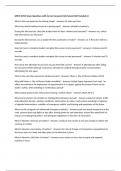
HMPYC80
RESEARCH METHODOLOGY
Assignment 1
Questions and Answers
Contains the correct answers for 24 multiple choice questions, as well as additional notes and headings from the
textbook
TEXTBOOK USED:
Fouché, C. B.; Strydom, H. & Roestenburg, W. J. H. (2021). Research at grass roots: For the social sciences and human
service professions (5th Edition).
ISBN: 978-0-627-03821-1
, ASSIGNMENT 01 2022 – unique number 867809 (Worth 5%)
To find the answers in the textbook: refer to chapter being asked and the heading provided in this guide.
_____________________________________________________________________________________________________________________
Chapter 1
1. How researchers see social reality is rooted in basic ontological perceptions. For example, interpretivism states
that -----.
a) there is an external reality that can be studied objectively and free of values. The ability to know things as they really are
is possible if specific, controlled methods are employed because pursuing these methods will place a necessary check on
subjectivity and restrain personal judgement and emotions.
b) social reality should be viewed and interpreted by the individual according to their ideological position. The “knower”
and “known” are interdependent and the social sciences are essentially subjective. Reality is seen as multi-layered and
complex; and any single phenomenon will have multiple interpretations.
c) knowledge and its provisional truths are best understood through a complex interplay between objective and subjective
(or interpretivist) ways of knowing. As such, knowledge is viewed and experienced as truly multifaceted and ever-
changing. This represents a middle path that synthesises the benefits offered by the single-approach methods associated
with the positivist and constructivist paradigms.
d) knowledge, reality and our existence as human beings evoke questions about who we are, what we know and how we
experience the world around us.
ADDITIONAL NOTES QUESTION 1:
2.2 Ontology
Advocates of interpretivism believe that the subject matter of the social sciences is fundamentally different from that of
the natural sciences. As such, social reality should be viewed and interpreted by the individual according to their
ideological position. The “knower” and “known” are interdependent and the social sciences are essentially subjective.
Reality is seen as multi-layered and complex; and any single phenomenon will have multiple interpretations.
_____________________________________________________________________________________________________________________________________________
2. Which one of the following does NOT apply to epistemological frameworks?
a) Positivists purport that the methods and procedures of the natural sciences are entirely appropriate to the social
sciences. This is informed by the ontological position of objectivism: that reality is out there to be studied, captured and
understood. Research therefore needs to be conducted from a detached, neutral, value-free and non-interactive position.
Researchers therefore only need to follow a systematic, prescribed series of steps to gather and analyse data.
b) Post-positivists argue that reality can never really be fully understood, only approximated, and therefore relies on
multiple methods to capture as much of reality as possible. As with positivism, it places an emphasis on the discovery and
verification of theories, but holds the notion that a variety of variables cannot always be controlled, and that positivist
research is often difficult and impractical for many forms of social science research.
c) Constructivists see reality as the result of a series of constructive processes and hold that only a narrative truth exists.
As such, reality can only be known by those who experience it personally. Constructivists have a “humanistic and social
justice commitment to study the social world from the perspective of the interacting individual” (Denzin, 2017, p. 10).
d) Axiology is the science of human values that enables us to identify the internal valuing systems that influence our
perceptions, decisions, and actions to clearly understand why we do what we do.
RESEARCH METHODOLOGY
Assignment 1
Questions and Answers
Contains the correct answers for 24 multiple choice questions, as well as additional notes and headings from the
textbook
TEXTBOOK USED:
Fouché, C. B.; Strydom, H. & Roestenburg, W. J. H. (2021). Research at grass roots: For the social sciences and human
service professions (5th Edition).
ISBN: 978-0-627-03821-1
, ASSIGNMENT 01 2022 – unique number 867809 (Worth 5%)
To find the answers in the textbook: refer to chapter being asked and the heading provided in this guide.
_____________________________________________________________________________________________________________________
Chapter 1
1. How researchers see social reality is rooted in basic ontological perceptions. For example, interpretivism states
that -----.
a) there is an external reality that can be studied objectively and free of values. The ability to know things as they really are
is possible if specific, controlled methods are employed because pursuing these methods will place a necessary check on
subjectivity and restrain personal judgement and emotions.
b) social reality should be viewed and interpreted by the individual according to their ideological position. The “knower”
and “known” are interdependent and the social sciences are essentially subjective. Reality is seen as multi-layered and
complex; and any single phenomenon will have multiple interpretations.
c) knowledge and its provisional truths are best understood through a complex interplay between objective and subjective
(or interpretivist) ways of knowing. As such, knowledge is viewed and experienced as truly multifaceted and ever-
changing. This represents a middle path that synthesises the benefits offered by the single-approach methods associated
with the positivist and constructivist paradigms.
d) knowledge, reality and our existence as human beings evoke questions about who we are, what we know and how we
experience the world around us.
ADDITIONAL NOTES QUESTION 1:
2.2 Ontology
Advocates of interpretivism believe that the subject matter of the social sciences is fundamentally different from that of
the natural sciences. As such, social reality should be viewed and interpreted by the individual according to their
ideological position. The “knower” and “known” are interdependent and the social sciences are essentially subjective.
Reality is seen as multi-layered and complex; and any single phenomenon will have multiple interpretations.
_____________________________________________________________________________________________________________________________________________
2. Which one of the following does NOT apply to epistemological frameworks?
a) Positivists purport that the methods and procedures of the natural sciences are entirely appropriate to the social
sciences. This is informed by the ontological position of objectivism: that reality is out there to be studied, captured and
understood. Research therefore needs to be conducted from a detached, neutral, value-free and non-interactive position.
Researchers therefore only need to follow a systematic, prescribed series of steps to gather and analyse data.
b) Post-positivists argue that reality can never really be fully understood, only approximated, and therefore relies on
multiple methods to capture as much of reality as possible. As with positivism, it places an emphasis on the discovery and
verification of theories, but holds the notion that a variety of variables cannot always be controlled, and that positivist
research is often difficult and impractical for many forms of social science research.
c) Constructivists see reality as the result of a series of constructive processes and hold that only a narrative truth exists.
As such, reality can only be known by those who experience it personally. Constructivists have a “humanistic and social
justice commitment to study the social world from the perspective of the interacting individual” (Denzin, 2017, p. 10).
d) Axiology is the science of human values that enables us to identify the internal valuing systems that influence our
perceptions, decisions, and actions to clearly understand why we do what we do.