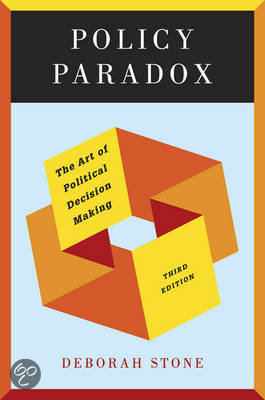
Deborah Stone: Policy Paradox
Course: Policy Professionals
2020-2021
Prof: Van Dooren
1. Goals: defined as aspirations, enduring values
Conflict - within goal and between goals - (and meaning-making) is in interpretation
Everyone wants them, but the dimensions are conflictual/contested and political
Aspirations are ‘made’ in the polis and the task of a policy analyst is to reveal goals
1. Equity: (=“distributions regarded as fair”)
Every distribution has 3 important dimensions: recipients, item, and process
Recipients-issues: who should get some? To whom
Membership: a community wherein everyone is entitled
E.g. a national social security system
[BUT what are the boundaries of this community?]
Merit: individual talent/hard work creates entitlement
E.g. The Beatles were very good, so they got successful
[BUT public/private investments and luck also plays a role]
Rank: there are differences in entitlement between segments of
‘the whole’, based on individual performances (i.e. internal
subdivisions of society)
E.g. a minister makes more a year than a small local mayor
[BUT who makes the lines between segments and based on what?]
Group: some intrinsic group-memberships outweigh individual
characteristics (i.e. major internal cleavages of society)
E.g. special programs specifically for minority groups; quota
[BUT society and its cleavages are not so well defined and not
everyone from a group experiences the same, this are always
illegitimate criteria]
BUT it’s in fact a correction for deviations of merit-based
selection and it creates a new membership for certain
organizations
Items-issues: what is being distributed? What
Need for the item: it is part of a whole of needs/assets
E.g. determining financial study aid based on different criteria
(student’s income, student’s academic merit, parents’ earnings, …)
Individual value of the item: moral perception of equal?
E.g. separatist education in Texas was not equal because the black
people did not have access to the prestigious schools for whites
, Process-issues: how should it be distributed? How
Competition: opportunity as ‘starting resources’
Lottery: opportunity as ‘statistical chance’
Voting: opportunity as ‘political participation’
2. Efficiency: (= “getting the most for the least”) ≠a goal in itself, nor a path
Ratio between input and output
Complications of efficiency (p.67)
Who determines main objective or weight of multiple ones?
How do outputs benefit different groups?
Is the market the most efficient?
Theory around aggregation of individual exchanges with 3
assumptions for actors (~neoliberalism) [p.77]
Rationality: homo economicus wants to maximize self-interest
[BUT real people are emotional, moral and social in their decisions
and even do things which aren’t in their self-interest, e.g. smoking]
Full information: objective info about price/quality of alternatives
and subjective info about an individual’s own preferences
[BUT obviously not all information is known or even public; it is
strategically used by actors]
Voluntarism: people only start to trade when they want to
[BUT often unequal relation! The difference with semi-coercion is
thin, e.g. a worker ‘accepts’ his wage, but works for a livelihood
AND the termination of a trade is not per se voluntarily, e.g.
company lay-offs ‘forcing’ someone in a less paid job]
Failures or defects of the market (which inhibits ‘welfare economics')
Externalities (=effects outside the exchange-partners-sphere)
E.g. environmental impact, business relocations, …
[Almost all economic transactions have outside harms]
Public goods (=collective goods that can serve more individuals at
once)
E.g. schools, hospitals, lighthouses, parks, …
[Funded by taxes, which are not voluntary transactions]
Conclusion: in the polis, the community is the paramount public
good. It creates trust to actually make markets function!
Critique on the ‘aggregating’ part of the theory
Everyone has multiple roles that conflict with each other (e.g. one
of a consumer and one of a producer of products)
People are social creatures who care for each other! Someone’s
welfare is dependent on the welfare of the ones she/he loves
Free-market arithmetic does not keep distribution of welfare in
account. The distribution often feeds inequality
Equality-efficiency trade-off? Two main reasons for this assumption
Unequal rewards motivate people to be productive: the potential
of getting many gains brings incentive to people to take risks, work
hard, innovate, …
Course: Policy Professionals
2020-2021
Prof: Van Dooren
1. Goals: defined as aspirations, enduring values
Conflict - within goal and between goals - (and meaning-making) is in interpretation
Everyone wants them, but the dimensions are conflictual/contested and political
Aspirations are ‘made’ in the polis and the task of a policy analyst is to reveal goals
1. Equity: (=“distributions regarded as fair”)
Every distribution has 3 important dimensions: recipients, item, and process
Recipients-issues: who should get some? To whom
Membership: a community wherein everyone is entitled
E.g. a national social security system
[BUT what are the boundaries of this community?]
Merit: individual talent/hard work creates entitlement
E.g. The Beatles were very good, so they got successful
[BUT public/private investments and luck also plays a role]
Rank: there are differences in entitlement between segments of
‘the whole’, based on individual performances (i.e. internal
subdivisions of society)
E.g. a minister makes more a year than a small local mayor
[BUT who makes the lines between segments and based on what?]
Group: some intrinsic group-memberships outweigh individual
characteristics (i.e. major internal cleavages of society)
E.g. special programs specifically for minority groups; quota
[BUT society and its cleavages are not so well defined and not
everyone from a group experiences the same, this are always
illegitimate criteria]
BUT it’s in fact a correction for deviations of merit-based
selection and it creates a new membership for certain
organizations
Items-issues: what is being distributed? What
Need for the item: it is part of a whole of needs/assets
E.g. determining financial study aid based on different criteria
(student’s income, student’s academic merit, parents’ earnings, …)
Individual value of the item: moral perception of equal?
E.g. separatist education in Texas was not equal because the black
people did not have access to the prestigious schools for whites
, Process-issues: how should it be distributed? How
Competition: opportunity as ‘starting resources’
Lottery: opportunity as ‘statistical chance’
Voting: opportunity as ‘political participation’
2. Efficiency: (= “getting the most for the least”) ≠a goal in itself, nor a path
Ratio between input and output
Complications of efficiency (p.67)
Who determines main objective or weight of multiple ones?
How do outputs benefit different groups?
Is the market the most efficient?
Theory around aggregation of individual exchanges with 3
assumptions for actors (~neoliberalism) [p.77]
Rationality: homo economicus wants to maximize self-interest
[BUT real people are emotional, moral and social in their decisions
and even do things which aren’t in their self-interest, e.g. smoking]
Full information: objective info about price/quality of alternatives
and subjective info about an individual’s own preferences
[BUT obviously not all information is known or even public; it is
strategically used by actors]
Voluntarism: people only start to trade when they want to
[BUT often unequal relation! The difference with semi-coercion is
thin, e.g. a worker ‘accepts’ his wage, but works for a livelihood
AND the termination of a trade is not per se voluntarily, e.g.
company lay-offs ‘forcing’ someone in a less paid job]
Failures or defects of the market (which inhibits ‘welfare economics')
Externalities (=effects outside the exchange-partners-sphere)
E.g. environmental impact, business relocations, …
[Almost all economic transactions have outside harms]
Public goods (=collective goods that can serve more individuals at
once)
E.g. schools, hospitals, lighthouses, parks, …
[Funded by taxes, which are not voluntary transactions]
Conclusion: in the polis, the community is the paramount public
good. It creates trust to actually make markets function!
Critique on the ‘aggregating’ part of the theory
Everyone has multiple roles that conflict with each other (e.g. one
of a consumer and one of a producer of products)
People are social creatures who care for each other! Someone’s
welfare is dependent on the welfare of the ones she/he loves
Free-market arithmetic does not keep distribution of welfare in
account. The distribution often feeds inequality
Equality-efficiency trade-off? Two main reasons for this assumption
Unequal rewards motivate people to be productive: the potential
of getting many gains brings incentive to people to take risks, work
hard, innovate, …