Week 3
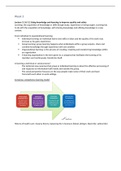
Lecture 3.1 & 3.2 Using knowledge and learning to improve quality and safety
Learning: the acquisition of knowledge or skills though study, experience or being taught. Learning has
to do with the acquisition of knowledge, with sharing knowledge and utilizing knowledge in a new
context.
From individual to organizational learning:
Individual learning: an individual learns new skills or ideas and the quality of his work may
increase as he gains experience.
Group learning: group learning happens when individuals within a group acquire, share and
combine knowledge through experience with one another.
Organizational learning: is the process of creating, retaining and transferring knowledge within
an organization
A learning organization is the term given to a company that facilitates the learning of its
members and continuously transforms itself.
Is learning a technical or social process?
- The technical view assumes that group or individual learning is about the effective processing of
and response to information both inside and outside the group.
- The social perspective focusses on the way people make sense of their work and learn
from/with each other in work settings.
Conscious competence learning model
History of health care: miasma theory, balancing the 4 humours (blood, phlegm, black bile, yellow bile)
, Nonaka's model of knowledge
Implicit knowledge is based on our experiences.
Explicit knowledge is knowledge that can be
verbalized, stored, accessed, and shared with
others.
Tacit knowledge is knowledge gained from
personal experience that is more difficult to
Internalization: conscious competence -> express.
unconscious competence
Kolb' learning style model Single vs double loop learning
Single: by repetition you become better at something.
Stages you go through when learning and Double: reflecting am I doing the right thing?
different styles of learning.
----------------------------------
Social realities: objective, subjective, intersubjective (objective and subjective, continuously changing).
Enablers of organizational learning:
1. A shared vision about a desirable future state.
2. Procedures for generating information about performance
3. Communication channels for diffusion and collective interpretation of information
4. Decentralized responsibilities for implementing changes and experimentation
5. Learning skills: the ability of organizational members to individually and collectively analyze and
improve their performance
6. Incentives for innovative actions and improvements instead of punishments for mistakes
7. A learning culture: trust, cooperation, transparency, accountability and equality
Learning in organizations according to Clegg:
Organisation is not order, is not something stable. Organizing is not only a process of ordering
(intension vs reality).
There is too much focus on rationality, ordering, structuring and controlling, while there is also
irrationality, flux, emotion and unpredictability.
Organizations balance between 2 threats: order and disorder.
Much organizing relates to what happens while management is busy making other plans.
Lecture 3.1 & 3.2 Using knowledge and learning to improve quality and safety
Learning: the acquisition of knowledge or skills though study, experience or being taught. Learning has
to do with the acquisition of knowledge, with sharing knowledge and utilizing knowledge in a new
context.
From individual to organizational learning:
Individual learning: an individual learns new skills or ideas and the quality of his work may
increase as he gains experience.
Group learning: group learning happens when individuals within a group acquire, share and
combine knowledge through experience with one another.
Organizational learning: is the process of creating, retaining and transferring knowledge within
an organization
A learning organization is the term given to a company that facilitates the learning of its
members and continuously transforms itself.
Is learning a technical or social process?
- The technical view assumes that group or individual learning is about the effective processing of
and response to information both inside and outside the group.
- The social perspective focusses on the way people make sense of their work and learn
from/with each other in work settings.
Conscious competence learning model
History of health care: miasma theory, balancing the 4 humours (blood, phlegm, black bile, yellow bile)
, Nonaka's model of knowledge
Implicit knowledge is based on our experiences.
Explicit knowledge is knowledge that can be
verbalized, stored, accessed, and shared with
others.
Tacit knowledge is knowledge gained from
personal experience that is more difficult to
Internalization: conscious competence -> express.
unconscious competence
Kolb' learning style model Single vs double loop learning
Single: by repetition you become better at something.
Stages you go through when learning and Double: reflecting am I doing the right thing?
different styles of learning.
----------------------------------
Social realities: objective, subjective, intersubjective (objective and subjective, continuously changing).
Enablers of organizational learning:
1. A shared vision about a desirable future state.
2. Procedures for generating information about performance
3. Communication channels for diffusion and collective interpretation of information
4. Decentralized responsibilities for implementing changes and experimentation
5. Learning skills: the ability of organizational members to individually and collectively analyze and
improve their performance
6. Incentives for innovative actions and improvements instead of punishments for mistakes
7. A learning culture: trust, cooperation, transparency, accountability and equality
Learning in organizations according to Clegg:
Organisation is not order, is not something stable. Organizing is not only a process of ordering
(intension vs reality).
There is too much focus on rationality, ordering, structuring and controlling, while there is also
irrationality, flux, emotion and unpredictability.
Organizations balance between 2 threats: order and disorder.
Much organizing relates to what happens while management is busy making other plans.