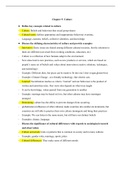
Chapter 5: Culture
● Define key concepts related to culture
- Culture: Beliefs and behaviour that social group shares
- Cultural norm: defines appropriate and inappropriate behaviour overtime,
- Language, customs, beliefs, collective identities, and knowledge
● Discuss the defining characteristics of culture and provide examples
- Innovative: Basic issues are shared among different cultures/societies, but the solutions to
them are different (can result from working conditions, education, etc)
- Culture is a reflection of how humans adapt to the environment
- New ideas lead to new practices, such as new products or services, which are based on
people’s same set of beliefs and values about innovation (creative solutions, techniques,
and technology)
- Example: Different diets, but pizza can be made to fit into one’s diet (vegan,gluten-free)
- Example: Climate Change - eco friendly technology, like electric cars
- Learned: Socialization teaches us what is “normal” and our behaviour is the product of
written and unwritten rules. Our views also depend on what were taught
- It can be knowledge, values passed from one generation to another
- Example: marriage may be based on love, but other cultures may have marriages
arranged
- Restraining: culture has the ability to prevent changes from occurring
- globalization (influences of other cultures) made countries into similar environments, but
countries are still able to practice their own culture (immigrate and bring their practices
- Example: We can listen to the same music, but still have our distinct beliefs
- Examples: dietary, language
- Discuss the significance of cultural differences with regards to sociological research
and observation
- Culture universals: traits or patterns that is common in society and in many cultures
- Example: gender roles, marriage, sports, jokes
- Cultural differences: They make sense of different morals
, - Example: Conversation etiquettes - In the US, people stand apart to respect their space,
while some countries in the middle east tend to stand really close for them
- Example: In England, they drive on the left side, here we drive on the right side (we think
it’s wrong, but it is right to them)
- Some people may express disgust in one's culture
- Ethnocentrism: judging another culture intentionally or unintentionally based on how it
compares to one's cultural norms (can lead to discrimintaiton)
- Example: eating chopsticks and hands rather than a spoon or a fork
- Culture imperialism: attempting to force one’s cultural values on another culture
- Example: Assimilating European values and culture on Indigenious people
- Culture shock: frustration people may experience after being exposed to a new culture
- Example: different food, not being able to understand a person
- Cultural relativism: evaluating a culture by its own standards instead of viewing it
through the lens of one’s own culture (used in ethnography)
- Can be hard because we have our own biases
- Example: In Canada, women have control over their own bodies and would question the
practice of women circumcision in Ethiopia as part of a cultural tradition
● Identify and provide examples of the various elements of culture
- Values: cultural standards that help control social conduct (what is true, good and how
people should behave, but doesn’t show we behave)
- In Canada, we value multiculturalism, as it goes with our appreciation of diversity
- we still see discrimination against minority groups and immigrants
- Different beliefs - we can celebrate diversity by allowing new immigrants or having a
celebrating for cultures (Greek Week)
- Example: Canada believes in equal opportunities for everyone, but politics is dominated
by men
- Example: Value lower crime, but different beliefs to accomplish those values. we can
punish them or give them the resources so they can integrate themselves back into society
- Beliefs: tenets that we hold to be true, in which individuals in society have special
beliefs, but they still share collective values
- Real Culture: how society is and what occurs
● Define key concepts related to culture
- Culture: Beliefs and behaviour that social group shares
- Cultural norm: defines appropriate and inappropriate behaviour overtime,
- Language, customs, beliefs, collective identities, and knowledge
● Discuss the defining characteristics of culture and provide examples
- Innovative: Basic issues are shared among different cultures/societies, but the solutions to
them are different (can result from working conditions, education, etc)
- Culture is a reflection of how humans adapt to the environment
- New ideas lead to new practices, such as new products or services, which are based on
people’s same set of beliefs and values about innovation (creative solutions, techniques,
and technology)
- Example: Different diets, but pizza can be made to fit into one’s diet (vegan,gluten-free)
- Example: Climate Change - eco friendly technology, like electric cars
- Learned: Socialization teaches us what is “normal” and our behaviour is the product of
written and unwritten rules. Our views also depend on what were taught
- It can be knowledge, values passed from one generation to another
- Example: marriage may be based on love, but other cultures may have marriages
arranged
- Restraining: culture has the ability to prevent changes from occurring
- globalization (influences of other cultures) made countries into similar environments, but
countries are still able to practice their own culture (immigrate and bring their practices
- Example: We can listen to the same music, but still have our distinct beliefs
- Examples: dietary, language
- Discuss the significance of cultural differences with regards to sociological research
and observation
- Culture universals: traits or patterns that is common in society and in many cultures
- Example: gender roles, marriage, sports, jokes
- Cultural differences: They make sense of different morals
, - Example: Conversation etiquettes - In the US, people stand apart to respect their space,
while some countries in the middle east tend to stand really close for them
- Example: In England, they drive on the left side, here we drive on the right side (we think
it’s wrong, but it is right to them)
- Some people may express disgust in one's culture
- Ethnocentrism: judging another culture intentionally or unintentionally based on how it
compares to one's cultural norms (can lead to discrimintaiton)
- Example: eating chopsticks and hands rather than a spoon or a fork
- Culture imperialism: attempting to force one’s cultural values on another culture
- Example: Assimilating European values and culture on Indigenious people
- Culture shock: frustration people may experience after being exposed to a new culture
- Example: different food, not being able to understand a person
- Cultural relativism: evaluating a culture by its own standards instead of viewing it
through the lens of one’s own culture (used in ethnography)
- Can be hard because we have our own biases
- Example: In Canada, women have control over their own bodies and would question the
practice of women circumcision in Ethiopia as part of a cultural tradition
● Identify and provide examples of the various elements of culture
- Values: cultural standards that help control social conduct (what is true, good and how
people should behave, but doesn’t show we behave)
- In Canada, we value multiculturalism, as it goes with our appreciation of diversity
- we still see discrimination against minority groups and immigrants
- Different beliefs - we can celebrate diversity by allowing new immigrants or having a
celebrating for cultures (Greek Week)
- Example: Canada believes in equal opportunities for everyone, but politics is dominated
by men
- Example: Value lower crime, but different beliefs to accomplish those values. we can
punish them or give them the resources so they can integrate themselves back into society
- Beliefs: tenets that we hold to be true, in which individuals in society have special
beliefs, but they still share collective values
- Real Culture: how society is and what occurs