NURSING 101-Medical-Surgical B
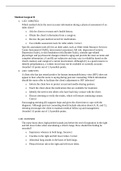
NURSING 101-Medical-Surgical B Medical-Surgical B 1. 1.ID: Which method elicits the most accurate information during a physical assessment of an older client? o Ask the client to recount one's health history. o Obtain the client's information from a caregiver. o Review the past medical record for medications. o Use reliable assessment tools for older adults. Correct Specific assessment tools (D) for an older adult, such as Older Adult Resource Services Center Instrument (OARS), mini-mental assessment, fall risk, depression (Geriatric Depression Scale), or skin breakdown risk (Braden Scale), consider age-related physiologic and psychosocial changes related to aging and provide the most accurate and complete information. (A and B) are subjective and may vary in reliability based on the client's memory and caregiver's current involvement. Although (C) is a good resource to identify polypharmacy, a written record may not be available or currently accurate. Awarded 1.0 points out of 1.0 possible points. 2. 2.ID: A client who has just tested positive for human immunodeficiency virus (HIV) does not appear to hear what the nurse is saying during post-test counseling. Which information should the nurse offer to facilitate the client's adjustment to HIV infection? o Inform the client how to protect sexual and needle-sharing partners. o Teach the client about the medications that are available for treatment. o Identify the need to test others who have had risky contact with the client. o Discuss retesting to verify the results, which will ensure continuing contact. Correct Encouraging retesting (D) supports hope and gives the client time to cope with the diagnosis. Although post-test counseling should include education about (A, B, and C), retesting encourages the client to maintain medical follow-up and management. Awarded 1.0 points out of 1.0 possible points. 3.ID: The nurse hears short, high-pitched sounds just before the end of inspiration in the right and left lower lobes when auscultating a client's lungs. How should this finding be recorded? o Inspiratory wheezes in both lungs. Incorrect o Crackles in the right and left lower lobes. Correct o Abnormal lung sounds in the bases of both lungs. o Pleural friction rub in the right and left lower lobes. Fine crackles (B) are short, high-pitched sounds heard just before the end of inspiration that are the result of rapid equalization of pressure when collapsed alveoli or terminal bronchioles suddenly snap open. Wheezing (A) is a continuous high-pitched squeaking or musical sound caused by rapid vibration of bronchial walls that are first evident on expiration and may be audible. Although (C) describes an adventitious lung sound, this documentation is vague. (D) is a creaking or grating sound from roughened, inflamed surfaces of the pleura rubbing together heard during inspiration, expiration, and with no change during coughing. Awarded 0.0 points out of 1.0 possible points. 3. 4.ID: What assessment finding should the nurse identify that indicates a client with an acute asthma exacerbation is beginning to improve after treatment? o Wheezing becomes louder. Correct o Cough remains unproductive. o Vesicular breath sounds decrease. o Bronchodilators stimulate coughing. Incorrect In an acute asthma attack, air flow may be so significantly restricted that wheezing is diminished. If the client is successfully responding to bronchodilators and respiratory treatments, wheezing becomes louder (A) as air flow increases in the airways. As the airways open and mucous is mobilized in response to treatment, the cough becomes more productive, not (B). Vesicular sounds are soft, low-pitched, gentle, rustling sounds heard over lung fields (C) and is not an indicator of improvement during asthma treatment. Bronchodilators do not stimulate coughing (D). Awarded 0.0 points out of 1.0 possible points. 4. 5.ID: The nurse is caring for a client with non-Hodgkin's lymphoma who is receiving chemotherapy. Laboratory results reveal a platelet count of 10,000/ml. What action should the nurse implement? o Encourage fluids to 3000 ml/day. o Check stools for occult blood. Correct o Provide oral hygiene every 2 hours. o Check for fever every 4 hours. Platelet counts less than 100,000/mm3 are indicative of thrombocytopenia, a common side effect of chemotherapy. A client with thrombocytopenia should be assessed frequently for occult bleeding in the emesis, sputum, feces (B), urine, nasogastric secretions, or wounds. (A) does not minimize the risk for bleeding associated with thrombocytopenia. (C) may cause increased bleeding in a client with thromobcytopenia. (D) assesses for infection, not risk for bleeding. Awarded 1.0 points out of 1.0 possible points. 5. 6.ID: Three weeks after discharge for an acute myocardial infarction (MI), a client returns to the cardiac center for follow-up. When the nurse asks about sleep patterns, the client tells the nurse that he sleeps fine but that his wife moved into the spare bedroom to sleep when he returned home. He states, I guess we will never have sex again after this. Which response is best for the nurse to provide? o Sexual intercourse can be strenuous on your heart, but closeness and intimacy, such as holding and cuddling, can be maintained with your wife. o Sexual activity can be resumed whenever you and your wife feel like it because the sexual response is more emotional rather than physical. o You should discuss your questions about your sexual activity with your healthcare provider because sexual activity may be limited by your heart damage. o Sexual activity is similar in cardiac workload and energy expenditure as climbing two flights of stairs and may be resumed like other activities. Correct Sexual intercourse after an MI, or acute coronary syndrome, has been found to require no more energy expenditure or cardiac stress than walking briskly up two flights of stairs (D), as long as other guidelines, such as limiting food and alcohol intake before intercourse, are followed. (A, B, and C) do not provide the best factual information to reduce the client's anxiety and misconceptions. Awarded 1.0 points out of 1.0 possible points. 6. 7.ID: A male client with chronic atrial fibrillation and a slow ventricular response is scheduled for surgical placement of a permanent pacemaker. The client asks the nurse how this devise will help him. How should the nurse explain the action of a synchronous pacemaker? o Ventricular irritability is prevented by the constant rate setting of pacemaker. o Ectopic stimulus in the atria is suppressed by the device usurping depolarization. o An impulse is fired every second to maintain a heart rate of 60 beats per minute. o An electrical stimulus is discharged when no ventricular response is sensed. Correct The artificial cardiac pacemaker is an electronic device used to pace the heart when the normal conduction pathway is damaged or diseased, such as a symptomatic dysrhythmias like atrial fibrillation with a slow ventricular response. Pacing modes that are synchronous (impulse generated on demand or as needed according to the patient's intrinsic rhythm) send an electrical signal from the pacemaker to the wall of the myocardium stimulating it to contract when no ventricular depolarization is sensed (D). (A, B, and C) do not provide accurate information. Awarded 1.0 points out of 1.0 possible points. 7. 8.ID: The nurse completes visual inspection of a client's abdomen. What technique should the nurse perform next in the abdominal examination? o Percussion. o Auscultation. Correct o Deep palpation. o Light palpation. Auscultation (B) of the client's abdomen is performed next because manual manipulation (A, C, and D) can stimulate the bowel and create false sounds heard during auscultation. Awarded 1.0 points out of 1.0 possible points. 8. 9.ID: During the assessment of a client who is 24 hours post-hemicolectomy with a temporary colostomy, the nurse determines that the client's stoma is dry and dark red in color. What action should the nurse implement? o Notify the surgeon. Correct o Document the assessment. o Secure a colostomy pouch over the stoma. o Place petrolatum gauze dressing over the stoma. The stoma should appear reddish pink and moist, which indicates circulatory perfusion to the surgical diversion of the intestine. If the stoma becomes dry, firm, flaccid, or is dark red or purple, the stoma is ischemic, and the surgeon should be notified immediately (A). Although (B, C, and D) may be implemented, the findings require immediate medical attention. Awarded 1.0 points out of 1.0 possible points. 9. 10.ID: The nurse is caring for a client with end stage liver disease who is being assessed for the presence of asterixis. To assess the client for asterixis, what position should the nurse ask the client to demonstrate? o Extend the left arm laterally with the left palm upward. o Extend the arm, dorsiflex the wrist, and extend the fingers. Correct o Extend the arms and hold this position for 30 seconds. o Extend arms with both legs adducted to shoulder width. Asterixis (flapping tremor, liver flap) is a hand-flapping tremor that is often seen frequently in hepatic encephalopathy. The tremor is induced by extending the arm and dorsiflexing the wrist causing rapid, non-rhythmic extension and flexion of the wrist while attempting to hold position (B). (A, C, and D) do not illicit axterixis. Awarded 1.0 points out of 1.0 possible points. 10. 11.ID: A client is admitted to the emergency department after being lost for four days while hiking in a national forest. Upon review of the laboratory results, the nurse determines the client's serum level for thyroid-stimulating hormone (TSH) is elevated. Which additional assessment should the nurse make? o Body mass index. o Skin elasticity and turgor. o Thought processes and speech. o Exposure to cold environmental temperatures. Correct TSH influences the amount of thyroxine secretion which increases the rate of metabolism to maintain body temperature near normal. Prolonged exposure to cold environmental temperatures (D) stimulates the hypothalamus to secrete thyrotropin-releasing hormone, which increases anterior pituitary serum release of TSH. (A) may reflect weight loss from lack of food. Tenting of the skin (B) is indicative of dehydration. Slow or confused thought processes (C) or speech patterns may be related to sleep deprivation. Awarded 1.0 points out of 1.0 possible points. 11. 12.ID: Which finding should the nurse report to the healthcare provider for a client with a circumferential extremity burn? o Full thickness burns rather than partial thickness. o Supinates extremity but unable to fully pronate the extremity. o Slow capillary refill in the digits with absent distal pulse points. Correct o Inability to distinguish sharp versus dull sensations in the extremity. A circumferential burn can form an eschar that results from burn exudate fluid that dries and acts as a tourniquet as fluid shifts occur in the interstitial tissue. As edema increases tissue pressure, blood flow to the distal extremity is compromised, which is manifested by slow capillary refill and absent distal pulses (C), so the healthcare provider should be notified about any compromised circulation that requires escharotomy. Although eschar formation occurs more readily over full thickness burns (A), the circumferential location of the burn is most likely to constrict underlying structures. Limited movement (B) is often due to pain. (D) may be related to the depth of the burn. Awarded 1.0 points out of 1.0 possible points. 12. 13.ID: The nurse is preparing a teaching plan for a client with newly diagnosed glacoma and a history of allergic rhinitis. Which information is most important for the nurse to provide the client about using over-the-counter (OTC) medications for allergies? o Notify your healthcare provider if there is an increase in heart rate. o Increase fluid intake while taking an antihistamine or decongestant. o Avoid allergy medications that contain pseudoephedrine or phenylephrine. Correct o Ophthalmic lubricating drops may be used for eye dryness due to allergy medications. OTC allergy medications may contain ephedrine, phenylephrine, or pseudoephedrine, which can cause adrenergic side effects, such as increased intraocular pressure, so a client with glaucoma should avoid using these OTC medications (C). A client with hypertension should avoid using OTC medications containing ingredients that can increase blood pressure and heart rate (A), but an increase in IOP is most important in a client with glaucoma. (B and D) may provide symptomatic relief for other side effects, such as dry mouth or eye dryness related to common agents used for allergic rhinits. Awarded 1.0 points out of 1.0 possible points. 13. 14.ID: The nurse obtains a client's history that includes right mastectomy and radiation therapy for cancer of the breast 10 years ago. Which current health problem should the nurse consider is a consequence of the radiation therapy? o Asthma. o Myocardial infarction. o Chronic esophagitis with gastroesophageal reflux. o Pathologic fracture of two ribs on the right chest. Correct The ribs lie in the radiation pathway and lose density over time, becoming thin and brittle, so the occurence of two right-sided ribs with pathological fractures resulting without evidence of trauma (D) is related to radiation damage. The heart (B), esophagus (C), and larger bronchi (A) are not usually in the radiation path. Awarded 1.0 points out of 1.0 possible points. 14. 15.ID: A client asks the nurse about the purpose of beginning chemotherapy (CT) because the tumor is still very small. Which information supports the explanation that the nurse should provide? o Side effects are less likely if therapy is started early. o Collateral circulation increases as the tumor grows. o Sensitivity of cancer cells to CT is based on cell cycle rate. o The cell count of the tumor reduces by half with each dose. Correct Initiating chemotherapy while the tumor is small provides a better chance of eradicating all cancer cells because 50% of cancer cells or tumo
Geschreven voor
- Instelling
- Arizona State University
- Vak
- NURSING 101
Documentinformatie
- Geüpload op
- 18 augustus 2021
- Aantal pagina's
- 43
- Geschreven in
- 2021/2022
- Type
- Tentamen (uitwerkingen)
- Bevat
- Vragen en antwoorden
Onderwerpen
-
nursing 101
-
nursing 101 medical surgical b

Ook beschikbaar in voordeelbundel