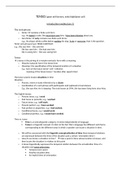
TENSES (geen def kennen, enkel tijdslijnen oef)
Introduction (weblecture 1)
The verb phrase:
o Finite: VP contains a finite verb form
e.g.: He baked a cake; She must have seen him; I have been thinking about you.
o Non-finite: VP only contains non-finite verb forms
e.g.: He always drinks coffee before walking his dog; To be or not to be, that is the question.
Finite verb phrases have TENSE CONTRAST:
e.g.: She sees him – She saw him
She has seen him – She had seen him
She is seeing him – She was seeing him
Tense:
a tense is the pairing of a morpho-syntactic form with a meaning
o Morpho-syntactic form= the tense form
o Meaning= the specification of the temporal location of a situation
E.g.: form of the future tense= will + infinitive
meaning of the future tense= ‘location after speech time’
The tense system locates situations in time
Situation:
o Process, event or state referred to by a clause
o Combination of a verb phrase with participants and (optional) circumstances
E.g.: She saw him; He is sleeping; The train leaves at 5PM; She has been living here since May.
The English tenses:
o Present tense, e.g. I work
o Past tense or preterite, e.g. I worked
o Future tense, e.g. I will work.
o Present perfect, e.g. I have worked.
o Past perfect or pluperfect, e.g. I had worked.
o Conditional tense, e.g. I would work.
o Conditional perfect, e.g. I would have worked.
Time vs. tense
Time is an extralinguistic category: it exists independently of language
Tense is a linguistic concept: it refers to the fact that a language has different verb forms
corresponding to the different ways in which a speaker can locate a situation in time.
o We will be concerned with the linguistic conceptualization of time (how temporal relations
are expressed between the time of the situation and a certain ‘orientation time’)
o How do we locate a situation in time? take a point in time whose location is known, and
then locate the situation in relation to this point
o A tense linguistically expresses the temporal relation between the actualization time of a
situation and some other time:
Temporal zero-point
Another situation time
An implicit time of orientation
,Temporal zero-point (t0)
o The temporal zero-point t0 is the time to which all the temporal relations expressed by a
tense are directly or indirectly related
o The temporal zero-point is nearly always the speech time or encoding time: the time of
uttering or writing the message.
o In certain contexts, it is possible for the speaker to choose the decoding time
(hearing/reading and interpreting the utterance) as the temporal zero-point:
E.g.: You are now entering Washington County
E.g.: when writing a letter that is sent before Christmas, but reaches destination after
Christmas: I hope you had a nice Christmas
BUT most of the time: encoding time=decoding time.
Time spheres: past and present (sectors/zones)
Time zones: past, pre-present, present and post-present.
4 absolute sectors
Relative and absolute tenses (weblecture 2)
Locating situations in time:
o A tense linguistically expresses the temporal relation between the actualization time of a
situation and some other time:
Temporal zero-point absolute tenses: directly related to t0
Another situation time relative tenses: indirectly related to t 0
An implicit time of orientation
E.g.: He said he will come: the ‘coming’ is after t0, still has to happen. Future tense.
vs. He said he would come: more ambiguous. Happens after the situation of saying. Relative tense
(conditional)
Absolute tenses:
o Absolute tense: relates its situation directly to t0:
o The past tense: establishes a domain in the past
o The present perfect: establishes a domain in the pre-present
o The present tense: establishes a domain in the present
o The future tense: establishes a domain in the post-present sector
E.g.: He said he will come:
both absolute (past and postpresent)
, Relative tenses:
Relative tense: relates its situation to a binding TIME OF ORIENTATION (of another situation)
o The past tense: expresses simultaneity in the past domain
o The past perfect: expresses anteriority in the past domain
o The conditional: expresses posteriority in the past domain
E.g.: He said he would come:
‘said’: absolute tense (on timeline), ‘would come’: relative tense (below timeline + arrow)
Temporal domains:
A temporal domain is a set of situations which are temporally related to each other by means of
tenses.
o Absolute tenses establish a new temporal domain (on timeline)
o Relative tenses expand an existing temporal domain
When introduction a new situation in the discourse, the speaker can:
o SHIFT to a new temporal domain: new situation is related directly to the temporal zero-point
of the speaker: absolute tense
E.g.: he said he will come
o Temporally SUBORDINATE the new situation to another situation in an already established
temporal domain: relative tense
E.g.: he said he would come
Shift of domain:
E.g.: He said he will come ; He started smoking after he turned eighteen.
(after: indicates an order of events)
A shift of domain within the past-time sphere requires that the temporal order of the
situations be clear form the use of time adverbials/the order of the clauses/the
context/general pragmatic knowledge (=knowledge about the world).
E.g.: They had planned [relative tense: before] to tease her, but they ended up being very nice to her.
VS. They planned [absolute tense] to tease her, but they ended up being very nice to her.
Temporal subordination:
E.g.: He said he would come; He started smoking after he had turned eighteen.
Temporal subordination (through the use of relative rather than absolute tense) does not
always go hand in hand with syntactic subordination!
o Syntactically subordinate clauses may or may not show temporal subordination:
E.g.: He said he will come: synt sub, but not temporal sub (absolute)
Introduction (weblecture 1)
The verb phrase:
o Finite: VP contains a finite verb form
e.g.: He baked a cake; She must have seen him; I have been thinking about you.
o Non-finite: VP only contains non-finite verb forms
e.g.: He always drinks coffee before walking his dog; To be or not to be, that is the question.
Finite verb phrases have TENSE CONTRAST:
e.g.: She sees him – She saw him
She has seen him – She had seen him
She is seeing him – She was seeing him
Tense:
a tense is the pairing of a morpho-syntactic form with a meaning
o Morpho-syntactic form= the tense form
o Meaning= the specification of the temporal location of a situation
E.g.: form of the future tense= will + infinitive
meaning of the future tense= ‘location after speech time’
The tense system locates situations in time
Situation:
o Process, event or state referred to by a clause
o Combination of a verb phrase with participants and (optional) circumstances
E.g.: She saw him; He is sleeping; The train leaves at 5PM; She has been living here since May.
The English tenses:
o Present tense, e.g. I work
o Past tense or preterite, e.g. I worked
o Future tense, e.g. I will work.
o Present perfect, e.g. I have worked.
o Past perfect or pluperfect, e.g. I had worked.
o Conditional tense, e.g. I would work.
o Conditional perfect, e.g. I would have worked.
Time vs. tense
Time is an extralinguistic category: it exists independently of language
Tense is a linguistic concept: it refers to the fact that a language has different verb forms
corresponding to the different ways in which a speaker can locate a situation in time.
o We will be concerned with the linguistic conceptualization of time (how temporal relations
are expressed between the time of the situation and a certain ‘orientation time’)
o How do we locate a situation in time? take a point in time whose location is known, and
then locate the situation in relation to this point
o A tense linguistically expresses the temporal relation between the actualization time of a
situation and some other time:
Temporal zero-point
Another situation time
An implicit time of orientation
,Temporal zero-point (t0)
o The temporal zero-point t0 is the time to which all the temporal relations expressed by a
tense are directly or indirectly related
o The temporal zero-point is nearly always the speech time or encoding time: the time of
uttering or writing the message.
o In certain contexts, it is possible for the speaker to choose the decoding time
(hearing/reading and interpreting the utterance) as the temporal zero-point:
E.g.: You are now entering Washington County
E.g.: when writing a letter that is sent before Christmas, but reaches destination after
Christmas: I hope you had a nice Christmas
BUT most of the time: encoding time=decoding time.
Time spheres: past and present (sectors/zones)
Time zones: past, pre-present, present and post-present.
4 absolute sectors
Relative and absolute tenses (weblecture 2)
Locating situations in time:
o A tense linguistically expresses the temporal relation between the actualization time of a
situation and some other time:
Temporal zero-point absolute tenses: directly related to t0
Another situation time relative tenses: indirectly related to t 0
An implicit time of orientation
E.g.: He said he will come: the ‘coming’ is after t0, still has to happen. Future tense.
vs. He said he would come: more ambiguous. Happens after the situation of saying. Relative tense
(conditional)
Absolute tenses:
o Absolute tense: relates its situation directly to t0:
o The past tense: establishes a domain in the past
o The present perfect: establishes a domain in the pre-present
o The present tense: establishes a domain in the present
o The future tense: establishes a domain in the post-present sector
E.g.: He said he will come:
both absolute (past and postpresent)
, Relative tenses:
Relative tense: relates its situation to a binding TIME OF ORIENTATION (of another situation)
o The past tense: expresses simultaneity in the past domain
o The past perfect: expresses anteriority in the past domain
o The conditional: expresses posteriority in the past domain
E.g.: He said he would come:
‘said’: absolute tense (on timeline), ‘would come’: relative tense (below timeline + arrow)
Temporal domains:
A temporal domain is a set of situations which are temporally related to each other by means of
tenses.
o Absolute tenses establish a new temporal domain (on timeline)
o Relative tenses expand an existing temporal domain
When introduction a new situation in the discourse, the speaker can:
o SHIFT to a new temporal domain: new situation is related directly to the temporal zero-point
of the speaker: absolute tense
E.g.: he said he will come
o Temporally SUBORDINATE the new situation to another situation in an already established
temporal domain: relative tense
E.g.: he said he would come
Shift of domain:
E.g.: He said he will come ; He started smoking after he turned eighteen.
(after: indicates an order of events)
A shift of domain within the past-time sphere requires that the temporal order of the
situations be clear form the use of time adverbials/the order of the clauses/the
context/general pragmatic knowledge (=knowledge about the world).
E.g.: They had planned [relative tense: before] to tease her, but they ended up being very nice to her.
VS. They planned [absolute tense] to tease her, but they ended up being very nice to her.
Temporal subordination:
E.g.: He said he would come; He started smoking after he had turned eighteen.
Temporal subordination (through the use of relative rather than absolute tense) does not
always go hand in hand with syntactic subordination!
o Syntactically subordinate clauses may or may not show temporal subordination:
E.g.: He said he will come: synt sub, but not temporal sub (absolute)