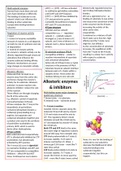
Multi-subunit enzymes [ATP] >>> [CTP] – ATCase activated Allosterically regulated enzymes
Formed from more than one sub- to synthesise pyrimidine nucleotides don’t follow Michaelis-Menten
unit chain (identical or different). until [ATP] and [CTP] balance. kinetics.
The binding of substrate to one [CTP] >>> [ATP] ATCase inhibited by We see a sigmoidal curve – as
subunit (chain) can influence the CTP and permits the purine binding of substrate to one active
binding to other substrates nucleotide biosynthesis to balance site favours the conversion of the
(cooperative binding between ATP and CTP concentrations. entire enzyme into the R-state,
subunits) ATCase structure increasing the activity of the
300 kDA and has subunit other active sites. –
Regulation of enzyme activity composition c6r6. r – regulatory cooperativity.
2 ways: subunit. C – catalytic subunit. Considered as a mixture of both
1-Control of enzyme availability Arranged as 2 sets of timers of C the R-state curve (low Km, high
Amount of enzyme in a cell depends subunit, and 3 sets of dimers of r affinity) and the T-state curve
on both its rate of synthesis and rate subunit. Each r2 dimer bonds to 2 C3 (high Km, low affinity).
of degradation trimers. As the concentration of substrate
2- Control of enzyme activity increases, the equilibrium shifts
An enzyme’s catalytic activity can be Bi-substrate analogue (PALA) from the T-state to the R-state,
directly regulated through structural Competitive inhibitor – similar to resulting in a steep rise in activity
alterations that influence the reaction intermediate of aspartate with respect to substrate
enzyme substrate binding affinity. and carbamoyl phosphate. concentration.
Allosteric mechanisms can cause Active site of ATCase forms a crystal
large changes in enzymatic activity. structure in the presence of PALA.
Substrate bound at subunit interface
Allosteric effectors between pairs of c chains within a
Molecules that can bind to an catalytic trimer. Most active site
enzyme away from the active site, residues belong to one sub-unit.
and hence change the enzyme’s
activity for its substrate. Allosteric Allosteric enzymes
activator: increase reaction rate;
allosteric inhibitor: reduce the rate & inhibitors
of the reaction.
These effects are through changing PALA biding causes major changes to
the fit of the active site. quaternary structure
E.g. allosteric control of aspartate T (tense) state – no substrate
transcarbamoylase (ATCase). R (relaxed) state – substrate bound
ATCase catalyses the 1st step in the
biosynthesis of pyrimidines. T-> R state transition
Carbamoyl phosphate donates a Catalytic trimers separate along the
carbamoyl group leading to e.g. molecular three-fold axis by around
arginine, but aspartate and 12 Å and rotate around the axis by
carbamoyl phosphate together give 10°. The regulatory dimers rotate
a product only used in the synthesis clockwise around the 2-fold axis by
of pyrimidine nucleotides e.g 15° and separate by around 4 Å along
primary UMP, which is used to the 3-fold axis.
derive other triphosphates. Both CTP and ATP bind to the same
ATCase activity site (outer edge of regulatory subunit,
Both substrates bind cooperatively. around 50Å away from catalytic site).
ATC is allosterically inhibited by CTP CTP binds preferentially to T-state &
(pyrimidine), but allosterically increases stability. To R-state it Note: it is rare for the binding of
activated by ATP (purine). induces contraction of r dimer, c substrate to one subunit to
The V versus [s] curve is sigmoidal trimers get 0.5Å closer – more like T- decrease the likelihood of other
(co-operative binding) and ATP and state (less active) subunits binding to the
CTP are comparable to competitive ATP binds preferentially to R-state & substrate (negative
inhibitors – affect KM but NOT increases stability. To T-state, it cooperativity), but this can
Vmax. Continued on next column. causes the trimers to move apart by happen.
0.4Å – more like R-state (more active)
Formed from more than one sub- to synthesise pyrimidine nucleotides don’t follow Michaelis-Menten
unit chain (identical or different). until [ATP] and [CTP] balance. kinetics.
The binding of substrate to one [CTP] >>> [ATP] ATCase inhibited by We see a sigmoidal curve – as
subunit (chain) can influence the CTP and permits the purine binding of substrate to one active
binding to other substrates nucleotide biosynthesis to balance site favours the conversion of the
(cooperative binding between ATP and CTP concentrations. entire enzyme into the R-state,
subunits) ATCase structure increasing the activity of the
300 kDA and has subunit other active sites. –
Regulation of enzyme activity composition c6r6. r – regulatory cooperativity.
2 ways: subunit. C – catalytic subunit. Considered as a mixture of both
1-Control of enzyme availability Arranged as 2 sets of timers of C the R-state curve (low Km, high
Amount of enzyme in a cell depends subunit, and 3 sets of dimers of r affinity) and the T-state curve
on both its rate of synthesis and rate subunit. Each r2 dimer bonds to 2 C3 (high Km, low affinity).
of degradation trimers. As the concentration of substrate
2- Control of enzyme activity increases, the equilibrium shifts
An enzyme’s catalytic activity can be Bi-substrate analogue (PALA) from the T-state to the R-state,
directly regulated through structural Competitive inhibitor – similar to resulting in a steep rise in activity
alterations that influence the reaction intermediate of aspartate with respect to substrate
enzyme substrate binding affinity. and carbamoyl phosphate. concentration.
Allosteric mechanisms can cause Active site of ATCase forms a crystal
large changes in enzymatic activity. structure in the presence of PALA.
Substrate bound at subunit interface
Allosteric effectors between pairs of c chains within a
Molecules that can bind to an catalytic trimer. Most active site
enzyme away from the active site, residues belong to one sub-unit.
and hence change the enzyme’s
activity for its substrate. Allosteric Allosteric enzymes
activator: increase reaction rate;
allosteric inhibitor: reduce the rate & inhibitors
of the reaction.
These effects are through changing PALA biding causes major changes to
the fit of the active site. quaternary structure
E.g. allosteric control of aspartate T (tense) state – no substrate
transcarbamoylase (ATCase). R (relaxed) state – substrate bound
ATCase catalyses the 1st step in the
biosynthesis of pyrimidines. T-> R state transition
Carbamoyl phosphate donates a Catalytic trimers separate along the
carbamoyl group leading to e.g. molecular three-fold axis by around
arginine, but aspartate and 12 Å and rotate around the axis by
carbamoyl phosphate together give 10°. The regulatory dimers rotate
a product only used in the synthesis clockwise around the 2-fold axis by
of pyrimidine nucleotides e.g 15° and separate by around 4 Å along
primary UMP, which is used to the 3-fold axis.
derive other triphosphates. Both CTP and ATP bind to the same
ATCase activity site (outer edge of regulatory subunit,
Both substrates bind cooperatively. around 50Å away from catalytic site).
ATC is allosterically inhibited by CTP CTP binds preferentially to T-state &
(pyrimidine), but allosterically increases stability. To R-state it Note: it is rare for the binding of
activated by ATP (purine). induces contraction of r dimer, c substrate to one subunit to
The V versus [s] curve is sigmoidal trimers get 0.5Å closer – more like T- decrease the likelihood of other
(co-operative binding) and ATP and state (less active) subunits binding to the
CTP are comparable to competitive ATP binds preferentially to R-state & substrate (negative
inhibitors – affect KM but NOT increases stability. To T-state, it cooperativity), but this can
Vmax. Continued on next column. causes the trimers to move apart by happen.
0.4Å – more like R-state (more active)