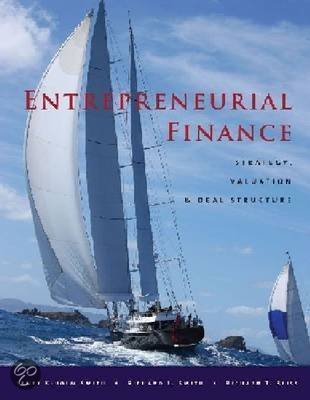
Entrepreneurial Finance
The clearest distinction between strategic and entrepreneurial finance since an
operating budget is a short-term budget, capital outlays/ expenditures are excluded
because they are long-term costs.
Bootstrap financing
Financing that does not depend on an investor’s assessment of the merits of the
opportunity or on the value of the assets of the venture. Entrepreneurs usually use
bootstrapping in the starting phase of their venture before outside financing is feasible.
The founders are then financing their start-up with their personal resources, for
example savings. However, using the resources of family and friends as a source of
finance for a new venture is also called bootstrapping. An entrepreneur could also use
resources from friends and family, however the difference with angel investors is the
exemption of tax possibilities.
Angel investors
Next to bootstrapping, angel investors also provide sources of finance for a venture
before outside financing is feasible for an entrepreneur. Angel investors are individual
investors that invest fairly small amounts (25.000 – 500.000) in early phase start-ups.
Angel investors also provide knowledge and experience mostly concerning the
particular market the start-up tries to enter. They are willing to invest over long
horizons. Evolved to a quasi-institutional form with angels acting as group and co-invest.
Venture Capital
Venture capital is a source of finance that is provided by authorized firms that are
willing to invest in high-risk baring opportunities assuming to get a high return. Four
factors are important from the perspective of the entrepreneur in determining if venture
capital is appropriate and which venture capital firm is best suited for the venture:
namely timing, geography, investment horizon and objectives, and the industry factor in
which the venture capital firm has expertise.
Government Programs
Many countries have established agencies to support small business formation and
growth. They for example provide subsidies for start-ups.
Trade Credit
Trade credit is the largest source of external short-term financing for businesses in the
US.
Arises whenever a business makes a purchase from a supplier that offers
payment terms.
The terms are usually industry specific.
Largest source of external short-term financing for firms in the US.
More important in emerging economies, where risk capital is often scarce.
,Factoring
Factoring is a short-term non-bank financing of accounts receivable. A business creates
accounts receivable when it offers trade credit to costumers. A factor buys these
accounts receivable in order to manage the collection of the accounts receivable. The
factoring company receives fees for handling, lending, and risk.
Asset-based lenders
Asset-based lenders, or ‘secured lenders’, provide debt capital to businesses that have
assets that can serve as collateral. In assets based lending, the quality of the collateral
and not the financial strength of the borrower is of prime importance. The lender bases
the amount of loan on the value of the asset being financed, and the ease with which it
could be sold off it the borrower defaults. It is a type of ‘off balance sheet’ financing
Venture leasing
An entrepreneur who requires tangible assets can lease, rather than purchase them.
Usually involves assets that are key to the operation of the venture. The lessor’s return
may be tied to the financial performance of the venture. Tax advantages to leasing as
compared to owning.
Franchising
Can enable a business concept to grow rapidly by using capital from franchisees.
Franchisor establishes a business format and offers franchising opportunities to
prospective franchisees.
Mezzanine Capital
Capital rose after the firm has established a record of positive net income with revenues
approaching ten million or more. Often provided by some Venture Capital firms or other
Private Equity firms. Mezzanine financing is basically debt capital that gives the lender
the rights to convert to an ownership or equity interest in the company if the loan is not
paid back in time and in full. It is generally subordinated to debt provided by senior
lenders such as banks and venture capital companies.
IPO (exit)
The decision of a company to float new shares on the primary public market is called an
Initial Public Offering (IPO). Ventures choose for an Initial Public Offering in order to
gain capital. However, a disadvantage is the dilution of decision-making power for the
original shareholders.
Management Buyout (MBO) (exit)
A transaction where a company’s management team purchases the assets and
operations of the business they manage. A management buyout (MBO) is appealing to
professional managers because of the greater potential rewards from being owners of
the business rather than employees. MBOs are favored exit strategies for large
corporations who wish to pursue the sale of divisions that are not part of their core
business, or by private businesses where the owners wish to retire. The financing
required for an MBO is often quite substantial, and is usually a combination of debt and
equity that is derived from the buyers, financiers and sometimes the seller.
, Leveraged Buyout (LBO) (exit)
The acquisition of another company using a significant amount of borrowed money
(bonds or loans) to meet the cost of acquisition. Often, the assets of the company being
acquired are used as collateral for the loans in addition to the assets of the acquiring
company. The purpose of leveraged buyouts is to allow companies to make large
acquisitions without having to commit a lot of capital.
Factoring
A business creates accounts receivable when it offers trade credit to costumers. A factor
buys these accounts receivable in order to manage the collection of the accounts
receivable (Janet Kiholm Smith, Sources of New Venture Financing, page 50). The
factoring company receives fees for handling, lending, and risk.
Growth Capital
Growth capital is next to management buyout also a form of private equity (Huffnagel,
2014). Private equity firms provide growth capital for ventures with the idea of creating
value through profitable revenue growth. Moreover, research has shown that growth-
equity is outperforming venture capital over three, five, and ten-year investment
periods. In two of my cases, growth capital is used as a source of finance; namely LIOF
investing in Ekompany and Mentha Capital investing in Kleertjes.com.
Debt financing
Pros:
Interest is tax deductible
Debt is usually less expensive than equity
No loss of control
Cons:
Cash flow required for interest and principal payments
Senior to equity and has contractual rights in the case of financial distress
Equity financing
The process of raising capital through the sale of shares in an enterprise. Equity
financing essentially refers to the sale of an ownership interest to raise funds for
business purposes.
Pros
Establishes outside market for the venture’s shares. Investors’ feedback on
managerial decisions. Can be used to effect acquisitions. Employee stock
incentives.
Large amounts of capital can be raised
Cons
Relatively expensive
Disclosure requirements
Focus on short-term earnings
The clearest distinction between strategic and entrepreneurial finance since an
operating budget is a short-term budget, capital outlays/ expenditures are excluded
because they are long-term costs.
Bootstrap financing
Financing that does not depend on an investor’s assessment of the merits of the
opportunity or on the value of the assets of the venture. Entrepreneurs usually use
bootstrapping in the starting phase of their venture before outside financing is feasible.
The founders are then financing their start-up with their personal resources, for
example savings. However, using the resources of family and friends as a source of
finance for a new venture is also called bootstrapping. An entrepreneur could also use
resources from friends and family, however the difference with angel investors is the
exemption of tax possibilities.
Angel investors
Next to bootstrapping, angel investors also provide sources of finance for a venture
before outside financing is feasible for an entrepreneur. Angel investors are individual
investors that invest fairly small amounts (25.000 – 500.000) in early phase start-ups.
Angel investors also provide knowledge and experience mostly concerning the
particular market the start-up tries to enter. They are willing to invest over long
horizons. Evolved to a quasi-institutional form with angels acting as group and co-invest.
Venture Capital
Venture capital is a source of finance that is provided by authorized firms that are
willing to invest in high-risk baring opportunities assuming to get a high return. Four
factors are important from the perspective of the entrepreneur in determining if venture
capital is appropriate and which venture capital firm is best suited for the venture:
namely timing, geography, investment horizon and objectives, and the industry factor in
which the venture capital firm has expertise.
Government Programs
Many countries have established agencies to support small business formation and
growth. They for example provide subsidies for start-ups.
Trade Credit
Trade credit is the largest source of external short-term financing for businesses in the
US.
Arises whenever a business makes a purchase from a supplier that offers
payment terms.
The terms are usually industry specific.
Largest source of external short-term financing for firms in the US.
More important in emerging economies, where risk capital is often scarce.
,Factoring
Factoring is a short-term non-bank financing of accounts receivable. A business creates
accounts receivable when it offers trade credit to costumers. A factor buys these
accounts receivable in order to manage the collection of the accounts receivable. The
factoring company receives fees for handling, lending, and risk.
Asset-based lenders
Asset-based lenders, or ‘secured lenders’, provide debt capital to businesses that have
assets that can serve as collateral. In assets based lending, the quality of the collateral
and not the financial strength of the borrower is of prime importance. The lender bases
the amount of loan on the value of the asset being financed, and the ease with which it
could be sold off it the borrower defaults. It is a type of ‘off balance sheet’ financing
Venture leasing
An entrepreneur who requires tangible assets can lease, rather than purchase them.
Usually involves assets that are key to the operation of the venture. The lessor’s return
may be tied to the financial performance of the venture. Tax advantages to leasing as
compared to owning.
Franchising
Can enable a business concept to grow rapidly by using capital from franchisees.
Franchisor establishes a business format and offers franchising opportunities to
prospective franchisees.
Mezzanine Capital
Capital rose after the firm has established a record of positive net income with revenues
approaching ten million or more. Often provided by some Venture Capital firms or other
Private Equity firms. Mezzanine financing is basically debt capital that gives the lender
the rights to convert to an ownership or equity interest in the company if the loan is not
paid back in time and in full. It is generally subordinated to debt provided by senior
lenders such as banks and venture capital companies.
IPO (exit)
The decision of a company to float new shares on the primary public market is called an
Initial Public Offering (IPO). Ventures choose for an Initial Public Offering in order to
gain capital. However, a disadvantage is the dilution of decision-making power for the
original shareholders.
Management Buyout (MBO) (exit)
A transaction where a company’s management team purchases the assets and
operations of the business they manage. A management buyout (MBO) is appealing to
professional managers because of the greater potential rewards from being owners of
the business rather than employees. MBOs are favored exit strategies for large
corporations who wish to pursue the sale of divisions that are not part of their core
business, or by private businesses where the owners wish to retire. The financing
required for an MBO is often quite substantial, and is usually a combination of debt and
equity that is derived from the buyers, financiers and sometimes the seller.
, Leveraged Buyout (LBO) (exit)
The acquisition of another company using a significant amount of borrowed money
(bonds or loans) to meet the cost of acquisition. Often, the assets of the company being
acquired are used as collateral for the loans in addition to the assets of the acquiring
company. The purpose of leveraged buyouts is to allow companies to make large
acquisitions without having to commit a lot of capital.
Factoring
A business creates accounts receivable when it offers trade credit to costumers. A factor
buys these accounts receivable in order to manage the collection of the accounts
receivable (Janet Kiholm Smith, Sources of New Venture Financing, page 50). The
factoring company receives fees for handling, lending, and risk.
Growth Capital
Growth capital is next to management buyout also a form of private equity (Huffnagel,
2014). Private equity firms provide growth capital for ventures with the idea of creating
value through profitable revenue growth. Moreover, research has shown that growth-
equity is outperforming venture capital over three, five, and ten-year investment
periods. In two of my cases, growth capital is used as a source of finance; namely LIOF
investing in Ekompany and Mentha Capital investing in Kleertjes.com.
Debt financing
Pros:
Interest is tax deductible
Debt is usually less expensive than equity
No loss of control
Cons:
Cash flow required for interest and principal payments
Senior to equity and has contractual rights in the case of financial distress
Equity financing
The process of raising capital through the sale of shares in an enterprise. Equity
financing essentially refers to the sale of an ownership interest to raise funds for
business purposes.
Pros
Establishes outside market for the venture’s shares. Investors’ feedback on
managerial decisions. Can be used to effect acquisitions. Employee stock
incentives.
Large amounts of capital can be raised
Cons
Relatively expensive
Disclosure requirements
Focus on short-term earnings