Week 1 :
Preparation : Chapter 1: Accounting
in action
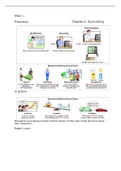
Managerial accounting provides internal reports to help users make decisions about
their companies.
Rigged: truqué
, Insight boxes provide examples of business situations from various perspectives—
ethics, investor, international, and company social responsibility. Guideline answers
to the critical thinking questions and additional questions are available at the book's
companion website.
There are two primary accounting standard-setting bodies—the International
Accounting Standards Board (IASB) and the Financial Accounting Standards Board
(FASB), to prevent fraud and to favorize well-being of firms.
Relevance and faithful representation are two primary qualities that make accounting
information useful for decision-making.
Monetary assumption: Accounting report only contain transaction data (expressible in
money terms)
Economic entity assumption: Personal costs ≠ business costs ≠ different businesses
expenses
Proprietorship: business own by 1 person. No legal distinctions btw businesses and
owner, but accounting one (see upper).
Partnership: owned by 2 or more persons. Same as Proprietorship. Usually used to
organize retail and service type businesses. -> Unlimited personal liability
Corporation: Separate legal entity, with ownership divided into transferable shares. -
> Shareholders have a limited liability, but not personally liable for debts etc. Can
transfer their ownership whenever, without dissolving it = unlimited life.
- In the world: more proprietorship and partnership but less money productive
(biggest firms are corporations)
Cash distribution to
- Assets: resources a business owns. Have the shareholders or others BUT
capacity to provide future services or benefits: not expenses. Cash from
net income “useless”.
- Liabilities and equities are the right or claims
against these resources.
Liabilities: Claims of those to whom the company owes money (creditors) –
claims against assets. If creditors are not paid, they can claim the money
and lead to the liquidation (but claiming must be before ownership’s)
Equity: Claims of owners/ Ownership claim. Referred as a “residual equity”
– or the leftover after taking away liabilities. Consist of share capital (funds
get by selling shares to investors) and retained earnings (determined by
revenue, expenses and dividend).
Preparation : Chapter 1: Accounting
in action
Managerial accounting provides internal reports to help users make decisions about
their companies.
Rigged: truqué
, Insight boxes provide examples of business situations from various perspectives—
ethics, investor, international, and company social responsibility. Guideline answers
to the critical thinking questions and additional questions are available at the book's
companion website.
There are two primary accounting standard-setting bodies—the International
Accounting Standards Board (IASB) and the Financial Accounting Standards Board
(FASB), to prevent fraud and to favorize well-being of firms.
Relevance and faithful representation are two primary qualities that make accounting
information useful for decision-making.
Monetary assumption: Accounting report only contain transaction data (expressible in
money terms)
Economic entity assumption: Personal costs ≠ business costs ≠ different businesses
expenses
Proprietorship: business own by 1 person. No legal distinctions btw businesses and
owner, but accounting one (see upper).
Partnership: owned by 2 or more persons. Same as Proprietorship. Usually used to
organize retail and service type businesses. -> Unlimited personal liability
Corporation: Separate legal entity, with ownership divided into transferable shares. -
> Shareholders have a limited liability, but not personally liable for debts etc. Can
transfer their ownership whenever, without dissolving it = unlimited life.
- In the world: more proprietorship and partnership but less money productive
(biggest firms are corporations)
Cash distribution to
- Assets: resources a business owns. Have the shareholders or others BUT
capacity to provide future services or benefits: not expenses. Cash from
net income “useless”.
- Liabilities and equities are the right or claims
against these resources.
Liabilities: Claims of those to whom the company owes money (creditors) –
claims against assets. If creditors are not paid, they can claim the money
and lead to the liquidation (but claiming must be before ownership’s)
Equity: Claims of owners/ Ownership claim. Referred as a “residual equity”
– or the leftover after taking away liabilities. Consist of share capital (funds
get by selling shares to investors) and retained earnings (determined by
revenue, expenses and dividend).