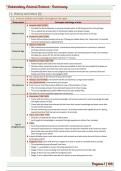
1. History and ethics [3]
1.1. Animal welfare and rights throughout the ages
Time period Concepts and things of note
❥ Aristotle (384-322 BC)
❣ Created the Scala Naturae: a vertical classification of all living and non-living things
❣ This created the introduction to thinking of higher and lesser beings
Before Christ ❣ This was interpreted as human beings more superior as they were at the top
❥ Plutarchus (46-120 BC)
❣ Some ethical ideas already came up; Pythagoras talked about the ‘cleverness’ of animals
and even talked about vegetarianism
❥ Galenus (129-216)
❣ Did vivisections and dissections, vivisections were performed on conscious, restraint
animals without any pain-relief
Classical Age
❣ Dissecting human bodies was considered a taboo so instead people would use monkeys
and pigs as a proxy for the human body and its anatomy
❣ Galenus’ knowledge prevailed until the 17th century
❥ Augustinus Hippo (354-430)
❣ Added Angels and God to the natural order (scala naturae)
Middle Ages ❣ Humans were moved up to be as close as possible to God, this only added the distance
between animals and thus they were seen as even more inferior
❣ Scientifically there was no real progress as diseases were seen as curses by God and
being cured was seen as having good faith
❥ The critical view of the Ancient times was revived
❥ Vesalius (1514-1564): corrected Aristotle and Galenus using human bodies
❥ Van Leeuwenhoek: invented the microscope
Renaissance ❥ From here on now there was a different view of the position of man
❣ The microscope allowed more detailed research of other beings
❣ This only highlighted possible differences but also similarities
❥ The birth of a more scientific approach came to be
❥ Descartes (1596-1650)
❣ Came with the theory of innate knowledge: all humans were born with knowledge through
the higher power of God
❣ Came with the idea that animals did not have this innate knowledge and were more akin
to automated machines
❣ He saw reasoning (“je pense donc je suis”) as the key behind the significance of a being,
saying therefore that humans are superior to animals
❥ John Locke (1632-1704)
❣ Directly combatted the ideas of Descartes
❣ He thought all knowledge is acquired through experience rather than innately
❥ Halen
Age of
❣ First described blood pressure and did other cardiovascular research
Enlightenment
❣ He would experiment on living horses: these horses were restraint and conscious and a
glass tube was inserted in their carotid artery and this was seen as okay since animals
were thought to be lesser
❥ Industrialization gave man less contact with animals and also more time to think on these
existing principles
❥ Hogarth (1751) came with the four stages of cruelty in order to combat animal cruelty
❣ This published piece followed Tom Nero
❣ Stage 1: a young Nero is seen torturing animals for fun
❣ Stage 2: Nero is now working and mistreats his horse who has a broken leg
❣ Stage 3: Nero has now killed his pregnant lover
❣ Stage 4: all cruelties Nero has done on others is now being done to him
, ❥ Kant (1724-1804)EX
❣ Created deontology: a duty-based ethical theory asserting that the morality of an action
is based on whether the action itself is right or wrong under a set of rules, rather than on
its consequences
❣ These were universal under all circumstances: if you decide to do something you should
always do that and vice versa
❣ Humanity and humans were to be treated as a goal and not as a means
❣ He also thought reasoning was the key to what decide has dignity or not: according to him
humans have absolute worth whilst animals only have instrumental value
❣ So humans had to take care of animals but not because they are important but because
Age of
humans should always behave morally
Enlightenment
❥ Bentham and Mill (1748-1832)EX
❣ He came with the idea of sentient beings: instead of looking at reasoning we should be
looking at suffering, if they can suffer and enjoy then they have a value
❣ This view is called utilism: reasoning is less important than happiness and we should
consider the consequences of our actions
❣ This was a more calculus approach: everybody was counted and nobody counted for
more than one
❣ He also thought a more balanced system was needed for the use of animals in research:
as long as the suffering is outweighed by the benefit for man it was okay to use animals in
research
❥ Charles Darwin (1809-1882)
❣ Hypothesised on the origin of species
❣ Created the start of zoocentrism
❥ Claude Bernard (1813-1878): made the foundation of animal experiments (should be
properly controlled) and came with the first tests in animals
❥ Anaesthesia invented in 1846
❥ The situation in the UK
❣ Vivisections were performed live by Magendie and could be viewed when buying a ticket,
this created outburst due to people reading a lot of pro-animal ideas
❣ As a response the first law for animal-welfare came to be: the Cruelty against animals act
(1867)
⤷ Included the cruel treatment of cattle act (1822) and the cruelty against animals act
(1835)
⤷ Also included laws on animal research
⧙ Anaesthesia was mandatory so no more vivisection
⧙ You could use an animal only once and had to kill it immediately after the experiment
Modern Times ⧙ Animal experiments were only allowed to advance human health
⧙ If you didn’t follow these rules, prosecution was possible
❣ There also came a National Anti-Vivisection Society: the discussion shifted to preventing
harm rather than questioning the value of animal research
❣ Animal usage increased due to anaesthetics (gave people free reign) and usually failed to
properly work (so it was still vivisection)
❣ There was also the brown dog affair: in a university aula a vivisection occurred on a
conscious brown dog, this created an outburst in international students present and a
committee was established to investigate the use of animals in experiments
❥ Animal experiments only increased and infections were being studied now
❣ Pasteur studied rabies in dogs and rabbits and also came with the human endpoint (point
in progression of disease where it’s better to kill animal)
❣ Koch came up with the Koch’s postulates
❣ Drugs and vaccines were scientifically being tested
❣ Rodents were being used
❥ As psychology also was developing further it was apparent that animals were more similar
to man and this only increased the controversy regarding animal experiments and how they
were used and treated
, ❥ In Belgium animal-welfare advanced very slowly
❣ Belgium had a lot of influence from German scientists (such as Kant) and thus still
thought of animals as only existing for humans to use
❣ This idea was still common even in 1994 and influenced by Catholic tradition
❣ In 1867 there was a law against harm of owned animals: this only applied to animals that
were under someone’s possession, free and lab animals were not included in this law
❥ Russel and Burch (1959) came with the principles of humane experimental techniques
❣ They focobjectivelyused more on determining what is and isn’t humane and how
humanity can be promoted without prejudice to scientific and medical aims as well as
how they can objectively assess the effects of procedures of animals
❣ They also came up with the 3 R’s
❥ Tom Regan
❣ He came up with ‘The case for Animal Rights’ (1983): this was an extension on the ideas
of Kant (intrinsic value to all species)
❣ He came up with the idea of moral agents and moral patients
⤷ Moral agents have full autonomy and are capable in making decisions (have the
necessary cognitive skills required), this included humans
⤷ Moral patients are individuals who have desires, longings and known emotions and
include all other ‘subjects of life’
⤷ All subjects of life should be considered as a goal/end not as a means; so animal
experiments could not happen
⤷ Moral agents have a duty to respect the rights of moral patients
⤷ Both possess equal value!
❥ Peter Singer came up with Animal liberation (1970)EX
❣ Speciesim: it is discrimination to regard one species as better or worse than other
❣ Utilitarianism
⤷ One should give priority to relieve the greater suffering
⤷ Scale-principle: if the suffering of an animal is exceeded by the benefit for human
health then it is allowed to do animal experimentation
❥ In Europe
❣ 1986 European directive was created based on Rusell and Burch’s ideas
❣ In 2010 the European directive was refined and elaborated on
❥ In Belgium
Present DayEX
❣ 1986 Belgian law on animal welfare was made (+100 years after UK’s law and mentioned
lab animals, animal experiments, registration and royal decree (implementation of law)
❣ The new European directive was implemented and a royal decree followed in 2013
❣ In 2014 the animal welfare was moved to the regional (gewesten) level
1.2. How did present-day legislation affect animal use?EX
*Decrease only occurs a few years after a legislation or law passed
Further decrease New European Ban of animal Decrease of animal use due since it takes time for things to change and it to take full affect
of animal use* use for cosmetics to 1986 European directive*
directive
Ban on experiments Ban of usage of Start work on new, more
of tobacco Great Apes detailed directive
, 2. Legislation [18]
2.1. Legislation on different aspects of animal welfare and health
2.1.A. Overview of legislations in Europe and Belgium
❥ Based on and following the European directive of 1986 and later also 2010...
❣ Belgium made an animal welfare law in 1986 and a Royal Decree in 1993 to enforce this
❣ Belgium made another Royal Decree in 2013 (based on the 2010 EU directive)
Laws are voted by parliament
Royal Dec rees : established by the federal parliament and are guidelin es on the law which are mandatory to follow
Decree: established by the regional parliament and are gui delines on the law which are mandatory to follow
❥ In 2017 further decrees followed:
❣ They detailed the protection of laboratory animals and the composition of the Flemish laboratory
animal commission
❣ Were made based on the transfer of the area of competence from a national to a regional level
❥ In 2023 a Flemish Codex for animal welfare was made
❥ In 2024 an addition was made into the Belgian constitution that further solidified animal welfare
❣ In the constitution: “animals are sentient beings and their welfare should be protected”
❣ Because this is recorded in the constitutions, all laws and decrees now have to comply with this
2.1.B. Legislation on laboratory animals
① What are lab animals
Laboratory animals are one of the following:
1. The living cephalopods used or intended for use in animal experiments, or which are specifically kept
so that their organs or tissues can be used for scientific purposes
❣ Cephalopods: squid, octopus, cuttlefish, nautilus, etc.)
❣ Cephalopods are lab animals if they used for animal experiments
❣ Cephalopods are lab animals if they are kept so their organs/tissues can be used for scientific
experiments
2. The living non-human vertebrates used or intended for use in animal experiments, or which are kept
specifically so that their organs or tissues may be used for scientific purposes, including their self-
feeding larval forms, as well as foetal forms of mammals from entry of the last third of their normal
development
❣ Non-human vertebrates: fish, birds, amphibians, reptiles and mammals (that aren’t humans)
❣ Non-human vertebrates are lab animals if they are used for animal experiments
❣ Non-human vertebrates are lab animals if they are kept so their organs/tissues can be used for
scientific experiments
❣ These rules apply not only after birth but also before birth if the animal is in the self-feeding larval
form OR if the foetus is in the last third of gestation
❣ What is meant by “self-feeding larval forms” or “from entry of the last third of their normal
development”?
⤷ In fish: when both ends of the intestines are open and the fish takes in food
⤷ In amphibians: from the time when they start actively moving in search of food
⤷ In cephalopods: immediately after hatching
⤷ In birds and reptiles: when they hatch or are born alive (regardless of if by human action or not)
⤷ Mammals: in the last third of normal development (last third of gestation)
1.1. Animal welfare and rights throughout the ages
Time period Concepts and things of note
❥ Aristotle (384-322 BC)
❣ Created the Scala Naturae: a vertical classification of all living and non-living things
❣ This created the introduction to thinking of higher and lesser beings
Before Christ ❣ This was interpreted as human beings more superior as they were at the top
❥ Plutarchus (46-120 BC)
❣ Some ethical ideas already came up; Pythagoras talked about the ‘cleverness’ of animals
and even talked about vegetarianism
❥ Galenus (129-216)
❣ Did vivisections and dissections, vivisections were performed on conscious, restraint
animals without any pain-relief
Classical Age
❣ Dissecting human bodies was considered a taboo so instead people would use monkeys
and pigs as a proxy for the human body and its anatomy
❣ Galenus’ knowledge prevailed until the 17th century
❥ Augustinus Hippo (354-430)
❣ Added Angels and God to the natural order (scala naturae)
Middle Ages ❣ Humans were moved up to be as close as possible to God, this only added the distance
between animals and thus they were seen as even more inferior
❣ Scientifically there was no real progress as diseases were seen as curses by God and
being cured was seen as having good faith
❥ The critical view of the Ancient times was revived
❥ Vesalius (1514-1564): corrected Aristotle and Galenus using human bodies
❥ Van Leeuwenhoek: invented the microscope
Renaissance ❥ From here on now there was a different view of the position of man
❣ The microscope allowed more detailed research of other beings
❣ This only highlighted possible differences but also similarities
❥ The birth of a more scientific approach came to be
❥ Descartes (1596-1650)
❣ Came with the theory of innate knowledge: all humans were born with knowledge through
the higher power of God
❣ Came with the idea that animals did not have this innate knowledge and were more akin
to automated machines
❣ He saw reasoning (“je pense donc je suis”) as the key behind the significance of a being,
saying therefore that humans are superior to animals
❥ John Locke (1632-1704)
❣ Directly combatted the ideas of Descartes
❣ He thought all knowledge is acquired through experience rather than innately
❥ Halen
Age of
❣ First described blood pressure and did other cardiovascular research
Enlightenment
❣ He would experiment on living horses: these horses were restraint and conscious and a
glass tube was inserted in their carotid artery and this was seen as okay since animals
were thought to be lesser
❥ Industrialization gave man less contact with animals and also more time to think on these
existing principles
❥ Hogarth (1751) came with the four stages of cruelty in order to combat animal cruelty
❣ This published piece followed Tom Nero
❣ Stage 1: a young Nero is seen torturing animals for fun
❣ Stage 2: Nero is now working and mistreats his horse who has a broken leg
❣ Stage 3: Nero has now killed his pregnant lover
❣ Stage 4: all cruelties Nero has done on others is now being done to him
, ❥ Kant (1724-1804)EX
❣ Created deontology: a duty-based ethical theory asserting that the morality of an action
is based on whether the action itself is right or wrong under a set of rules, rather than on
its consequences
❣ These were universal under all circumstances: if you decide to do something you should
always do that and vice versa
❣ Humanity and humans were to be treated as a goal and not as a means
❣ He also thought reasoning was the key to what decide has dignity or not: according to him
humans have absolute worth whilst animals only have instrumental value
❣ So humans had to take care of animals but not because they are important but because
Age of
humans should always behave morally
Enlightenment
❥ Bentham and Mill (1748-1832)EX
❣ He came with the idea of sentient beings: instead of looking at reasoning we should be
looking at suffering, if they can suffer and enjoy then they have a value
❣ This view is called utilism: reasoning is less important than happiness and we should
consider the consequences of our actions
❣ This was a more calculus approach: everybody was counted and nobody counted for
more than one
❣ He also thought a more balanced system was needed for the use of animals in research:
as long as the suffering is outweighed by the benefit for man it was okay to use animals in
research
❥ Charles Darwin (1809-1882)
❣ Hypothesised on the origin of species
❣ Created the start of zoocentrism
❥ Claude Bernard (1813-1878): made the foundation of animal experiments (should be
properly controlled) and came with the first tests in animals
❥ Anaesthesia invented in 1846
❥ The situation in the UK
❣ Vivisections were performed live by Magendie and could be viewed when buying a ticket,
this created outburst due to people reading a lot of pro-animal ideas
❣ As a response the first law for animal-welfare came to be: the Cruelty against animals act
(1867)
⤷ Included the cruel treatment of cattle act (1822) and the cruelty against animals act
(1835)
⤷ Also included laws on animal research
⧙ Anaesthesia was mandatory so no more vivisection
⧙ You could use an animal only once and had to kill it immediately after the experiment
Modern Times ⧙ Animal experiments were only allowed to advance human health
⧙ If you didn’t follow these rules, prosecution was possible
❣ There also came a National Anti-Vivisection Society: the discussion shifted to preventing
harm rather than questioning the value of animal research
❣ Animal usage increased due to anaesthetics (gave people free reign) and usually failed to
properly work (so it was still vivisection)
❣ There was also the brown dog affair: in a university aula a vivisection occurred on a
conscious brown dog, this created an outburst in international students present and a
committee was established to investigate the use of animals in experiments
❥ Animal experiments only increased and infections were being studied now
❣ Pasteur studied rabies in dogs and rabbits and also came with the human endpoint (point
in progression of disease where it’s better to kill animal)
❣ Koch came up with the Koch’s postulates
❣ Drugs and vaccines were scientifically being tested
❣ Rodents were being used
❥ As psychology also was developing further it was apparent that animals were more similar
to man and this only increased the controversy regarding animal experiments and how they
were used and treated
, ❥ In Belgium animal-welfare advanced very slowly
❣ Belgium had a lot of influence from German scientists (such as Kant) and thus still
thought of animals as only existing for humans to use
❣ This idea was still common even in 1994 and influenced by Catholic tradition
❣ In 1867 there was a law against harm of owned animals: this only applied to animals that
were under someone’s possession, free and lab animals were not included in this law
❥ Russel and Burch (1959) came with the principles of humane experimental techniques
❣ They focobjectivelyused more on determining what is and isn’t humane and how
humanity can be promoted without prejudice to scientific and medical aims as well as
how they can objectively assess the effects of procedures of animals
❣ They also came up with the 3 R’s
❥ Tom Regan
❣ He came up with ‘The case for Animal Rights’ (1983): this was an extension on the ideas
of Kant (intrinsic value to all species)
❣ He came up with the idea of moral agents and moral patients
⤷ Moral agents have full autonomy and are capable in making decisions (have the
necessary cognitive skills required), this included humans
⤷ Moral patients are individuals who have desires, longings and known emotions and
include all other ‘subjects of life’
⤷ All subjects of life should be considered as a goal/end not as a means; so animal
experiments could not happen
⤷ Moral agents have a duty to respect the rights of moral patients
⤷ Both possess equal value!
❥ Peter Singer came up with Animal liberation (1970)EX
❣ Speciesim: it is discrimination to regard one species as better or worse than other
❣ Utilitarianism
⤷ One should give priority to relieve the greater suffering
⤷ Scale-principle: if the suffering of an animal is exceeded by the benefit for human
health then it is allowed to do animal experimentation
❥ In Europe
❣ 1986 European directive was created based on Rusell and Burch’s ideas
❣ In 2010 the European directive was refined and elaborated on
❥ In Belgium
Present DayEX
❣ 1986 Belgian law on animal welfare was made (+100 years after UK’s law and mentioned
lab animals, animal experiments, registration and royal decree (implementation of law)
❣ The new European directive was implemented and a royal decree followed in 2013
❣ In 2014 the animal welfare was moved to the regional (gewesten) level
1.2. How did present-day legislation affect animal use?EX
*Decrease only occurs a few years after a legislation or law passed
Further decrease New European Ban of animal Decrease of animal use due since it takes time for things to change and it to take full affect
of animal use* use for cosmetics to 1986 European directive*
directive
Ban on experiments Ban of usage of Start work on new, more
of tobacco Great Apes detailed directive
, 2. Legislation [18]
2.1. Legislation on different aspects of animal welfare and health
2.1.A. Overview of legislations in Europe and Belgium
❥ Based on and following the European directive of 1986 and later also 2010...
❣ Belgium made an animal welfare law in 1986 and a Royal Decree in 1993 to enforce this
❣ Belgium made another Royal Decree in 2013 (based on the 2010 EU directive)
Laws are voted by parliament
Royal Dec rees : established by the federal parliament and are guidelin es on the law which are mandatory to follow
Decree: established by the regional parliament and are gui delines on the law which are mandatory to follow
❥ In 2017 further decrees followed:
❣ They detailed the protection of laboratory animals and the composition of the Flemish laboratory
animal commission
❣ Were made based on the transfer of the area of competence from a national to a regional level
❥ In 2023 a Flemish Codex for animal welfare was made
❥ In 2024 an addition was made into the Belgian constitution that further solidified animal welfare
❣ In the constitution: “animals are sentient beings and their welfare should be protected”
❣ Because this is recorded in the constitutions, all laws and decrees now have to comply with this
2.1.B. Legislation on laboratory animals
① What are lab animals
Laboratory animals are one of the following:
1. The living cephalopods used or intended for use in animal experiments, or which are specifically kept
so that their organs or tissues can be used for scientific purposes
❣ Cephalopods: squid, octopus, cuttlefish, nautilus, etc.)
❣ Cephalopods are lab animals if they used for animal experiments
❣ Cephalopods are lab animals if they are kept so their organs/tissues can be used for scientific
experiments
2. The living non-human vertebrates used or intended for use in animal experiments, or which are kept
specifically so that their organs or tissues may be used for scientific purposes, including their self-
feeding larval forms, as well as foetal forms of mammals from entry of the last third of their normal
development
❣ Non-human vertebrates: fish, birds, amphibians, reptiles and mammals (that aren’t humans)
❣ Non-human vertebrates are lab animals if they are used for animal experiments
❣ Non-human vertebrates are lab animals if they are kept so their organs/tissues can be used for
scientific experiments
❣ These rules apply not only after birth but also before birth if the animal is in the self-feeding larval
form OR if the foetus is in the last third of gestation
❣ What is meant by “self-feeding larval forms” or “from entry of the last third of their normal
development”?
⤷ In fish: when both ends of the intestines are open and the fish takes in food
⤷ In amphibians: from the time when they start actively moving in search of food
⤷ In cephalopods: immediately after hatching
⤷ In birds and reptiles: when they hatch or are born alive (regardless of if by human action or not)
⤷ Mammals: in the last third of normal development (last third of gestation)