Example:
MCQ:
A well-managed firm will have __________ .
A. a high ‘accounting’ return on investments (ROI)
B. a high CAPM expected return
C. both A and B
D. none of A and B
ó Well-managed firm = the company is doing well each year, they have a good performance year after year
(stable company, good decisions).
ð Such a company will certainly have a high return on investment (ROI).
ð Will it also have a high expected return according to CAPM?
ð This company will not be very risky, so the beta would be rather low.
ð The risk premium will also be low, so as an investor you will be satisfied more quickly, and therefore the
CAPM expected return will not necessarily be high.
ð As an investor, you should therefore buy companies before they are well managed.
101
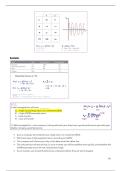
, Security Market Line (SML)
SML: security market line = trade-off between E(ri) & ßi.
CAPM: E(r4 ) = rƒ + β4 [ E(rC ) − rƒ ]
Reward-risk equation:
- Reward = expected return
- Risk = beta (contribution to market risk)
rƒ = intercept
E(rM) – rƒ = slope
SML: determined by 2 parameters → the constant &
the slope
Market portfolio: will have the highest Sharpe ratio → most optimal portfolio E(r)= Rƒ
ð = (risk-free asset) + risk premium
ð >1: risky
ð <1: defensive
ð Implies that you will not be compensated for company-specific risks, as these can be diversified.
ð CAPM only provides compensation for systematic risk.
ð MRP = market risk premium = average risk aversion ∙ market risk
MCQ:
If all investors become more risk averse, the SML will _________ and stock prices will _________ .
A. shift downward; fall
B. shift upward; rise
C. have the same intercept with a steeper slope; fall
D. have the same intercept with a flatter slope; rise
Explanation: what happens to stock prices? They fall. If you demand
higher expected returns, asset prices will fall in order to increase the
return.
102
,Fairly priced assets (P = V): plot exactly on SML.
ð Expected return is compensation for risk.
ð If CAPM holds, all securities and portfolios must lie on the SML in market equilibrium.
ð Under(over)priced stocks: above (below) SML
o Expected returns greater (lower) than CAPM
o Positive (negative) Alpha
Provides benchmark for evaluation of investment performance:
E(r' ) = α' + rƒ + β' [ E(rC ) − rƒ ]
1. Alpha & active management
Ex ante: alpha = forecasted return – required return
Forecasted return = expected return based on se-
curity analysis (ex. scenario analysis)
Required return = expected return based on CAPM
(equilibrium model)
2. So mutual funds
Estimates of individual mutual fund alphas: Ex post: alpha = actual return (ex post) – return required.
Postive alfa means that the return was higher than the return
you needed → performed better than expected, given the risk
they took.
Average is close to 0.
-3% = the return was 3% lower than what you expected to get
back in return.
103
, ð Ex-post analysis = once the return has actually been realized, checking whether it is higher than the
expected return.
ð Is the ex-post α > 0 for a mutual fund?
o If so, the fund manager has succeeded in beating the market.
MCQ:
Security X has an expected rate of return of 13% and a beta of 1.15. The risk-free rate is 5%, and the market
expected rate of return is 15%. According to the capital asset pricing model, security X is ________ .
A. fairly priced (ãX = 0 ; PX = VX)
B. Overpriced (ãX < 0 ; PX > VX)
C. Underpriced (ãX > 0 ; PX < VX)
D. none of these answers
ó typical EXAM question
Exercise:
104
MCQ:
A well-managed firm will have __________ .
A. a high ‘accounting’ return on investments (ROI)
B. a high CAPM expected return
C. both A and B
D. none of A and B
ó Well-managed firm = the company is doing well each year, they have a good performance year after year
(stable company, good decisions).
ð Such a company will certainly have a high return on investment (ROI).
ð Will it also have a high expected return according to CAPM?
ð This company will not be very risky, so the beta would be rather low.
ð The risk premium will also be low, so as an investor you will be satisfied more quickly, and therefore the
CAPM expected return will not necessarily be high.
ð As an investor, you should therefore buy companies before they are well managed.
101
, Security Market Line (SML)
SML: security market line = trade-off between E(ri) & ßi.
CAPM: E(r4 ) = rƒ + β4 [ E(rC ) − rƒ ]
Reward-risk equation:
- Reward = expected return
- Risk = beta (contribution to market risk)
rƒ = intercept
E(rM) – rƒ = slope
SML: determined by 2 parameters → the constant &
the slope
Market portfolio: will have the highest Sharpe ratio → most optimal portfolio E(r)= Rƒ
ð = (risk-free asset) + risk premium
ð >1: risky
ð <1: defensive
ð Implies that you will not be compensated for company-specific risks, as these can be diversified.
ð CAPM only provides compensation for systematic risk.
ð MRP = market risk premium = average risk aversion ∙ market risk
MCQ:
If all investors become more risk averse, the SML will _________ and stock prices will _________ .
A. shift downward; fall
B. shift upward; rise
C. have the same intercept with a steeper slope; fall
D. have the same intercept with a flatter slope; rise
Explanation: what happens to stock prices? They fall. If you demand
higher expected returns, asset prices will fall in order to increase the
return.
102
,Fairly priced assets (P = V): plot exactly on SML.
ð Expected return is compensation for risk.
ð If CAPM holds, all securities and portfolios must lie on the SML in market equilibrium.
ð Under(over)priced stocks: above (below) SML
o Expected returns greater (lower) than CAPM
o Positive (negative) Alpha
Provides benchmark for evaluation of investment performance:
E(r' ) = α' + rƒ + β' [ E(rC ) − rƒ ]
1. Alpha & active management
Ex ante: alpha = forecasted return – required return
Forecasted return = expected return based on se-
curity analysis (ex. scenario analysis)
Required return = expected return based on CAPM
(equilibrium model)
2. So mutual funds
Estimates of individual mutual fund alphas: Ex post: alpha = actual return (ex post) – return required.
Postive alfa means that the return was higher than the return
you needed → performed better than expected, given the risk
they took.
Average is close to 0.
-3% = the return was 3% lower than what you expected to get
back in return.
103
, ð Ex-post analysis = once the return has actually been realized, checking whether it is higher than the
expected return.
ð Is the ex-post α > 0 for a mutual fund?
o If so, the fund manager has succeeded in beating the market.
MCQ:
Security X has an expected rate of return of 13% and a beta of 1.15. The risk-free rate is 5%, and the market
expected rate of return is 15%. According to the capital asset pricing model, security X is ________ .
A. fairly priced (ãX = 0 ; PX = VX)
B. Overpriced (ãX < 0 ; PX > VX)
C. Underpriced (ãX > 0 ; PX < VX)
D. none of these answers
ó typical EXAM question
Exercise:
104