

Samenvatting Plant physiology H10: Salicylic acid
Introduction:
Medicinal plant Aspirin
Already chemically synthesized, also naturally occurring of course
Salicylic acid Biosynthesis:
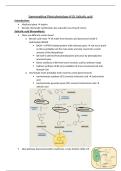
There are different routes found
o Benzoic acid route SA made from benzoic acid (precursor) by BA-2-
hydroxylase (BA2H)
BA2H = CYP450-related protein with unknown gene not much proof
so this is probably not the main route and only counts for a small
amount of the biosynthesis
BA itself is derived from phenylalanine precursor by phenylalanine
ammonia lyase
Direct synthesis of BA from trans-cinnamic acid by unknown steps
Indirect synthesis of BA via -oxidation of trans-cinnamoyl-CoA into
benzoyl-CoA
o Chorismate route (probably main route bcs some genes known)
Isochorismate synthase (ICS) converts chorismic acid isochorismic
acid
Isochorismate pyruvate lyase (IPL) converts isochorismic acid
salicylic acid
New pathway discovered which could have a main fraction (slide 13)
, Salicylic acid Signaling:
Receptor = NPR1 (non-expressor of PR proteins) activates downstream
transcription factors (positive regulator)
o NPR3 & 4 can ubiquitinate NPR1 and can therefore control NPR1 stability
they are E3 ligases of the SCF complex & are true SA receptors
o NPR1 finally gets degraded by the 26S proteasome
SA signaling is dose/concentration dependend
o No to low [SA] no activation of SA-dependent transcription factors (NPR4)
o Medium [SA] NPR1 doesn’t interact & can activate transcription factors
o High [SA] no activation of SA-dependent transcription factors (NPR3)
To determine which one is the real receptor table slide 17
Salicylic acid Physiology:
Hypersensitivity response = a disease resistance response to prevent (biotrophic)
disease spreading by producing necrotic lesions around the initial point of infection
PCD
o Size of HR zone depends on host plant & pathogen
o Makes use of ROS
Systemic acquired resistance response = a whole plant resistance response that
occurs following an earlier localized exposure to a pathogen production of
different molecules
o Necrotrophic pathogens JA responses
o Biotrophic pathogens SA responses
o SA therefore induces SAR
o In agriculture priming is often used = pre-treatment to activate SAR to lower
disease susceptibility & to prevent an eventual disease outbreak or future
infections
o More than 1 mobile element signals the SAR via the phloem
o Volatile MeSA can induce SAR in neighboring plants
Inhibits ethylene production
Flower induction of duckweeds
Thermogenesis = generation of heat by plants
Introduction:
Medicinal plant Aspirin
Already chemically synthesized, also naturally occurring of course
Salicylic acid Biosynthesis:
There are different routes found
o Benzoic acid route SA made from benzoic acid (precursor) by BA-2-
hydroxylase (BA2H)
BA2H = CYP450-related protein with unknown gene not much proof
so this is probably not the main route and only counts for a small
amount of the biosynthesis
BA itself is derived from phenylalanine precursor by phenylalanine
ammonia lyase
Direct synthesis of BA from trans-cinnamic acid by unknown steps
Indirect synthesis of BA via -oxidation of trans-cinnamoyl-CoA into
benzoyl-CoA
o Chorismate route (probably main route bcs some genes known)
Isochorismate synthase (ICS) converts chorismic acid isochorismic
acid
Isochorismate pyruvate lyase (IPL) converts isochorismic acid
salicylic acid
New pathway discovered which could have a main fraction (slide 13)
, Salicylic acid Signaling:
Receptor = NPR1 (non-expressor of PR proteins) activates downstream
transcription factors (positive regulator)
o NPR3 & 4 can ubiquitinate NPR1 and can therefore control NPR1 stability
they are E3 ligases of the SCF complex & are true SA receptors
o NPR1 finally gets degraded by the 26S proteasome
SA signaling is dose/concentration dependend
o No to low [SA] no activation of SA-dependent transcription factors (NPR4)
o Medium [SA] NPR1 doesn’t interact & can activate transcription factors
o High [SA] no activation of SA-dependent transcription factors (NPR3)
To determine which one is the real receptor table slide 17
Salicylic acid Physiology:
Hypersensitivity response = a disease resistance response to prevent (biotrophic)
disease spreading by producing necrotic lesions around the initial point of infection
PCD
o Size of HR zone depends on host plant & pathogen
o Makes use of ROS
Systemic acquired resistance response = a whole plant resistance response that
occurs following an earlier localized exposure to a pathogen production of
different molecules
o Necrotrophic pathogens JA responses
o Biotrophic pathogens SA responses
o SA therefore induces SAR
o In agriculture priming is often used = pre-treatment to activate SAR to lower
disease susceptibility & to prevent an eventual disease outbreak or future
infections
o More than 1 mobile element signals the SAR via the phloem
o Volatile MeSA can induce SAR in neighboring plants
Inhibits ethylene production
Flower induction of duckweeds
Thermogenesis = generation of heat by plants


