Workshop 1 (Spectroscopy 1)
1. When monochromatic radiation of 500 nm is sent through an absorption cell 5 cm long,
containing 0.01M solution of an absorbing solute [Ru(bpy)3]2+, 23% of the incident radiation
is absorbed. Calculate the molar extinction coefficient.
2. What is the de Broglie wavelength of an object of a mass 2mg, travelling at a speed of 100
km/s?
3. If the energy difference between vibrational levels is 900 cm-1, (a) what will the temperature
be, when the population ratio of adjacent levels is 0.2?
(b) How will the result change if the higher vibration level corresponds to 3 different iso-
energetic states?
4. The absorption of light due to the transitions of molecule between different rotational states
is only possible when the molecule has a permanent dipole. Which of the following gas
molecules have microwave absorption spectra: H2, HF, CH4, CH3CH3, CH3Cl, CH2Cl2, O2
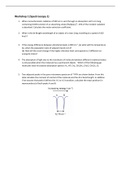
5. Two adjacent peaks in the pure microwave spectrum of 27Al1H are shown below. From this
data calculate the moment of inertial of the molecule and the Al-H bond length. In addition
if we assume that peak A defines the J=1 to J=2 transition, calculate the exact position (in
wavenumbers) of both peaks A and B.
1. When monochromatic radiation of 500 nm is sent through an absorption cell 5 cm long,
containing 0.01M solution of an absorbing solute [Ru(bpy)3]2+, 23% of the incident radiation
is absorbed. Calculate the molar extinction coefficient.
2. What is the de Broglie wavelength of an object of a mass 2mg, travelling at a speed of 100
km/s?
3. If the energy difference between vibrational levels is 900 cm-1, (a) what will the temperature
be, when the population ratio of adjacent levels is 0.2?
(b) How will the result change if the higher vibration level corresponds to 3 different iso-
energetic states?
4. The absorption of light due to the transitions of molecule between different rotational states
is only possible when the molecule has a permanent dipole. Which of the following gas
molecules have microwave absorption spectra: H2, HF, CH4, CH3CH3, CH3Cl, CH2Cl2, O2
5. Two adjacent peaks in the pure microwave spectrum of 27Al1H are shown below. From this
data calculate the moment of inertial of the molecule and the Al-H bond length. In addition
if we assume that peak A defines the J=1 to J=2 transition, calculate the exact position (in
wavenumbers) of both peaks A and B.