Drug Summaries – Humza Ibrahim
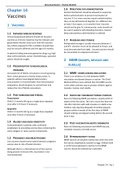
1.6 DIRECTIONS FOR ADMINISTRATION
Chapter 14 Alcohol disinfectant should be allowed to evaporate
Vaccines before administration to prevent inactivation of
vaccine. If 2 or more vaccines require administration,
they can be administered together at a different site
at least 2.5cm apart, or on another limb. Vaccines
1 VACCINES should not be give IV; intramuscular route should not
be used in patients with bleeding disorders, instead
1.1 IMPAIRED IMMUNE RESPONSE deep subcutaneous administration is advised.
Immunosuppressed patients should not be given
vaccines as immune response may be reduced, and 1.7 HANDLING AND STORAGE
generalised infection may occur with live vaccines. Refrigerated storage is usually necessary between 2
Any infants exposed to TNF-a inhibitor should have and 8°C. Vaccines must not be allowed to freeze, and
any live vaccines differed until the age of 6 months. must be protected from light. Unused vaccines should
In patients taking immunosuppressive drugs e.g. high be incinerated at a disposal contractor.
dose corticosteroids, cancer chemotherapy, specialist
advice should be sought.
2 MMR (MUMPS, MEASLES AND
1.2 PREDISPOSITION TO NEUROLOGICAL RUBELLA)
PROBLEMS
Increased risk of febrile convulsions occurring during 2.1 MMR - BOWEL DISEASE AND AUTISM
fever, when personal or family history exists. In There is no evidence of a link between MMR
patients without neurological deterioration, vaccination and bowel disease or autism. The Chief
immunisation is recommended. Post-immunisation Medical Officers have advised that the MMR vaccine
antipyretics should be given to control fever and is the safest and best way to protect children against
reduce the risk of febrile convulsions. measles, mumps, and rubella.
1.3 POST-IMMUNISATION PYREXIA 2.2 IDIOPATHIC THROMBOCYTOPENIC PURPURA
Paracetamol Rare risk following MMR vaccination, usually within 6
Child 2–3 months 60 mg as a single dose repeated weeks of the first dose. The risk is much less than the
once after 4–6 hours if necessary risk after infection with wild measles or rubella virus.
Children who develop idiopathic thrombocytopenic
Ibuprofen
purpura within 6 weeks of the first dose of MMR
Child 2–3 months 50 mg as a single dose repeated
should undergo serological testing before the second
once after 6 hours if necessary
dose is due.
1.4 ALLERGY AND CROSS-SENSITIVITY
2.3 POST-VACCINATION ASEPTIC MENINGITIS
Contraindicated in patients with confirmed
Rare risk following vaccination with MMR vaccine;
anaphylaxis to preceding vaccine dose containing the
complete recovery normally occurs.
same antigens or same vaccine components.
2.4 HYPERSENSITIVITY TO EGG
1.5 PREGNANCY AND BREASTFEEDING
MMR vaccine can be given safely even when the child
Live vaccines should not be administered to pregnant
has had an anaphylactic reaction to egg. Children with
women due to risk of foetal infection.
a confirmed anaphylactic reaction to the MMR
Although there is a theoretical risk of live vaccine vaccine should be assessed by a specialist.
being present in breast milk, vaccination is not
contraindicated.
Chapter 14 – Pg 1
Compiled using the British National Formulary
1.6 DIRECTIONS FOR ADMINISTRATION
Chapter 14 Alcohol disinfectant should be allowed to evaporate
Vaccines before administration to prevent inactivation of
vaccine. If 2 or more vaccines require administration,
they can be administered together at a different site
at least 2.5cm apart, or on another limb. Vaccines
1 VACCINES should not be give IV; intramuscular route should not
be used in patients with bleeding disorders, instead
1.1 IMPAIRED IMMUNE RESPONSE deep subcutaneous administration is advised.
Immunosuppressed patients should not be given
vaccines as immune response may be reduced, and 1.7 HANDLING AND STORAGE
generalised infection may occur with live vaccines. Refrigerated storage is usually necessary between 2
Any infants exposed to TNF-a inhibitor should have and 8°C. Vaccines must not be allowed to freeze, and
any live vaccines differed until the age of 6 months. must be protected from light. Unused vaccines should
In patients taking immunosuppressive drugs e.g. high be incinerated at a disposal contractor.
dose corticosteroids, cancer chemotherapy, specialist
advice should be sought.
2 MMR (MUMPS, MEASLES AND
1.2 PREDISPOSITION TO NEUROLOGICAL RUBELLA)
PROBLEMS
Increased risk of febrile convulsions occurring during 2.1 MMR - BOWEL DISEASE AND AUTISM
fever, when personal or family history exists. In There is no evidence of a link between MMR
patients without neurological deterioration, vaccination and bowel disease or autism. The Chief
immunisation is recommended. Post-immunisation Medical Officers have advised that the MMR vaccine
antipyretics should be given to control fever and is the safest and best way to protect children against
reduce the risk of febrile convulsions. measles, mumps, and rubella.
1.3 POST-IMMUNISATION PYREXIA 2.2 IDIOPATHIC THROMBOCYTOPENIC PURPURA
Paracetamol Rare risk following MMR vaccination, usually within 6
Child 2–3 months 60 mg as a single dose repeated weeks of the first dose. The risk is much less than the
once after 4–6 hours if necessary risk after infection with wild measles or rubella virus.
Children who develop idiopathic thrombocytopenic
Ibuprofen
purpura within 6 weeks of the first dose of MMR
Child 2–3 months 50 mg as a single dose repeated
should undergo serological testing before the second
once after 6 hours if necessary
dose is due.
1.4 ALLERGY AND CROSS-SENSITIVITY
2.3 POST-VACCINATION ASEPTIC MENINGITIS
Contraindicated in patients with confirmed
Rare risk following vaccination with MMR vaccine;
anaphylaxis to preceding vaccine dose containing the
complete recovery normally occurs.
same antigens or same vaccine components.
2.4 HYPERSENSITIVITY TO EGG
1.5 PREGNANCY AND BREASTFEEDING
MMR vaccine can be given safely even when the child
Live vaccines should not be administered to pregnant
has had an anaphylactic reaction to egg. Children with
women due to risk of foetal infection.
a confirmed anaphylactic reaction to the MMR
Although there is a theoretical risk of live vaccine vaccine should be assessed by a specialist.
being present in breast milk, vaccination is not
contraindicated.
Chapter 14 – Pg 1
Compiled using the British National Formulary