1
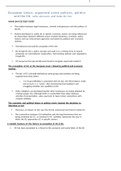
E u ro pe a n Un i o n : o rga n i s e d c r i m e p o l i ci e s , p ol i ti c s
a n d t h e E U - J e l l e J a n s s e n s a n d A n ke D e Vo s
WAAR GAAT DE TEKST OVER?
The relation between legal businesses, criminal entrepreneurs and the policies of
the EU.
Policies developed to tackle OC in specific economic sectors are being influenced
by interactions between different actors involved (business, criminals, policy-
makers and law enforcement agencies) and biased by political and economic
motives.
The historical roots and the conception of OC in EU
EU turned OC into a policy concept and used it as a driving force to launch
proposals on international cooperation, harmonizing policies and regulations
trough MS.
OC was put on the map and MS were forced to recognize, report and combat it.
The conception of OC at the European level = biased by political and economic
motives
The def. of OC is broadly defined but some groups and activities are being
targeted more than others
o F.e: Drug trafficking is associated with OC but, the illicit tobacco trade
not so much. (= a ‘sector’ that characterized by fraudulent and
smuggling activities also qualified as OC)
Policy initiatives are developed quicker when businesses are being attacked by
criminal groups (f.e: (through theft or counterfeit) than when business
activities (transportation, sales, payment of taxes) show connections with
criminal activities
The economic and political biases in policies move beyond the decisions to
intervene or not
They have an impact on the way the EU has intervened and tried to tackle OC.
The connections between EU institutions and the legal businesses that are
being victimized by OC, or involved in OC activities, determine the way in
which the EU approaches OC in specific sectors.
2 notable features of the history & conception of OC in EU.
OC has been presented as a threat to the economic and social fabric of the EU
, 2
o This has led to the development of numerous regulations and policies
o While the concept of OC was clouded in a mist of misrepresentation and
misunderstanding.
Conceptual vagueness has an impact on the material scope of EU policies, and the
nature of these policies.
o Developing policies to tackle ‘unclear’ lead to ineffective and questionable
policies.
o Examples of how political and economic bias in the decision-making
process has influenced these policies are given.
2 case studies illustrate that
o OC as a ‘threat’ can be used to invoke the development of new policies
and new responsibilities for law enforcement agencies
o The interaction between legal businesses, criminal entrepreneurs and
policy-makers have an impact on the policies developed against
E u ro pe a n Un i o n : o rga n i s e d c r i m e p o l i ci e s , p ol i ti c s
a n d t h e E U - J e l l e J a n s s e n s a n d A n ke D e Vo s
WAAR GAAT DE TEKST OVER?
The relation between legal businesses, criminal entrepreneurs and the policies of
the EU.
Policies developed to tackle OC in specific economic sectors are being influenced
by interactions between different actors involved (business, criminals, policy-
makers and law enforcement agencies) and biased by political and economic
motives.
The historical roots and the conception of OC in EU
EU turned OC into a policy concept and used it as a driving force to launch
proposals on international cooperation, harmonizing policies and regulations
trough MS.
OC was put on the map and MS were forced to recognize, report and combat it.
The conception of OC at the European level = biased by political and economic
motives
The def. of OC is broadly defined but some groups and activities are being
targeted more than others
o F.e: Drug trafficking is associated with OC but, the illicit tobacco trade
not so much. (= a ‘sector’ that characterized by fraudulent and
smuggling activities also qualified as OC)
Policy initiatives are developed quicker when businesses are being attacked by
criminal groups (f.e: (through theft or counterfeit) than when business
activities (transportation, sales, payment of taxes) show connections with
criminal activities
The economic and political biases in policies move beyond the decisions to
intervene or not
They have an impact on the way the EU has intervened and tried to tackle OC.
The connections between EU institutions and the legal businesses that are
being victimized by OC, or involved in OC activities, determine the way in
which the EU approaches OC in specific sectors.
2 notable features of the history & conception of OC in EU.
OC has been presented as a threat to the economic and social fabric of the EU
, 2
o This has led to the development of numerous regulations and policies
o While the concept of OC was clouded in a mist of misrepresentation and
misunderstanding.
Conceptual vagueness has an impact on the material scope of EU policies, and the
nature of these policies.
o Developing policies to tackle ‘unclear’ lead to ineffective and questionable
policies.
o Examples of how political and economic bias in the decision-making
process has influenced these policies are given.
2 case studies illustrate that
o OC as a ‘threat’ can be used to invoke the development of new policies
and new responsibilities for law enforcement agencies
o The interaction between legal businesses, criminal entrepreneurs and
policy-makers have an impact on the policies developed against