Commissies Medische Ethiek
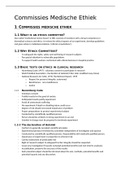
1 COMMISSIES MEDISCHE ETHIEK
1.1 WHAT IS AN ETHICS COMMITTEE?
Also called ‘institutional review board’ or IRB, consists of members with a broad competency in
biomedical sciences and ethics. It reviews the ethical aspects of an experiment, develops guidelines
and gives advice in individual problems (‘ethical consultations’).
1.2 WHY ETHICS COMMITTEES?
- To safeguard the rights, safety and well-being of research subjects
- Pay special attention to vulnerable populations
- To support health workers confronted with ethical decisions in hospital practice
1.3 BASIC TEXTS ON ETHICS IN CLINICAL RESEARCH
- Nuremberg Code (1947) - voluntary consent to participate in research
- World Medical Association - Declaration of Helsinki (1964, later modified many times)
- National Research Act (USA, 1974) The Belmont Report, 1978
o Respect for persons (integrity, autonomy)
o Beneficience - non-maleficience
o Justice
1.3.1 Nuremberg Code
- Voluntary consent
- Fruitful results for the good of society
- Anticipated results justify experiment
- Avoid all unnecessary suffering
- No experiment if death or disabling injury could occur
- Degree of risk should not exceed importance of problem
- Proper preparations to protect experimental subject
- Conducted by scientifically qualified persons
- Person should be at liberty to bring experiment to an end
- Scientist in charge must be prepared to terminate experiment
1.3.2 The declaration of Helsinki
- Conform to generally accepted scientific principles
- Experimental protocol reviewed by committee independent of investigator and sponsor
- Conducted by scientifically qualified persons. Responsibility with medically qualified person.
- Importance of experiment in proportion to inherent risk.
- Careful assessment of predictable risk
- Right of research subject to safeguard his/her integrity should be respected.
- Cease any investigation if hazards outweigh potential benefits (ook met interim analyses).
- In publication, preserve the accuracy of the results
- Each potential subject should be informed about the aim, methods, potential benefits and
potential hazards and any discomfort.
, - Subject should have the right to abstain from participation and withdraw his/her consent at
any time.
1.3.3 Participation in clinical trials
- Decision making capacity
- Voluntariness
- Communication
- Selection of research subjects
- Assessment of risks and benefits
o Subjects at risk
o Types of risk involved
o Balance of benefits and risks
1.3.4 Belgian Law
- Royal Decree 12 August 1994: every hospital or –group needs to have a recognized ethics
committee
- Organization
o 8-15 members
o Majority of MD’s affiliated with the hospital
o ≥ 1 GP not affiliated
o ≥ 1 nurse - jurist
o Not allowed: director, medical director (hoofdgeneesheer), president of medical
council, director nursing
o Standard operating procedures, mandate 4 years, renewable, ≥ 1 meeting per
trimester, yearly report
- Assignment
o Advisory function with respect to the ethical aspects of hospital care
o Supportive function in decisions concerning individual ethical problems
o Advisory function with respect to all protocols concerning experiments in human trial
subjects – 4 MAY 04 became ‘decisive’
- Advice is (was) confidential, not compulsory, written, individual and if necessary, can reflect
the individual opinions of the committee members
- Questions from any member of personnel and any physician
1 COMMISSIES MEDISCHE ETHIEK
1.1 WHAT IS AN ETHICS COMMITTEE?
Also called ‘institutional review board’ or IRB, consists of members with a broad competency in
biomedical sciences and ethics. It reviews the ethical aspects of an experiment, develops guidelines
and gives advice in individual problems (‘ethical consultations’).
1.2 WHY ETHICS COMMITTEES?
- To safeguard the rights, safety and well-being of research subjects
- Pay special attention to vulnerable populations
- To support health workers confronted with ethical decisions in hospital practice
1.3 BASIC TEXTS ON ETHICS IN CLINICAL RESEARCH
- Nuremberg Code (1947) - voluntary consent to participate in research
- World Medical Association - Declaration of Helsinki (1964, later modified many times)
- National Research Act (USA, 1974) The Belmont Report, 1978
o Respect for persons (integrity, autonomy)
o Beneficience - non-maleficience
o Justice
1.3.1 Nuremberg Code
- Voluntary consent
- Fruitful results for the good of society
- Anticipated results justify experiment
- Avoid all unnecessary suffering
- No experiment if death or disabling injury could occur
- Degree of risk should not exceed importance of problem
- Proper preparations to protect experimental subject
- Conducted by scientifically qualified persons
- Person should be at liberty to bring experiment to an end
- Scientist in charge must be prepared to terminate experiment
1.3.2 The declaration of Helsinki
- Conform to generally accepted scientific principles
- Experimental protocol reviewed by committee independent of investigator and sponsor
- Conducted by scientifically qualified persons. Responsibility with medically qualified person.
- Importance of experiment in proportion to inherent risk.
- Careful assessment of predictable risk
- Right of research subject to safeguard his/her integrity should be respected.
- Cease any investigation if hazards outweigh potential benefits (ook met interim analyses).
- In publication, preserve the accuracy of the results
- Each potential subject should be informed about the aim, methods, potential benefits and
potential hazards and any discomfort.
, - Subject should have the right to abstain from participation and withdraw his/her consent at
any time.
1.3.3 Participation in clinical trials
- Decision making capacity
- Voluntariness
- Communication
- Selection of research subjects
- Assessment of risks and benefits
o Subjects at risk
o Types of risk involved
o Balance of benefits and risks
1.3.4 Belgian Law
- Royal Decree 12 August 1994: every hospital or –group needs to have a recognized ethics
committee
- Organization
o 8-15 members
o Majority of MD’s affiliated with the hospital
o ≥ 1 GP not affiliated
o ≥ 1 nurse - jurist
o Not allowed: director, medical director (hoofdgeneesheer), president of medical
council, director nursing
o Standard operating procedures, mandate 4 years, renewable, ≥ 1 meeting per
trimester, yearly report
- Assignment
o Advisory function with respect to the ethical aspects of hospital care
o Supportive function in decisions concerning individual ethical problems
o Advisory function with respect to all protocols concerning experiments in human trial
subjects – 4 MAY 04 became ‘decisive’
- Advice is (was) confidential, not compulsory, written, individual and if necessary, can reflect
the individual opinions of the committee members
- Questions from any member of personnel and any physician