OpenStax Organic Chemistry: A Tenth Edition Student Solutions Manual
Chapter 20 – Carboxylic Acids and Nitriles
Solutions to Problems
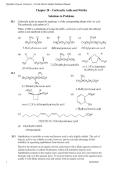
20.1 Carboxylic acids are named by replacing -e of the corresponding alkane with -oic acid.
The carboxylic acid carbon is C1.
When –CO2H is a substituent of a ring, the suffix -carboxylic acid is used; the carboxyl
carbon is not numbered in this system.
(a) (b) (c)
(d) (e) (f)
20.2
(a) (b)
(c) (d)
(e)
(f) CH3CH2CH=CHCN
2-Pentenenitrile
20.3 Naphthalene is insoluble in water and benzoic acid is only slightly soluble. The salt of
benzoic acid is very soluble in water, however, and we can take advantage of this
solubility in separating naphthalene from benzoic acid.
Dissolve the mixture in an organic solvent, and extract with a dilute aqueous solution of
sodium hydroxide or sodium bicarbonate, which will neutralize benzoic acid.
Naphthalene remains in the organic layer, and all the benzoic acid, now converted to the
benzoate salt, is in the aqueous layer. To recover benzoic acid, remove the aqueous layer,
acidify it with dilute mineral acid, and extract with an organic solvent.
1 10/30/2023
, OpenStax Organic Chemistry: A Tenth Edition Student Solutions Manual
20.4
⎯⎯
Ka
Cl2 CHCO2 H + H 2 O ⎯ → Cl2 CHCO2− H3O +
⎯
Cl2 CHCO2− H3O +
Ka = = 3.32 10−2
Cl2CHCO2 H
Initial molarity Molarity after dissociation
Cl2CHCO2H 0.10 M 0.10 M – y
Cl2CHCO2– 0 y
H3O+ 0 y
y y
Ka = = 3.3210−2
0.10 − y
Using the quadratic formula to solve for y, we find that y = 0.0434 M
0.0434 M
Percent dissociation = 100% = 43.4%
0.1000 M
20.5 Use the Henderson–Hasselbalch equation to calculate the ratio.
(a)
[A − ]
log = pH− pK a = 4.50 − 3.83 = 0.67
HA
[A − ]
= 100.67 = 4.68 :[A − ] = 4.68 HA
HA
HA + [A − ] = 100%
HA + 4.68 HA = 5.68 HA = 100%
HA = 100% 5.68 = 18%
[A − ] = 100% −18% = 82%
82% of 0.0010 M glycolic acid is dissociated at pH = 4.50
(b)
[A − ]
log = pH− pK a = 5.30 − 4.87 = 0.43
HA
[A − ]
= 100.43 = 2.69 :[A − ] = 2.69 HA
HA
HA +[A − ] = 100%
HA + 2.69 HA = 3.69 HA = 100%
HA = 100% 3.69 = 27%
[A − ] = 100% − 27% = 73%
73% of 0.0020 M propanoic acid is dissociated at pH = 5.30.
1/5/2024 2
, OpenStax Organic Chemistry: A Tenth Edition Student Solutions Manual
20.6 You would expect lactic acid to be a stronger acid because the electron-withdrawing
inductive effect of the hydroxyl group can stabilize the lactate anion.
20.7
The pKa1 of oxalic acid is lower than that of a monocarboxylic acid because the
carboxylate anion is stabilized both by resonance and by the electron-withdrawing
inductive effect of the nearby second carboxylic acid group.
The pKa2 of oxalic acid is higher than pKa1 because an electrostatic repulsion between the
two adjacent negative charges destabilizes the dianion.
20.8 A pKa of 4.45 indicates that p-cyclopropylbenzoic acid is a weaker acid than benzoic
acid. This, in turn, indicates that a cyclopropyl group must be electron-donating.
Since electron-donating groups increase reactivity in electrophilic substitution
reactions, p-cyclopropylbenzene should be more reactive than benzene toward
electrophilic bromination.
20.9 Remember that electron-withdrawing groups increase carboxylic acid acidity, and
electron-donating groups decrease carboxylic acid acidity. Benzoic acid is more
acidic than acetic acid.
(a)
(b)
20.10 In part (a), Grignard carboxylation must be used because the starting materials
can't undergo SN2 reactions. In (b), either method can be used.
1.Mg, ether
(a) ( CH3 )3 CCl ⎯⎯ ⎯ ⎯⎯
→ ( CH3 )3 CCO2 H
2.CO2 , ether
3. H3O+
1. Mg, ether
(b) CH3CH 2CH 2 Br ⎯2⎯ ⎯ ⎯⎯
. CO2 , ether
3. H O+
→ or ⎯12.⎯ ⎯⎯
. NaCN
H O+
→CH3CH 2CH 2 CO2 H
3 3
3 11/7/2023
Chapter 20 – Carboxylic Acids and Nitriles
Solutions to Problems
20.1 Carboxylic acids are named by replacing -e of the corresponding alkane with -oic acid.
The carboxylic acid carbon is C1.
When –CO2H is a substituent of a ring, the suffix -carboxylic acid is used; the carboxyl
carbon is not numbered in this system.
(a) (b) (c)
(d) (e) (f)
20.2
(a) (b)
(c) (d)
(e)
(f) CH3CH2CH=CHCN
2-Pentenenitrile
20.3 Naphthalene is insoluble in water and benzoic acid is only slightly soluble. The salt of
benzoic acid is very soluble in water, however, and we can take advantage of this
solubility in separating naphthalene from benzoic acid.
Dissolve the mixture in an organic solvent, and extract with a dilute aqueous solution of
sodium hydroxide or sodium bicarbonate, which will neutralize benzoic acid.
Naphthalene remains in the organic layer, and all the benzoic acid, now converted to the
benzoate salt, is in the aqueous layer. To recover benzoic acid, remove the aqueous layer,
acidify it with dilute mineral acid, and extract with an organic solvent.
1 10/30/2023
, OpenStax Organic Chemistry: A Tenth Edition Student Solutions Manual
20.4
⎯⎯
Ka
Cl2 CHCO2 H + H 2 O ⎯ → Cl2 CHCO2− H3O +
⎯
Cl2 CHCO2− H3O +
Ka = = 3.32 10−2
Cl2CHCO2 H
Initial molarity Molarity after dissociation
Cl2CHCO2H 0.10 M 0.10 M – y
Cl2CHCO2– 0 y
H3O+ 0 y
y y
Ka = = 3.3210−2
0.10 − y
Using the quadratic formula to solve for y, we find that y = 0.0434 M
0.0434 M
Percent dissociation = 100% = 43.4%
0.1000 M
20.5 Use the Henderson–Hasselbalch equation to calculate the ratio.
(a)
[A − ]
log = pH− pK a = 4.50 − 3.83 = 0.67
HA
[A − ]
= 100.67 = 4.68 :[A − ] = 4.68 HA
HA
HA + [A − ] = 100%
HA + 4.68 HA = 5.68 HA = 100%
HA = 100% 5.68 = 18%
[A − ] = 100% −18% = 82%
82% of 0.0010 M glycolic acid is dissociated at pH = 4.50
(b)
[A − ]
log = pH− pK a = 5.30 − 4.87 = 0.43
HA
[A − ]
= 100.43 = 2.69 :[A − ] = 2.69 HA
HA
HA +[A − ] = 100%
HA + 2.69 HA = 3.69 HA = 100%
HA = 100% 3.69 = 27%
[A − ] = 100% − 27% = 73%
73% of 0.0020 M propanoic acid is dissociated at pH = 5.30.
1/5/2024 2
, OpenStax Organic Chemistry: A Tenth Edition Student Solutions Manual
20.6 You would expect lactic acid to be a stronger acid because the electron-withdrawing
inductive effect of the hydroxyl group can stabilize the lactate anion.
20.7
The pKa1 of oxalic acid is lower than that of a monocarboxylic acid because the
carboxylate anion is stabilized both by resonance and by the electron-withdrawing
inductive effect of the nearby second carboxylic acid group.
The pKa2 of oxalic acid is higher than pKa1 because an electrostatic repulsion between the
two adjacent negative charges destabilizes the dianion.
20.8 A pKa of 4.45 indicates that p-cyclopropylbenzoic acid is a weaker acid than benzoic
acid. This, in turn, indicates that a cyclopropyl group must be electron-donating.
Since electron-donating groups increase reactivity in electrophilic substitution
reactions, p-cyclopropylbenzene should be more reactive than benzene toward
electrophilic bromination.
20.9 Remember that electron-withdrawing groups increase carboxylic acid acidity, and
electron-donating groups decrease carboxylic acid acidity. Benzoic acid is more
acidic than acetic acid.
(a)
(b)
20.10 In part (a), Grignard carboxylation must be used because the starting materials
can't undergo SN2 reactions. In (b), either method can be used.
1.Mg, ether
(a) ( CH3 )3 CCl ⎯⎯ ⎯ ⎯⎯
→ ( CH3 )3 CCO2 H
2.CO2 , ether
3. H3O+
1. Mg, ether
(b) CH3CH 2CH 2 Br ⎯2⎯ ⎯ ⎯⎯
. CO2 , ether
3. H O+
→ or ⎯12.⎯ ⎯⎯
. NaCN
H O+
→CH3CH 2CH 2 CO2 H
3 3
3 11/7/2023