4 Psychopathology
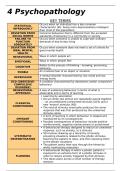
KEY TERMS
Occurs when an individual has a less common
STATISTICAL
characteristic (EG. being more depressed/less intelligent
INFREQUENCY
than most of the population)
DEVIATION FROM Concerns behaviour that is different from the accepted
SOCIAL NORMS standards of behaviour in a community or society
FAILURE TO Occurs when someone is unable to cope with ordinary
FUNCTION demands of day-to-day living
ADEQUATELY
DEVIATION FROM Occurs when someone does not meet a set of criteria for
IDEAL MENTAL good mental health
HEALTH
BEHAVIOURAL Ways in which people act
EMOTIONAL Ways in which people feel
Refers to the process of thinking – knowing, perceiving,
COGNITIVE
believing
PHOBIA An irrational fear of an object or situation
A mental disorder characterised by low mood and low
DEPRESSION
energy levels
OCD (OBSESSIVE- A condition characterised by obsessions and/or compulsive
COMPULSIVE behaviour
DISORDER)
BEHAVIOURAL A way of explaining behaviour in terms of what is
APPROACH observable and in terms of learning
Learning by association
Occurs when two stimuli are repeatedly paired together
– an unconditioned (unlearned) stimulus (UCS) and a
CLASSICAL
new ‘neutral’ stimulus (NS)
CONDITIONING
The neutral stimulus eventually produces the same
response that was first produced by the unlearned
stimulus alone
A form of learning in which behaviour is shaped and
OPERANT maintained by its consequences
CONDITIONING Possible consequences of behaviour include positive
reinforcement, negative reinforcement or punishment
A behavioural therapy designed to reduce an unwanted
response, such as anxiety, to a stimulus
SD involves drawing up a hierarchy of anxiety-
SYSTEMATIC provoking situations related to the phobic stimulus,
DESENSITISATION teaching the patient to relax, and then exposing them
to the phobic situations
The patient works their way through the hierarchy
whilst maintaining relaxation
A behavioural therapy in which a phobic patient is
exposed to an extreme form of a phobic stimulus in
FLOODING order to reduce anxiety triggered by that stimulus
This takes place across a small number of therapy
sessions
, The term ‘cognitive’ has come to mean ‘mental
COGNITIVE processes’, so this approach is focused on how our
APPROACH mental processes (EG. Thoughts, perceptions, attention)
affect behaviour
BECK proposed that there were three kinds of negative
thinking that contributed to becoming depressed:
negative views of the world, the future and the self
NEGATIVE TRIAD
Such negative views lead a person to interpret their
experiences in a negative way and so make them more
vulnerable to depression
ELLIS proposed that depression occurs when an
activating event (A) triggers an irrational belief (B)
ABC MODEL which in turn produces a consequence (C) (IE. An
emotional response like depression)
The key to this process is the irrational belief
A method for treating mental disorders based on both
cognitive and behavioural techniques
COGNITIVE
From the cognitive viewpoint, the therapy aims to deal
BEHAVIOURAL
with thinking, such as challenging negative thoughts
THERAPY (CBT)
The therapy also includes behavioural techniques such
as behavioural activation
Also called dysfunctional thoughts
In ELLIS’ model and therapy, these are defined as
IRRATIONAL thoughts that are likely to interfere with a person’s
THOUGHTS happiness
Such dysfunctional thoughts lead to mental disorders
such as depression
A perspective that emphasises the importance of physical
BIOLOGICAL
processes in the body such as genetic inheritance and
APPROACH
neural function
Genes make up chromosomes and consist of DNA which
codes the physical features of an organism (such as eye
GENETIC colour, height) and psychological features (such as
EXPLANATIONS mental disorder, intelligence)
Genes are transmitted from parents to offspring (IE.
Inherited)
The view that physical and psychological characteristics
NEURAL are determined by the behaviour of the nervous
EXPLANATIONS system, in particular the brain as well as individual
reasons
Treatment involving drugs (IE. Chemicals that have a
particular effect on the functioning of the brain or some
DRUG THERAPY other body system)
In the case of psychological disorders such drugs
usually effect neurotransmitter levels
Definitions of Abnormality
Psychopathology = the study of psychological disorders
o How we identify when someone is psychologically unwell
o How do we determine if their behaviour differs from what we consider normal
and at what point should that person be classified as ‘abnormal’
, STATISTICAL INFREQUENCY
Occurs when an individual has a less common characteristic, for example being more
depressed or less intelligent than most of the population.
The most obvious way to define anything as ‘normal’ or ‘abnormal’ is according to the
number of times we observe it – this is called STATISTICS
According to the Statistical infrequency definition, a behaviour is seen as abnormal if it
is statistically uncommon or not seen very often.
Therefore, abnormality is determined by looking at the distribution of a particular
behaviour.
A common example is that of IQ and intellectual disability disorder
o The average IQ is approximately 100
o 65% of the population have an IQ in the region of 85 to 115.
o Furthermore, 95% of the population have an IQ in the region of 70 to 130.
o However, a small percentage of the population have an IQ below 70 (known as
intellectual disability disorder) or above 130 and these people are statistically
uncommon and consequently
Therefore, they would be classified as abnormal according to this
definition.
A normal distribution curve can be used to represent the
proportions of the population who share a
particular characteristic….
AO3 EVALUATION
MISDIAGNOSIS LABELLING REAL-LIFE
APPLICATION
LIMITATION – issue of LIMITATION – labelling STRENGTH – real-life
misdiagnosis someone as abnormal application in the
can be unhelpful diagnosis of
‘Statistically’, some regardless of the intellectual disability
behaviours are common statistics disorder
EG. Depression – 10% of
people will experience it at If an individual with unusual There is a place for
some point, making this characteristics (EG a very statistical infrequency
behaviour ‘normal’ low IQ) is living a healthy, when thinking about
On the other hand, fulfilled life and is capable what are normal and
‘statistically’ some of working etc…, simply abnormal behaviours.
behaviours are uncommon does not need a diagnosis
EG. High IQ – making them of Intellectual disability All assessments of
‘abnormal’ despite their disorder patients with mental
desirable nature. If that person was labelled, disorders include some
These definitely do not it may… sort of measurement of
require treatment to return - cause them distress how severe their
them to ‘normal’. - have a negative effect on symptoms are
Therefore, the definition the way others view them compared to statistical
needs to identify behaviours - contribute to a poor self- norms (as distinct from
that are both infrequent AND esteem social norms)
undesirable. - become an invitation for
This is makes it a limitation discrimination. This makes statistical
when explaining abnormality This means being labelled infrequency a useful
and should not be used in as statistically infrequent, tool in parts of a clinical
isolation when making a could cause the person assessment.
diagnosis. more distress than the
condition itself.
DEVIATION FROM SOCIAL NORMS
KEY TERMS
Occurs when an individual has a less common
STATISTICAL
characteristic (EG. being more depressed/less intelligent
INFREQUENCY
than most of the population)
DEVIATION FROM Concerns behaviour that is different from the accepted
SOCIAL NORMS standards of behaviour in a community or society
FAILURE TO Occurs when someone is unable to cope with ordinary
FUNCTION demands of day-to-day living
ADEQUATELY
DEVIATION FROM Occurs when someone does not meet a set of criteria for
IDEAL MENTAL good mental health
HEALTH
BEHAVIOURAL Ways in which people act
EMOTIONAL Ways in which people feel
Refers to the process of thinking – knowing, perceiving,
COGNITIVE
believing
PHOBIA An irrational fear of an object or situation
A mental disorder characterised by low mood and low
DEPRESSION
energy levels
OCD (OBSESSIVE- A condition characterised by obsessions and/or compulsive
COMPULSIVE behaviour
DISORDER)
BEHAVIOURAL A way of explaining behaviour in terms of what is
APPROACH observable and in terms of learning
Learning by association
Occurs when two stimuli are repeatedly paired together
– an unconditioned (unlearned) stimulus (UCS) and a
CLASSICAL
new ‘neutral’ stimulus (NS)
CONDITIONING
The neutral stimulus eventually produces the same
response that was first produced by the unlearned
stimulus alone
A form of learning in which behaviour is shaped and
OPERANT maintained by its consequences
CONDITIONING Possible consequences of behaviour include positive
reinforcement, negative reinforcement or punishment
A behavioural therapy designed to reduce an unwanted
response, such as anxiety, to a stimulus
SD involves drawing up a hierarchy of anxiety-
SYSTEMATIC provoking situations related to the phobic stimulus,
DESENSITISATION teaching the patient to relax, and then exposing them
to the phobic situations
The patient works their way through the hierarchy
whilst maintaining relaxation
A behavioural therapy in which a phobic patient is
exposed to an extreme form of a phobic stimulus in
FLOODING order to reduce anxiety triggered by that stimulus
This takes place across a small number of therapy
sessions
, The term ‘cognitive’ has come to mean ‘mental
COGNITIVE processes’, so this approach is focused on how our
APPROACH mental processes (EG. Thoughts, perceptions, attention)
affect behaviour
BECK proposed that there were three kinds of negative
thinking that contributed to becoming depressed:
negative views of the world, the future and the self
NEGATIVE TRIAD
Such negative views lead a person to interpret their
experiences in a negative way and so make them more
vulnerable to depression
ELLIS proposed that depression occurs when an
activating event (A) triggers an irrational belief (B)
ABC MODEL which in turn produces a consequence (C) (IE. An
emotional response like depression)
The key to this process is the irrational belief
A method for treating mental disorders based on both
cognitive and behavioural techniques
COGNITIVE
From the cognitive viewpoint, the therapy aims to deal
BEHAVIOURAL
with thinking, such as challenging negative thoughts
THERAPY (CBT)
The therapy also includes behavioural techniques such
as behavioural activation
Also called dysfunctional thoughts
In ELLIS’ model and therapy, these are defined as
IRRATIONAL thoughts that are likely to interfere with a person’s
THOUGHTS happiness
Such dysfunctional thoughts lead to mental disorders
such as depression
A perspective that emphasises the importance of physical
BIOLOGICAL
processes in the body such as genetic inheritance and
APPROACH
neural function
Genes make up chromosomes and consist of DNA which
codes the physical features of an organism (such as eye
GENETIC colour, height) and psychological features (such as
EXPLANATIONS mental disorder, intelligence)
Genes are transmitted from parents to offspring (IE.
Inherited)
The view that physical and psychological characteristics
NEURAL are determined by the behaviour of the nervous
EXPLANATIONS system, in particular the brain as well as individual
reasons
Treatment involving drugs (IE. Chemicals that have a
particular effect on the functioning of the brain or some
DRUG THERAPY other body system)
In the case of psychological disorders such drugs
usually effect neurotransmitter levels
Definitions of Abnormality
Psychopathology = the study of psychological disorders
o How we identify when someone is psychologically unwell
o How do we determine if their behaviour differs from what we consider normal
and at what point should that person be classified as ‘abnormal’
, STATISTICAL INFREQUENCY
Occurs when an individual has a less common characteristic, for example being more
depressed or less intelligent than most of the population.
The most obvious way to define anything as ‘normal’ or ‘abnormal’ is according to the
number of times we observe it – this is called STATISTICS
According to the Statistical infrequency definition, a behaviour is seen as abnormal if it
is statistically uncommon or not seen very often.
Therefore, abnormality is determined by looking at the distribution of a particular
behaviour.
A common example is that of IQ and intellectual disability disorder
o The average IQ is approximately 100
o 65% of the population have an IQ in the region of 85 to 115.
o Furthermore, 95% of the population have an IQ in the region of 70 to 130.
o However, a small percentage of the population have an IQ below 70 (known as
intellectual disability disorder) or above 130 and these people are statistically
uncommon and consequently
Therefore, they would be classified as abnormal according to this
definition.
A normal distribution curve can be used to represent the
proportions of the population who share a
particular characteristic….
AO3 EVALUATION
MISDIAGNOSIS LABELLING REAL-LIFE
APPLICATION
LIMITATION – issue of LIMITATION – labelling STRENGTH – real-life
misdiagnosis someone as abnormal application in the
can be unhelpful diagnosis of
‘Statistically’, some regardless of the intellectual disability
behaviours are common statistics disorder
EG. Depression – 10% of
people will experience it at If an individual with unusual There is a place for
some point, making this characteristics (EG a very statistical infrequency
behaviour ‘normal’ low IQ) is living a healthy, when thinking about
On the other hand, fulfilled life and is capable what are normal and
‘statistically’ some of working etc…, simply abnormal behaviours.
behaviours are uncommon does not need a diagnosis
EG. High IQ – making them of Intellectual disability All assessments of
‘abnormal’ despite their disorder patients with mental
desirable nature. If that person was labelled, disorders include some
These definitely do not it may… sort of measurement of
require treatment to return - cause them distress how severe their
them to ‘normal’. - have a negative effect on symptoms are
Therefore, the definition the way others view them compared to statistical
needs to identify behaviours - contribute to a poor self- norms (as distinct from
that are both infrequent AND esteem social norms)
undesirable. - become an invitation for
This is makes it a limitation discrimination. This makes statistical
when explaining abnormality This means being labelled infrequency a useful
and should not be used in as statistically infrequent, tool in parts of a clinical
isolation when making a could cause the person assessment.
diagnosis. more distress than the
condition itself.
DEVIATION FROM SOCIAL NORMS