Exchang
e
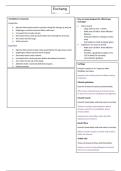
Ventilation in mammals How are lungs designed for efficient gas
exchange?
Inspiration
Many alveoli
o External intercostal muscles contract raising the ribcage up and out.
- Large surface area : volume
o Diaphragm contracts become flatter and lower.
- Walls one cell thick- short diffusion
o Increased chest cavity volume.
distance
o Decreased chest cavity pressure below the atmospheric pressure. - Surfactant (doesn’t collapse surface
o Air moves into the lungs. area)
o Active process. - Permeable to small/ nonpolar gases
Expiration Capillaries run close to alveoli.
- Walls one cell thick- short diffusion
o External intercostal muscles relax lowering the rib cage down and in. distance.
o Diaphragm relaxes become dome shaped. - Provides a good blood supply more
o Decreased chest cavity volume. CO2 in blood O2 out steep
o Increased chest cavity pressure below atmospheric pressure. concentration gradient.
o Air is then forced out of the lungs.
o Aided by elastic recoil and abdominal organs. Cartilage
o Passive process.
Found in trachea in a C shape to allow
flexibility and space.
Supports the trachea prevent collapse during
inspiration.
Ciliated epithelium
Line the airways of trachea and bronchiole
After mucus released beat and moves mucus
to top of airway to be swallowed and digested.
Smooth muscle
Found in bronchiole walls and some in trachea.
Contract causing vasoconstriction where
airways constrict or vasodilation where
airways dilate.
Important to control flow when harmful
substances are present.
Elastic fibres
Found in bronchiole walls and some in trachea.
Allows smooth muscle to stretch and recoil to
dilate the airways.
Goblet cells
Tissue of airways trachea and bronchioles.
Release mucus to trap pathogens to prevent
them from entering blood.
e
Ventilation in mammals How are lungs designed for efficient gas
exchange?
Inspiration
Many alveoli
o External intercostal muscles contract raising the ribcage up and out.
- Large surface area : volume
o Diaphragm contracts become flatter and lower.
- Walls one cell thick- short diffusion
o Increased chest cavity volume.
distance
o Decreased chest cavity pressure below the atmospheric pressure. - Surfactant (doesn’t collapse surface
o Air moves into the lungs. area)
o Active process. - Permeable to small/ nonpolar gases
Expiration Capillaries run close to alveoli.
- Walls one cell thick- short diffusion
o External intercostal muscles relax lowering the rib cage down and in. distance.
o Diaphragm relaxes become dome shaped. - Provides a good blood supply more
o Decreased chest cavity volume. CO2 in blood O2 out steep
o Increased chest cavity pressure below atmospheric pressure. concentration gradient.
o Air is then forced out of the lungs.
o Aided by elastic recoil and abdominal organs. Cartilage
o Passive process.
Found in trachea in a C shape to allow
flexibility and space.
Supports the trachea prevent collapse during
inspiration.
Ciliated epithelium
Line the airways of trachea and bronchiole
After mucus released beat and moves mucus
to top of airway to be swallowed and digested.
Smooth muscle
Found in bronchiole walls and some in trachea.
Contract causing vasoconstriction where
airways constrict or vasodilation where
airways dilate.
Important to control flow when harmful
substances are present.
Elastic fibres
Found in bronchiole walls and some in trachea.
Allows smooth muscle to stretch and recoil to
dilate the airways.
Goblet cells
Tissue of airways trachea and bronchioles.
Release mucus to trap pathogens to prevent
them from entering blood.