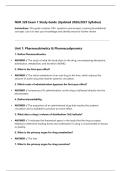
NUR 328 Exam 1 Study Guide (Updated 2026/2027 Syllabus)
Instructions: This guide contains 100+ questions and answers covering foundational
concepts. Use it to test your knowledge and identify areas for further review.
Unit 1: Pharmacokinetics & Pharmacodynamics
1. Define Pharmacokinetics.
ANSWER ✓ The study of what the body does to the drug, encompassing absorption,
distribution, metabolism, and excretion (ADME).
2. What is the first-pass effect?
ANSWER ✓ The initial metabolism of an oral drug in the liver, which reduces the
amount of active drug that reaches systemic circulation.
3. Which route of administration bypasses the first-pass effect?
ANSWER ✓ Intravenous (IV) administration, as the drug is delivered directly into the
bloodstream.
4. Define bioavailability.
ANSWER ✓ The proportion of an administered drug that reaches the systemic
circulation and is available to produce an active effect.
5. What does a drug's volume of distribution (Vd) indicate?
ANSWER ✓ It indicates the theoretical space in the body that the drug occupies,
helping to determine loading doses and understand if a drug is concentrated in tissues
or plasma.
6. What is the primary organ for drug metabolism?
ANSWER ✓ The liver.
7. What is the primary organ for drug excretion?
, ANSWER ✓ The kidneys.
8. Define half-life (t½).
ANSWER ✓ The time it takes for the plasma concentration of a drug to decrease by
50%.
9. How many half-lives does it typically take for a drug to be considered
"essentially eliminated" from the body?
ANSWER ✓ Approximately 5 half-lives.
10. Define steady state.
ANSWER ✓ The point at which the rate of drug administration equals the rate of drug
elimination, resulting in a stable plasma concentration.
11. What is the primary factor determining how often a drug should be
administered to maintain steady state?
ANSWER ✓ The drug's half-life. Typically, dosing intervals are set close to the drug's
half-life.
12. Define pharmacodynamics.
ANSWER ✓ The study of what the drug does to the body, including the mechanisms of
action and the biochemical/physiological effects.
13. What is an agonist?
ANSWER ✓ A drug that binds to a receptor and activates it, producing a physiological
response.
14. What is an antagonist?
ANSWER ✓ A drug that binds to a receptor but does not activate it, thereby blocking
the agonist from binding.
15. What is the therapeutic index (TI)?
ANSWER ✓ A ratio comparing the dose that produces toxicity (TD50) to the dose that
produces a therapeutic effect (ED50). A higher TI indicates a safer drug.
Instructions: This guide contains 100+ questions and answers covering foundational
concepts. Use it to test your knowledge and identify areas for further review.
Unit 1: Pharmacokinetics & Pharmacodynamics
1. Define Pharmacokinetics.
ANSWER ✓ The study of what the body does to the drug, encompassing absorption,
distribution, metabolism, and excretion (ADME).
2. What is the first-pass effect?
ANSWER ✓ The initial metabolism of an oral drug in the liver, which reduces the
amount of active drug that reaches systemic circulation.
3. Which route of administration bypasses the first-pass effect?
ANSWER ✓ Intravenous (IV) administration, as the drug is delivered directly into the
bloodstream.
4. Define bioavailability.
ANSWER ✓ The proportion of an administered drug that reaches the systemic
circulation and is available to produce an active effect.
5. What does a drug's volume of distribution (Vd) indicate?
ANSWER ✓ It indicates the theoretical space in the body that the drug occupies,
helping to determine loading doses and understand if a drug is concentrated in tissues
or plasma.
6. What is the primary organ for drug metabolism?
ANSWER ✓ The liver.
7. What is the primary organ for drug excretion?
, ANSWER ✓ The kidneys.
8. Define half-life (t½).
ANSWER ✓ The time it takes for the plasma concentration of a drug to decrease by
50%.
9. How many half-lives does it typically take for a drug to be considered
"essentially eliminated" from the body?
ANSWER ✓ Approximately 5 half-lives.
10. Define steady state.
ANSWER ✓ The point at which the rate of drug administration equals the rate of drug
elimination, resulting in a stable plasma concentration.
11. What is the primary factor determining how often a drug should be
administered to maintain steady state?
ANSWER ✓ The drug's half-life. Typically, dosing intervals are set close to the drug's
half-life.
12. Define pharmacodynamics.
ANSWER ✓ The study of what the drug does to the body, including the mechanisms of
action and the biochemical/physiological effects.
13. What is an agonist?
ANSWER ✓ A drug that binds to a receptor and activates it, producing a physiological
response.
14. What is an antagonist?
ANSWER ✓ A drug that binds to a receptor but does not activate it, thereby blocking
the agonist from binding.
15. What is the therapeutic index (TI)?
ANSWER ✓ A ratio comparing the dose that produces toxicity (TD50) to the dose that
produces a therapeutic effect (ED50). A higher TI indicates a safer drug.