na Attachment
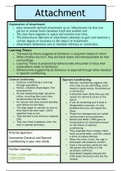
Explanation of Attachment
• Mary Ainsworth defined attachment as an "affectionate tie that one
person or animal forms between itself and another one".
• This ties them together in space and remains over time.
• The behavioural hallmark of attachment attempts to gain and maintain a
certain degree of closeness to the object of attachment.
• Attachment behaviours aim to maintain intimacy or connection.
•
Learning Theory
• The learning theory suggests all behaviour is acquired instead of inborn.
• When children are born, they are blank slates and impressionable by their
surroundings.
• Learning Theory is proposed by behaviourists who prefer to focus their
explanations solely on behaviour.
• Behaviourists suggest that all behaviour is acquired through either classical
or operant conditioning.
•
Classical Conditioning Operant Conditioning
• Classical conditioning is learning • Operant conditioning suggests that
through association. each time you do something, and it
• Pavlov, a Russian physiologist, first results in good results, the behaviour
described this. is reinforced.
• He was researching dogs' salivation • It becomes more likely that you will
reflex, recording how much they repeat the identical action in the
drooled before he fed them. future.
• He noticed that they started drooling • If you do something and it ends in
even before he fed them. disagreeable outcomes, it's less
• The dogs began to salivate as soon as probable that you will repeat the
they heard the door open, which thing.
signalled food arrival. • These two consequences are called
• They learned a new stimulus-response reinforcement and punishment.
(SR). • Dollard and Miller (1950) gave an
• They now drool (response) when the interpretation of attachment based
door is opened (stimulus). on the theory of operant
conditioning.
• They proposed that a hungry infant
Practise Question: feels uncomfortable, and this creates
a drive to reduce distress.
Summarise Classical and Operant • When the infant is fed, the urge is
conditioning in your own words. decreased and produces comfort.
• Food is the primary reinforcer and
the person who fulfils it is the
Further Learning: secondary reinforcer.
https://www.youtube.com/watch?v=g • Attachment happens because the
child seeks the person who has the
xEMkOtB8tM reward.
Explanation of Attachment
• Mary Ainsworth defined attachment as an "affectionate tie that one
person or animal forms between itself and another one".
• This ties them together in space and remains over time.
• The behavioural hallmark of attachment attempts to gain and maintain a
certain degree of closeness to the object of attachment.
• Attachment behaviours aim to maintain intimacy or connection.
•
Learning Theory
• The learning theory suggests all behaviour is acquired instead of inborn.
• When children are born, they are blank slates and impressionable by their
surroundings.
• Learning Theory is proposed by behaviourists who prefer to focus their
explanations solely on behaviour.
• Behaviourists suggest that all behaviour is acquired through either classical
or operant conditioning.
•
Classical Conditioning Operant Conditioning
• Classical conditioning is learning • Operant conditioning suggests that
through association. each time you do something, and it
• Pavlov, a Russian physiologist, first results in good results, the behaviour
described this. is reinforced.
• He was researching dogs' salivation • It becomes more likely that you will
reflex, recording how much they repeat the identical action in the
drooled before he fed them. future.
• He noticed that they started drooling • If you do something and it ends in
even before he fed them. disagreeable outcomes, it's less
• The dogs began to salivate as soon as probable that you will repeat the
they heard the door open, which thing.
signalled food arrival. • These two consequences are called
• They learned a new stimulus-response reinforcement and punishment.
(SR). • Dollard and Miller (1950) gave an
• They now drool (response) when the interpretation of attachment based
door is opened (stimulus). on the theory of operant
conditioning.
• They proposed that a hungry infant
Practise Question: feels uncomfortable, and this creates
a drive to reduce distress.
Summarise Classical and Operant • When the infant is fed, the urge is
conditioning in your own words. decreased and produces comfort.
• Food is the primary reinforcer and
the person who fulfils it is the
Further Learning: secondary reinforcer.
https://www.youtube.com/watch?v=g • Attachment happens because the
child seeks the person who has the
xEMkOtB8tM reward.