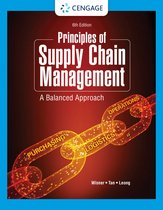
Principles of Supply Chain Management:
ST
A Balanced Approach – 6th Edition
UV
SOLUTIONS
IA
MANUAL
_A
PP
Joel D. Wisner, Keah-Choon Tan & G. Keong Leong
RO
Complete Solutions Manual for Instructors
VE
and Students
D?
© Joel D. Wisner, Keah-Choon Tan & G. Keong Leong
All rights reserved. Reproduction or distribution without permission is prohibited.
??
©MEDGEEK
, Solution Manual For
Principles of Supply Chain Management A Balanced Approach, 6th
ST
Edition by Joel Wisner, Keah-Choon Tan, G. Keong Leong
UV
Solution and Answer Guide
Joel Wisner, Keah-Choon Tan, G. Keong Leong, Principles of Supply Chain Management: A Balanced
Approach, Chapter 01: Answers to Questions/Problems
IA
Table of Contents
Discussion Questions .......................................................................................................... 1
Cases ................................................................................................................................ 7
_A
Learning Objectives ................................................................................................................................... 7
Answers to Questions................................................................................................................................ 7
Appendix 1.1 The Beer Game .............................................................................................. 8
Questions and Exercises ............................................................................................................................ 8
PP
Discussion Questions
1. Define the term supply chain management in your own words and list its most important
RO
activities.
Answers:
The Supply-Chain Council’s definition of supply chain management is ―managing supply and
demand, sourcing raw materials and parts, manufacturing and assembly, warehousing and
inventory tracking, order entry and order management, distribution across all channels, and
delivery to the customer.
VE
These are also the most important activities; however, integration of key supply chain processes
might also be included in there.
2. Can a small business like a local sandwich or bicycle shop benefit from practicing supply chain
management? What would they most likely concentrate on?
D?
Answers:
Yes, any organization can implement at least some of the important concepts. A good place to
start is the rationalization or reduction of the supply base. Small businesses might also want to
concentrate on customers as a starting point.
3. Describe and draw a supply chain for a bicycle repair shop and list the important supply chain
members.
??
Answers:
1
, This will vary from student to student, but should include, for instance, parts suppliers, bicycle
suppliers, and other suppliers (i.e., helmet suppliers) and services (i.e., repair services) as first-
tier suppliers and bicycle owners as first-tier customers.
ST
4. Can a bicycle repair shop have more than one supply chain? Explain.
Answers:
Yes. Every repair item the firm stocks has potentially a different supply chain associated with it.
5. What is a cold chain? Why did it become so important in 2020?
UV
Answers:
A cold chain is an alliance of companies that can monitor and protect the temperature of
perishable products to maintain quality and safety from the point of origin through distribution to
the final consumer. Cold chains became a popular news item in 2020 as COVID-19 vaccines
began to be distributed globally by Pfizer and Moderna. The two vaccines must be stored and
transported at sub-zero temperatures.
IA
6. How has the recent global pandemic impacted supply chain management?
Answers:
In general, it made things more difficult, particularly for global supply chains—companies have
gone bankrupt, retailers have stopped buying regularly, ports have shut down unexpectedly, and
_A
many purchases have gone online as people stayed home. Companies have had to react quickly
to the changes.
7. What roles do ―collaboration‖ and ―trust‖ play in the practice of supply chain management?
Answers:
This is essential for process integration. Sharing information and determining joint strategies is
PP
part of the process of integration and collaboration, and to do this, trust must be present
between the customer, focal firm, and supplier.
8. Why don’t firms just become more vertically integrated (for example buy out suppliers and
customers), instead of trying to manage their supply chains?
RO
Answers:
This could cause a loss of focus and keep managers and employees from doing their core
competencies, resulting in loss of performance.
9. What types of organizations would benefit the most from practicing supply chain management?
What sorts of improvements could be expected?
Answers:
VE
Firms with many suppliers, many complex products, large inventories, and many customers (in
other words, firms with many supply chains). Gains would be lower purchasing costs, lower
carrying costs, better product quality, and better customer service.
10. What are the benefits of supply chain management?
Answers:
D?
Reduction of the bullwhip effect, better buyer/supplier relationships, better quality, lower costs,
better customer service, higher demand, and more profits.
??
2
, 11. Can nonprofit, educational, or government organizations benefit from supply chain management?
How?
Answers:
ST
Yes. All services and organizations can benefit in terms of at least better customer service, better
inventory management, and cheaper purchase prices.
12. What does the term, ―third-tier supplier‖ mean? What about ―third-tier customer‖? What about
the ―focal firm‖? Provide examples.
UV
Answers:
First-tier suppliers are the focal firm’s direct suppliers. Second-tier suppliers are the focal firm’s
suppliers’ direct suppliers. Third-tier suppliers are the focal firm’s suppliers’ suppliers’ suppliers.
Company A sells wood to Company B. Company B sells furniture to Company C. Company C sells
the furniture to Wal-Mart. Company A is Wal-Mart’s third-tier supplier. Similarly, the focal firm’s
customers’ customers’ customers are their third-tier customers. The focal firm just refers to the
firm in question, or in the topic of discussion.
IA
13. What is the bullwhip effect and what causes it? How would you try to reduce the bullwhip effect?
Answers:
The magnification of safety stock and erratic buying behavior as customers along the supply
chain forecast demand and add safety stock to their forecasts and production schedules causes
_A
the bullwhip effect. As we move further back up the supply chain then, more and more of the
output is in the form of safety stocks. Reducing the need to forecast (by agreeing on a future
purchase quantity or using CPFR) is one way to reduce the bullwhip effect.
14. When did the idea and term, supply chain management, first begin to be thought about and
discussed? Which two operations management practices became the origin of supply chain
PP
management?
Answers:
The general idea of supply chain management had been discussed for many years prior to the
chain of events shown in Figure 1.1. Back in 1915, Arch W. Shaw of the Harvard Business School
wrote the textbook, Some Problems in Market Distribution, considered by many to be the first on
RO
the topic of what we now refer to as supply chain management. The text included discussions of
how best to purchase raw materials, transport products, locate facilities, and analyze productivity
and waste. According to C. John Langley, Jr., professor of supply chain management at the
Georgia Institute of Technology, ―The idea that companies ought to work together, and
coordinate activities has always been around, but ask people today what one of the biggest
problems with supply chains are today, and they say companies don’t work very well together.‖
The 1980s were the breakout years for supply chain management. One of the first widely
VE
recorded uses of the term supply chain management came about in a paper published in 1982.
Intense global competition beginning in the 1980s (and continuing today) provided an incentive
for U.S. manufacturers to offer lower-cost, higher-quality products along with higher levels of
customer service. Manufacturers utilized just-in-time (JIT) and total quality management (TQM)
strategies to improve quality, manufacturing efficiency, and delivery times. In a JIT
D?
manufacturing environment with little inventory to cushion scheduling, production problems, or
both firms began to realize the potential benefits and importance of strategic and cooperative
supplier-buyer-customer relationships. The concept of these partnerships or alliances emerged as
manufacturers experimented with JIT and TQM. These were the origins of SCM.
15. Do you think supply chain management is simply the latest trend in management thinking and
will die out in a few years? Why or why not?
??
Answers:
3
ST
A Balanced Approach – 6th Edition
UV
SOLUTIONS
IA
MANUAL
_A
PP
Joel D. Wisner, Keah-Choon Tan & G. Keong Leong
RO
Complete Solutions Manual for Instructors
VE
and Students
D?
© Joel D. Wisner, Keah-Choon Tan & G. Keong Leong
All rights reserved. Reproduction or distribution without permission is prohibited.
??
©MEDGEEK
, Solution Manual For
Principles of Supply Chain Management A Balanced Approach, 6th
ST
Edition by Joel Wisner, Keah-Choon Tan, G. Keong Leong
UV
Solution and Answer Guide
Joel Wisner, Keah-Choon Tan, G. Keong Leong, Principles of Supply Chain Management: A Balanced
Approach, Chapter 01: Answers to Questions/Problems
IA
Table of Contents
Discussion Questions .......................................................................................................... 1
Cases ................................................................................................................................ 7
_A
Learning Objectives ................................................................................................................................... 7
Answers to Questions................................................................................................................................ 7
Appendix 1.1 The Beer Game .............................................................................................. 8
Questions and Exercises ............................................................................................................................ 8
PP
Discussion Questions
1. Define the term supply chain management in your own words and list its most important
RO
activities.
Answers:
The Supply-Chain Council’s definition of supply chain management is ―managing supply and
demand, sourcing raw materials and parts, manufacturing and assembly, warehousing and
inventory tracking, order entry and order management, distribution across all channels, and
delivery to the customer.
VE
These are also the most important activities; however, integration of key supply chain processes
might also be included in there.
2. Can a small business like a local sandwich or bicycle shop benefit from practicing supply chain
management? What would they most likely concentrate on?
D?
Answers:
Yes, any organization can implement at least some of the important concepts. A good place to
start is the rationalization or reduction of the supply base. Small businesses might also want to
concentrate on customers as a starting point.
3. Describe and draw a supply chain for a bicycle repair shop and list the important supply chain
members.
??
Answers:
1
, This will vary from student to student, but should include, for instance, parts suppliers, bicycle
suppliers, and other suppliers (i.e., helmet suppliers) and services (i.e., repair services) as first-
tier suppliers and bicycle owners as first-tier customers.
ST
4. Can a bicycle repair shop have more than one supply chain? Explain.
Answers:
Yes. Every repair item the firm stocks has potentially a different supply chain associated with it.
5. What is a cold chain? Why did it become so important in 2020?
UV
Answers:
A cold chain is an alliance of companies that can monitor and protect the temperature of
perishable products to maintain quality and safety from the point of origin through distribution to
the final consumer. Cold chains became a popular news item in 2020 as COVID-19 vaccines
began to be distributed globally by Pfizer and Moderna. The two vaccines must be stored and
transported at sub-zero temperatures.
IA
6. How has the recent global pandemic impacted supply chain management?
Answers:
In general, it made things more difficult, particularly for global supply chains—companies have
gone bankrupt, retailers have stopped buying regularly, ports have shut down unexpectedly, and
_A
many purchases have gone online as people stayed home. Companies have had to react quickly
to the changes.
7. What roles do ―collaboration‖ and ―trust‖ play in the practice of supply chain management?
Answers:
This is essential for process integration. Sharing information and determining joint strategies is
PP
part of the process of integration and collaboration, and to do this, trust must be present
between the customer, focal firm, and supplier.
8. Why don’t firms just become more vertically integrated (for example buy out suppliers and
customers), instead of trying to manage their supply chains?
RO
Answers:
This could cause a loss of focus and keep managers and employees from doing their core
competencies, resulting in loss of performance.
9. What types of organizations would benefit the most from practicing supply chain management?
What sorts of improvements could be expected?
Answers:
VE
Firms with many suppliers, many complex products, large inventories, and many customers (in
other words, firms with many supply chains). Gains would be lower purchasing costs, lower
carrying costs, better product quality, and better customer service.
10. What are the benefits of supply chain management?
Answers:
D?
Reduction of the bullwhip effect, better buyer/supplier relationships, better quality, lower costs,
better customer service, higher demand, and more profits.
??
2
, 11. Can nonprofit, educational, or government organizations benefit from supply chain management?
How?
Answers:
ST
Yes. All services and organizations can benefit in terms of at least better customer service, better
inventory management, and cheaper purchase prices.
12. What does the term, ―third-tier supplier‖ mean? What about ―third-tier customer‖? What about
the ―focal firm‖? Provide examples.
UV
Answers:
First-tier suppliers are the focal firm’s direct suppliers. Second-tier suppliers are the focal firm’s
suppliers’ direct suppliers. Third-tier suppliers are the focal firm’s suppliers’ suppliers’ suppliers.
Company A sells wood to Company B. Company B sells furniture to Company C. Company C sells
the furniture to Wal-Mart. Company A is Wal-Mart’s third-tier supplier. Similarly, the focal firm’s
customers’ customers’ customers are their third-tier customers. The focal firm just refers to the
firm in question, or in the topic of discussion.
IA
13. What is the bullwhip effect and what causes it? How would you try to reduce the bullwhip effect?
Answers:
The magnification of safety stock and erratic buying behavior as customers along the supply
chain forecast demand and add safety stock to their forecasts and production schedules causes
_A
the bullwhip effect. As we move further back up the supply chain then, more and more of the
output is in the form of safety stocks. Reducing the need to forecast (by agreeing on a future
purchase quantity or using CPFR) is one way to reduce the bullwhip effect.
14. When did the idea and term, supply chain management, first begin to be thought about and
discussed? Which two operations management practices became the origin of supply chain
PP
management?
Answers:
The general idea of supply chain management had been discussed for many years prior to the
chain of events shown in Figure 1.1. Back in 1915, Arch W. Shaw of the Harvard Business School
wrote the textbook, Some Problems in Market Distribution, considered by many to be the first on
RO
the topic of what we now refer to as supply chain management. The text included discussions of
how best to purchase raw materials, transport products, locate facilities, and analyze productivity
and waste. According to C. John Langley, Jr., professor of supply chain management at the
Georgia Institute of Technology, ―The idea that companies ought to work together, and
coordinate activities has always been around, but ask people today what one of the biggest
problems with supply chains are today, and they say companies don’t work very well together.‖
The 1980s were the breakout years for supply chain management. One of the first widely
VE
recorded uses of the term supply chain management came about in a paper published in 1982.
Intense global competition beginning in the 1980s (and continuing today) provided an incentive
for U.S. manufacturers to offer lower-cost, higher-quality products along with higher levels of
customer service. Manufacturers utilized just-in-time (JIT) and total quality management (TQM)
strategies to improve quality, manufacturing efficiency, and delivery times. In a JIT
D?
manufacturing environment with little inventory to cushion scheduling, production problems, or
both firms began to realize the potential benefits and importance of strategic and cooperative
supplier-buyer-customer relationships. The concept of these partnerships or alliances emerged as
manufacturers experimented with JIT and TQM. These were the origins of SCM.
15. Do you think supply chain management is simply the latest trend in management thinking and
will die out in a few years? Why or why not?
??
Answers:
3