ECN Exam 1 MindTap Study Guide
Part 1 Questions and Answers5
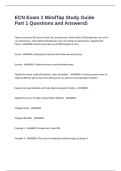
Farmer Jones has 100 acres of land. He can plant corn, which yields 100 bushels per acre, or he
can plant beans, which yield 40 bushels per acre. He chooses to plant beans. (Opportunity
Costs) - ANSWERS -Farmer Jones gives up 10,000 bushels of corn.
Scarce - ANSWERS -Having less resources than what we wish to have
Scarcity - ANSWERS -Limited resources and unlimited wants
Explain the classic trade-off between "guns and butter" - ANSWERS -If society spends more on
national defense (guns) then they will have less to spend on social programs (butter)
Explain why specialization and trade improve people's choices - ANSWERS -
Explain the source of large and persistent inflation - ANSWERS -
Marginal Costs - ANSWERS -
Marginal Benefits - ANSWERS -
Principle 1 - ANSWERS -People Face Trade Offs
Principle 2 - ANSWERS -The cost of something is what you give up to get it
, Principle 3 - ANSWERS -Rational People think at the margin
Principle 4 - ANSWERS -People respond to incentives
Principle 5 - ANSWERS -Trade can make everyone better off
Principle 6 - ANSWERS -Markets are usually a good way to organize economic activity
Principle 7 - ANSWERS -Governments can sometimes improve market outcomes
Principle 8 - ANSWERS -A country's standard of living depends on it's ability to produce goods
and services
Principle 9 - ANSWERS -Prices rise when the government prints too much money
Principle 10 - ANSWERS -Society faces a short run of trade offs between inflation and
unemployment
Economics - ANSWERS -Study of how society manages its scarce resources
Efficiency - ANSWERS -The property of society getting the most from its scarce resources
Equality - ANSWERS -The property of distributing economic prosperity uniformly among
society's members
Opportunity Cost - ANSWERS -Whatever is given up to get something else
Part 1 Questions and Answers5
Farmer Jones has 100 acres of land. He can plant corn, which yields 100 bushels per acre, or he
can plant beans, which yield 40 bushels per acre. He chooses to plant beans. (Opportunity
Costs) - ANSWERS -Farmer Jones gives up 10,000 bushels of corn.
Scarce - ANSWERS -Having less resources than what we wish to have
Scarcity - ANSWERS -Limited resources and unlimited wants
Explain the classic trade-off between "guns and butter" - ANSWERS -If society spends more on
national defense (guns) then they will have less to spend on social programs (butter)
Explain why specialization and trade improve people's choices - ANSWERS -
Explain the source of large and persistent inflation - ANSWERS -
Marginal Costs - ANSWERS -
Marginal Benefits - ANSWERS -
Principle 1 - ANSWERS -People Face Trade Offs
Principle 2 - ANSWERS -The cost of something is what you give up to get it
, Principle 3 - ANSWERS -Rational People think at the margin
Principle 4 - ANSWERS -People respond to incentives
Principle 5 - ANSWERS -Trade can make everyone better off
Principle 6 - ANSWERS -Markets are usually a good way to organize economic activity
Principle 7 - ANSWERS -Governments can sometimes improve market outcomes
Principle 8 - ANSWERS -A country's standard of living depends on it's ability to produce goods
and services
Principle 9 - ANSWERS -Prices rise when the government prints too much money
Principle 10 - ANSWERS -Society faces a short run of trade offs between inflation and
unemployment
Economics - ANSWERS -Study of how society manages its scarce resources
Efficiency - ANSWERS -The property of society getting the most from its scarce resources
Equality - ANSWERS -The property of distributing economic prosperity uniformly among
society's members
Opportunity Cost - ANSWERS -Whatever is given up to get something else