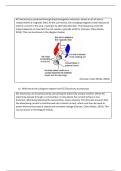
AC electricity is produced through electromagnetic induction, where a coil of wire is
rotated within a magnetic field. As the coil moves, the changing magnetic field induces an
electric current in the wire, causing it to alternate direction. The frequency of the AC
output depends on how fast the coil rotates, typically at 50 Hz (Canvas, Class Notes,
2024). This can be shown in the diagram below.
(Canvas, Class Notes, 2024).
b) With the aid of a diagram explain how DC Electricity is produced:
DC electricity can be produced by converting AC electricity using a rectifier. When AC
electricity passes through a commutator, it only allows the current to flow in one
direction, effectively blocking the reverse flow, due to polarity. This process ensures that
the alternating current is transformed into a direct current, which can then be used to
power devices that need a steady and constant voltage (Canvas, Class Notes, 2024). This
can be shown in the diagram below.
, (Canvas, Class Notes, 2024).
c) Undertake a practical experiment with an oscilloscope and a generator to
demonstrate the generation of both AC and DC Electricity.
Briefly describe your experiment and use photographs to record your findings
and observations.
When a DC supply was attached to the oscilloscope, it generated a straight line current
across the screen that flowed one way. This was supplied by connecting a 9V battery to
the oscilloscope. The oscilloscope screen shows a signal from a DC source at 10us. As
demonstrated below, when no supply is connected, the line does not sit at the starting
position, but it remains straight and appears further up on the screen.
rotated within a magnetic field. As the coil moves, the changing magnetic field induces an
electric current in the wire, causing it to alternate direction. The frequency of the AC
output depends on how fast the coil rotates, typically at 50 Hz (Canvas, Class Notes,
2024). This can be shown in the diagram below.
(Canvas, Class Notes, 2024).
b) With the aid of a diagram explain how DC Electricity is produced:
DC electricity can be produced by converting AC electricity using a rectifier. When AC
electricity passes through a commutator, it only allows the current to flow in one
direction, effectively blocking the reverse flow, due to polarity. This process ensures that
the alternating current is transformed into a direct current, which can then be used to
power devices that need a steady and constant voltage (Canvas, Class Notes, 2024). This
can be shown in the diagram below.
, (Canvas, Class Notes, 2024).
c) Undertake a practical experiment with an oscilloscope and a generator to
demonstrate the generation of both AC and DC Electricity.
Briefly describe your experiment and use photographs to record your findings
and observations.
When a DC supply was attached to the oscilloscope, it generated a straight line current
across the screen that flowed one way. This was supplied by connecting a 9V battery to
the oscilloscope. The oscilloscope screen shows a signal from a DC source at 10us. As
demonstrated below, when no supply is connected, the line does not sit at the starting
position, but it remains straight and appears further up on the screen.