RSK2602
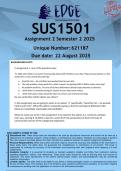
Assignment 1 Semester 2 2025
2 2025
Unique Number:
Due date: 20 August 2025
QUESTION 1
1.1 True – Operational failures from staff often stem from human error, intentional fraud, or
malicious acts such as data theft, all of which directly affect operational processes.
1.2 False – Technology and systems are internal drivers of operational risk, while external
drivers usually include regulatory changes, economic conditions, or natural disasters.
1.3 False – Operational risk does include human error, management failure, fraud, or control
weaknesses, but it excludes strategic and reputational risk, which are considered separate
categories.
1.4 False – Risk-indifferent attitudes accept increases in risk without demanding a change in
the risk/reward balance, which can be conducive to taking risks but without consideration of
potential benefits.
DISCLAIMER & TERMS OF USE
Educational Aid: These study notes are intended to be used as educational resources and should not be seen as a
replacement for individual research, critical analysis, or professional consultation. Students are encouraged to perform
their own research and seek advice from their instructors or academic advisors for specific assignment guidelines.
Personal Responsibility: While every effort has been made to ensure the accuracy and reliability of the information in
these study notes, the seller does not guarantee the completeness or correctness of all content. The buyer is
responsible for verifying the accuracy of the information and exercising their own judgment when applying it to their
assignments.
Academic Integrity: It is essential for students to maintain academic integrity and follow their institution's policies
regarding plagiarism, citation, and referencing. These study notes should be used as learning tools and sources of
inspiration. Any direct reproduction of the content without proper citation and acknowledgment may be considered
academic misconduct.
Limited Liability: The seller shall not be liable for any direct or indirect damages, losses, or consequences arising from
the use of these notes. This includes, but is not limited to, poor academic performance, penalties, or any other negative
consequences resulting from the application or misuse of the information provided.
, For additional support +27 81 278 3372
QUESTION 1
1.1 True – Operational failures from staff often stem from human error, intentional
fraud, or malicious acts such as data theft, all of which directly affect operational
processes.
1.2 False – Technology and systems are internal drivers of operational risk, while
external drivers usually include regulatory changes, economic conditions, or natural
disasters.
1.3 False – Operational risk does include human error, management failure, fraud, or
control weaknesses, but it excludes strategic and reputational risk, which are
considered separate categories.
1.4 False – Risk-indifferent attitudes accept increases in risk without demanding a
change in the risk/reward balance, which can be conducive to taking risks but
without consideration of potential benefits.
1.5 True – Self-insurance can be implemented through captive insurance
companies, which are owned and controlled by the insured organisation to cover its
own risks.
1.6 False – Risk appetite refers to the amount and type of risk an organisation is
willing to accept in pursuit of its objectives, not just what it is unwilling to lose.
1.7 False – The impact of risk exposures is typically rated as high, medium, or low,
while “probable,” “possible,” and “remote” are terms used for likelihood, not impact.
1.8 False – Risk transfer refers to shifting the financial consequences of a risk to a
third party, often via contracts or insurance, not the physical relocation of the risk.
1.9 False – The top-down approach starts with top management setting the tone and
framework, but it involves all organisational levels for effective risk management.
1.10 False – Value-at-Risk (VaR) measures the maximum expected loss over a
specific time horizon at a given confidence level under normal market conditions, not
extreme scenarios.
QUESTION 2
Assignment 1 Semester 2 2025
2 2025
Unique Number:
Due date: 20 August 2025
QUESTION 1
1.1 True – Operational failures from staff often stem from human error, intentional fraud, or
malicious acts such as data theft, all of which directly affect operational processes.
1.2 False – Technology and systems are internal drivers of operational risk, while external
drivers usually include regulatory changes, economic conditions, or natural disasters.
1.3 False – Operational risk does include human error, management failure, fraud, or control
weaknesses, but it excludes strategic and reputational risk, which are considered separate
categories.
1.4 False – Risk-indifferent attitudes accept increases in risk without demanding a change in
the risk/reward balance, which can be conducive to taking risks but without consideration of
potential benefits.
DISCLAIMER & TERMS OF USE
Educational Aid: These study notes are intended to be used as educational resources and should not be seen as a
replacement for individual research, critical analysis, or professional consultation. Students are encouraged to perform
their own research and seek advice from their instructors or academic advisors for specific assignment guidelines.
Personal Responsibility: While every effort has been made to ensure the accuracy and reliability of the information in
these study notes, the seller does not guarantee the completeness or correctness of all content. The buyer is
responsible for verifying the accuracy of the information and exercising their own judgment when applying it to their
assignments.
Academic Integrity: It is essential for students to maintain academic integrity and follow their institution's policies
regarding plagiarism, citation, and referencing. These study notes should be used as learning tools and sources of
inspiration. Any direct reproduction of the content without proper citation and acknowledgment may be considered
academic misconduct.
Limited Liability: The seller shall not be liable for any direct or indirect damages, losses, or consequences arising from
the use of these notes. This includes, but is not limited to, poor academic performance, penalties, or any other negative
consequences resulting from the application or misuse of the information provided.
, For additional support +27 81 278 3372
QUESTION 1
1.1 True – Operational failures from staff often stem from human error, intentional
fraud, or malicious acts such as data theft, all of which directly affect operational
processes.
1.2 False – Technology and systems are internal drivers of operational risk, while
external drivers usually include regulatory changes, economic conditions, or natural
disasters.
1.3 False – Operational risk does include human error, management failure, fraud, or
control weaknesses, but it excludes strategic and reputational risk, which are
considered separate categories.
1.4 False – Risk-indifferent attitudes accept increases in risk without demanding a
change in the risk/reward balance, which can be conducive to taking risks but
without consideration of potential benefits.
1.5 True – Self-insurance can be implemented through captive insurance
companies, which are owned and controlled by the insured organisation to cover its
own risks.
1.6 False – Risk appetite refers to the amount and type of risk an organisation is
willing to accept in pursuit of its objectives, not just what it is unwilling to lose.
1.7 False – The impact of risk exposures is typically rated as high, medium, or low,
while “probable,” “possible,” and “remote” are terms used for likelihood, not impact.
1.8 False – Risk transfer refers to shifting the financial consequences of a risk to a
third party, often via contracts or insurance, not the physical relocation of the risk.
1.9 False – The top-down approach starts with top management setting the tone and
framework, but it involves all organisational levels for effective risk management.
1.10 False – Value-at-Risk (VaR) measures the maximum expected loss over a
specific time horizon at a given confidence level under normal market conditions, not
extreme scenarios.
QUESTION 2