Garantie de satisfaction à 100% Disponible immédiatement après paiement En ligne et en PDF Tu n'es attaché à rien 4.2 TrustPilot
logo-home
Examen

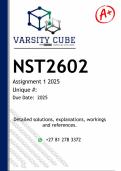
NST2602 Assignment 3 (COMPLETE ANSWERS) 2025 - DUE 27 July 2025

Vendu
7
Pages
16
Qualité
A+
Publié le
17-07-2025
Écrit en
2024/2025

NST2602 Assignment 3 (COMPLETE ANSWERS) 2025 - DUE 27 July 2025; 100% TRUSTED Complete, trusted solutions and explanations. For assistance, Whats-App 0.6.7-1.7.1-1.7.3.9. Ensure your success with us.. Question 1 [30 marks] 1.1 Define innovation in the context of technological advancement and provide two modern-day examples that demonstrate its impact on society. (2) 1.2 How can Indigenous Knowledge Systems contribute to solving contemporary environmental problems? (3) 1.3 Outline the phases of problem-solving in technology education and explain how each supports creative thinking. (5) 1.4 What is procedural knowledge, and how does it differ from conceptual knowledge in the context of learning technology? (3) 1.5 Discuss how integrating Indigenous practices into design thinking can influence the outcome of engineering projects. (2) 1.6 Highlight two significant milestones in the evolution of African iron-smelting technologies and their role in technological heritage. (4) 1.7 Why is it essential to develop analytical thinking skills in the design process? Support your answer with one example. (3) 1.8 Compare the influence of Chinese and Egyptian ancient technologies on modern innovations. (4) 1.9 Explain how traditional customs can shape the adoption of new technologies in diverse societies. (4) 1.1 Discuss how technological innovation affects social relationships in modern communities. (2) 1.2 How can traditional agricultural knowledge systems contribute to sustainable farming practices today? (3) 1.3 Identify five common stages in solving a technological problem and briefly explain how each contributes to the final outcome. (5) 1.4 What is the difference between procedural and conceptual knowledge in the context of teaching technology? Provide an example of each. (3) 1.5 In what ways can Indigenous Knowledge Systems help reduce technological dependency on imported solutions? (2) 1.6 Outline the major achievements in early African ironworking and explain their importance for understanding the continent’s scientific history. (4) 1.7 How can critical thinking be fostered in technology classrooms to enhance learner problem-solving abilities? (3) 1.8 Compare the influence of Roman engineering techniques and Egyptian construction practices on modern infrastructure. (4) 1.9 Explain how cultural values can shape the development and use of new technologies in different societies. (4) Question 2 [24 marks] 2.1 Suggest a technological innovation, rooted in Indigenous Knowledge Systems, that could improve food storage in rural communities. (4) 2.2 Design an implementation plan for using solar-powered educational tools in a no-electricity rural school. (6) 2.3 How does the incorporation of IKS change the way we view technological progress in African contexts? (4) 2.4 Discuss three key advantages and three possible limitations of using the design process in developing classroom technologies. (6) 2.5 What ethical issues should be considered when developing educational apps that may reinforce social biases? (4) Question 3 [23 marks] 3.1 Discuss how the introduction of factory-based production during the Industrial Revolution changed the structure of family life and labour. (4) 3.1 Critique the role of the Industrial Revolution in advancing and hindering societal progress. (4) 3.2 Evaluate the sustainability of mechanical and electrical technologies in meeting energy demands. (4) 3.3 Assess current efforts to reduce bias in technological systems. Are they effective? (5) 3.4 Suggest a method to preserve African indigenous metallurgical techniques in modern engineering. (5) 3.5 Outline a strategy to reduce the environmental impact of energy-intensive industries. (5) 3.2 Compare the environmental implications of relying on solar energy versus diesel generators in remote communities. (4) 3.3 Identify and explain two recent approaches to eliminating algorithmic bias in artificial intelligence systems. (5) 3.4 Propose an educational programme to transfer traditional African metalcraft knowledge into vocational technical schools. (5) 2.1 Identify a technological solution that uses Indigenous Knowledge Systems (IKS) to improve rural education. (4) 2.2 Develop a basic plan for introducing renewable energy into a low-income community. (6) 2.3 Analyse the influence of Indigenous Knowledge Systems (IKS) on the development of modern technologies. (4) 2.4 Evaluate the strengths and weaknesses of the design process in technology education. (6) 2.5 What factors contribute to bias in technology, and how does this affect society? 3.5 Suggest three practical steps that heavy industries can take to reduce carbon emissions while maintaining productivity. (5) 1.1 Define the term technology and give two examples of how it is used in society. (2) 1.2 Describe the role of Indigenous Knowledge Systems (IKS) in the development of technology. (3) 1.3 List and briefly explain the key steps in the design process in technology education. (5) 1.4 What is conceptual knowledge, and why is it important in technology education? (3) 1.5 What is the significance of Indigenous Knowledge Systems (IKS) for modern engineering and design practices? (2) 1.6 Describe the historical development of African metallurgy and explain its relevance to modern technology. (4) 1.7 Explain how critical thinking contributes to the design process. (3) 1.8 Compare the technological contributions of ancient Greek and Roman societies. (4) 1.9 Discuss the relationship between culture and technology. (4) 2.1 Suggest a culturally sensitive mobile application idea that could improve healthcare delivery in Indigenous communities. (4) 2.2 Design a step-by-step implementation plan for integrating solar-powered learning centers in remote schools. (6) 2.3 Examine how Indigenous Knowledge contributes to climate-resilient agriculture using a recent case study. (4) 2.4 Assess the effectiveness of current design thinking models used in South African classrooms. (6) 2.5 Identify and explain three ethical concerns that arise from artificial intelligence and its potential bias in technological systems. (5) Question 4 [23 marks] Scenario: A coastal community of 7,000 people faces severe flooding due to rising sea levels and poor waste management practices. The community has limited access to clean drinking water, modern sanitation, and sustainable construction materials. A team of engineers and local educators has been appointed to develop disaster-resilient infrastructure that respects local building traditions. Their goal is to integrate eco-friendly technologies while strengthening local skills and addressing environmental and cultural needs. 3.1 Discuss how digital technology has both empowered and disadvantaged communities during the Fourth Industrial Revolution. (4) 3.2 Critically examine how nanotechnology and biotechnology compare in terms of long-term energy sustainability. (4) 3.3 Propose two interventions that can improve transparency and fairness in algorithmic decision-making systems. (5) 3.4 Suggest a method for documenting and teaching African traditional forging techniques in higher education institutions. (5) 3.5 Recommend three environmentally friendly practices that industries can adopt to reduce carbon emissions. (5) 4.1 Examine the environmental, technological, and infrastructural challenges posed by the flooding in this community. (4) 4.2 What considerations should guide the development of eco-friendly housing that respects the cultural identity of the community? (4) 4.3 Analyse how neglecting community input in technology design can lead to ineffective or rejected solutions. (5) 4.4 What innovative funding approaches (e.g. green bonds, local cooperatives) can support the construction of resilient infrastructure in underserved areas? (5) 4.5 Suggest a participatory education programme that combines modern science with Indigenous building methods to support the local population. (5) A rural village with 10 000 residents depends on non-renewable energy sources such as paraffin lamps, wood, and coal for electricity and cooking. These practices have led to deforestation, health issues, and high energy costs. The village lacks modern infrastructure such as proper roads, schools, and healthcare facilities. A technology education team, including local leaders, is tasked with introducing renewable energy options (solar, wind, bioenergy) to improve living conditions while respecting cultural practices. Challenges include: reliance on tradition, high initial costs, potential design bias, sustainability of equipment, and integrating IKS with modern solutions. Answer the following based on the scenario: 4.1 Identify and analyse the social, cultural, and environmental challenges caused by dependence on non-renewable energy sources. (4) 4.2 What should the team consider when designing renewable energy solutions tailored for this village? (4) 4.3 Critically assess potential biases in the design and implementation of renewable energy technologies in rural areas. (5) 4.4 Examine the financial feasibility of installing renewable energy in the village. What funding models can be used? (5) 4.5 Propose a strategy led by the community to successfully implement renewable energy solutions. (5) A mountain-based settlement with 8000 residents lacks access to the national electricity grid. The community relies on diesel generators, causing noise, air pollution, and high fuel costs. The local council, in partnership with an engineering university, proposes installing micro-hydro systems from nearby rivers. However, they must overcome the following challenges: community resistance to change, a lack of technical skills, potential ecological disruption, cultural sensitivity regarding sacred water sources, and the long-term maintenance of the new systems. 4.1 Describe the cultural, environmental, and technical challenges of shifting from diesel to micro-hydro energy in the settlement. (4) 4.2 What steps can the project team take to ensure that local beliefs and traditions are respected in the planning process? (4) 4.3 Analyse the social consequences of excluding community voices in rural energy transition projects. (5) 4.4 Discuss how maintenance, training, and knowledge transfer should be addressed to ensure the sustainability of the micro-hydro system. (5) 4.5 Develop a participatory model that includes local elders, youth, and educators in managing the renewable energy project. (5)

Montrer plus Lire moins
Établissement
Cours


Oups ! Impossible de charger votre document. Réessayez ou contactez le support.

Livre connecté

École, étude et sujet

Établissement
Cours

Infos sur le Document

Publié le
17 juillet 2025
Nombre de pages
16
Écrit en
2024/2025
Type
Examen
Contenu
Questions et réponses

Sujets

Aperçu du contenu

NST2602
Assignment 3 2025
Unique number:

Due Date: 27 July 2025
QUESTION 1

1.1 Define the term technology and give two examples of how it is used in society.

Technology means using skills, knowledge, and tools to solve problems and create useful
products. The word comes from the Greek word techné, which means skill or craft, and
logos, which means study. Technology helps people improve their daily lives by building
tools and systems. It is not just machines, but also includes ideas and methods. For
example, using mobile phones to communicate quickly is a form of technology. Another
example is using farming machines to grow more food. Technology shapes the way we live,
work, and interact with the world.


1.2 Describe the role of Indigenous Knowledge Systems (IKS) in the development of
technology.

Indigenous Knowledge Systems (IKS) are based on local traditions and experiences passed
down through generations. This knowledge helps communities survive by using natural
Terms of use
resources wisely. IKS plays a big role in technology development
By making use because it offers
of this document localto:
you agree
 Use this document as a guide for learning, comparison and reference purpose,
Terms of use
 Not to duplicate, reproduce and/or misrepresent the contents of this document as your own work,
By making use of this document you agree to:
 Use this document
Fully accept the consequences
solely as a guide forshould you plagiarise
learning, reference,or and
misuse this document.
comparison purposes,
 Ensure originality of your own work, and fully accept the consequences should you plagiarise or misuse this document.
 Comply with all relevant standards, guidelines, regulations, and legislation governing academic and written work.

Disclaimer
Great care has been taken in the preparation of this document; however, the contents are provided "as is" without any express or
implied representations or warranties. The author accepts no responsibility or liability for any actions taken based on the
information contained within this document. This document is intended solely for comparison, research, and reference purposes.
Reproduction, resale, or transmission of any part of this document, in any form or by any means, is strictly prohibited.

2,66 €
Accéder à l'intégralité du document:

Garantie de satisfaction à 100%
Disponible immédiatement après paiement
En ligne et en PDF
Tu n'es attaché à rien

Avis des acheteurs vérifiés

Affichage de tous les avis
5 mois de cela

5,0

1 revues

5
1
4
0
3
0
2
0
1
0
Avis fiables sur Stuvia

Tous les avis sont réalisés par de vrais utilisateurs de Stuvia après des achats vérifiés.

Faites connaissance avec le vendeur

Seller avatar
Les scores de réputation sont basés sur le nombre de documents qu'un vendeur a vendus contre paiement ainsi que sur les avis qu'il a reçu pour ces documents. Il y a trois niveaux: Bronze, Argent et Or. Plus la réputation est bonne, plus vous pouvez faire confiance sur la qualité du travail des vendeurs.
EduPal University of South Africa (Unisa)
S'abonner Vous devez être connecté afin de pouvoir suivre les étudiants ou les formations
Vendu
149208
Membre depuis
7 année
Nombre de followers
35996
Documents
4352
Dernière vente
3 heures de cela

4,2

13562 revues

5
7808
4
2689
3
1791
2
455
1
819

Récemment consulté par vous

Pourquoi les étudiants choisissent Stuvia

Créé par d'autres étudiants, vérifié par les avis

Une qualité sur laquelle compter : rédigé par des étudiants qui ont réussi et évalué par d'autres qui ont utilisé ce document.

Le document ne convient pas ? Choisis un autre document

Aucun souci ! Tu peux sélectionner directement un autre document qui correspond mieux à ce que tu cherches.

Paye comme tu veux, apprends aussitôt

Aucun abonnement, aucun engagement. Paye selon tes habitudes par carte de crédit et télécharge ton document PDF instantanément.

Student with book image

“Acheté, téléchargé et réussi. C'est aussi simple que ça.”

Alisha Student

Foire aux questions