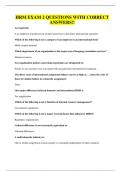
HRM EXAM 2 QUESTIONS WITH CORRECT
ANSWERS!!
An expatriate
Is an employee transferred out of their home base to the firm's international operation.
Which of the following is not a category of an employee in an international firm?
Multi-country national
Which department of an organization is the major user of language translation services?
Human resources
Tax equalization policies concerning expatriates are designated to:
Ensure no tax incentives are associated with any particular international assignment.
The direct costs of international assignment failures can be as high as __ times the costs of
those for similar failure in a domestic assignment:
Three
One major difference between domestic and international HRM is
Tax equalization
Which of the following is not a function of internal resource management?
Government regulations
Which of the following is not a major external factor that influences IHRM?
Regulatory requirements
Cultural difference is not necessarily equivalent to:
National differences
A multi domestic industry is:
One in which competition in each country is essentially independent of other countries
,Examples of a global industry include all of the following except:
Insurance
Series of linked domestic industries in which rivals compete against each other on a
worldwide basis is:
Global Industry
Emnic refers to which kind of specific aspect of concepts or behaviours?
Culture
What is a key driver for firms seeking international markets?
A small home market
Which ratio is not part of "index of transnationality"?
Foreign debt to total debt
Which of the following is a global mindset?
To formulate and implement HR policies that develop globally oriented staff.
An asymmetric event is
Terrorist attack on 9/11
All of the following is a difference between international and domestic HR
Less involvement in employee lives
What activity in international human resource would not be required in a domestic
environment?
Tax equalization
As foreign subsidiaries matures the local HR activities:
Have broadening responsibilities
Which three dimensions are presented in Morgan's model of IHRM?
, Types of employees, countries and human resource activities.
Differences between domestic and international HRM include:
The cultural environment, the extent of reliance of the multi-national on its home country or
domestic market and the attitudes of senior management.
Senior managers with little international experience:
Assume that there is a great deal of transferability between domestic and international HRM
practices.
Successful internationalizing the HR function require all except:
Global mindset
In Porter's value-chain model:
HRM is described as a support activity
HRM in the multinational context contains an overlap between elements of:
Cross-cultural management, comparable human resource and industrial relation systems.
A Japanese citizen working in Hong Jong for a Japanese multinational would be classified
as:
A parent country national (PCN)
HRM activities include all of the below EXCEPT:
Personal family planning
International HRM is reflected in
The need for a broader perspective
As a foreign subsidiary matures:
The local HR unit's responsibilities for planning, training and compensation would broaden.
Cross-cultural management research is based on the assumption that:
ANSWERS!!
An expatriate
Is an employee transferred out of their home base to the firm's international operation.
Which of the following is not a category of an employee in an international firm?
Multi-country national
Which department of an organization is the major user of language translation services?
Human resources
Tax equalization policies concerning expatriates are designated to:
Ensure no tax incentives are associated with any particular international assignment.
The direct costs of international assignment failures can be as high as __ times the costs of
those for similar failure in a domestic assignment:
Three
One major difference between domestic and international HRM is
Tax equalization
Which of the following is not a function of internal resource management?
Government regulations
Which of the following is not a major external factor that influences IHRM?
Regulatory requirements
Cultural difference is not necessarily equivalent to:
National differences
A multi domestic industry is:
One in which competition in each country is essentially independent of other countries
,Examples of a global industry include all of the following except:
Insurance
Series of linked domestic industries in which rivals compete against each other on a
worldwide basis is:
Global Industry
Emnic refers to which kind of specific aspect of concepts or behaviours?
Culture
What is a key driver for firms seeking international markets?
A small home market
Which ratio is not part of "index of transnationality"?
Foreign debt to total debt
Which of the following is a global mindset?
To formulate and implement HR policies that develop globally oriented staff.
An asymmetric event is
Terrorist attack on 9/11
All of the following is a difference between international and domestic HR
Less involvement in employee lives
What activity in international human resource would not be required in a domestic
environment?
Tax equalization
As foreign subsidiaries matures the local HR activities:
Have broadening responsibilities
Which three dimensions are presented in Morgan's model of IHRM?
, Types of employees, countries and human resource activities.
Differences between domestic and international HRM include:
The cultural environment, the extent of reliance of the multi-national on its home country or
domestic market and the attitudes of senior management.
Senior managers with little international experience:
Assume that there is a great deal of transferability between domestic and international HRM
practices.
Successful internationalizing the HR function require all except:
Global mindset
In Porter's value-chain model:
HRM is described as a support activity
HRM in the multinational context contains an overlap between elements of:
Cross-cultural management, comparable human resource and industrial relation systems.
A Japanese citizen working in Hong Jong for a Japanese multinational would be classified
as:
A parent country national (PCN)
HRM activities include all of the below EXCEPT:
Personal family planning
International HRM is reflected in
The need for a broader perspective
As a foreign subsidiary matures:
The local HR unit's responsibilities for planning, training and compensation would broaden.
Cross-cultural management research is based on the assumption that: