[TYPE THE COMPANY NAME]
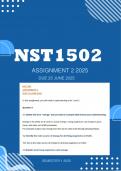
MIP1502 Assignment 2
(COMPLETE ANSWERS)
2025 - DUE 30 June
2025
NO PLAGIARISM
[Pick the date]
[Type the abstract of the document here. The abstract is typically a short summary of the contents of
the document. Type the abstract of the document here. The abstract is typically a short summary of
the contents of the document.]
,Exam (elaborations)
MIP1502 Assignment 2 (COMPLETE
ANSWERS) 2025 - DUE 30 June 2025
Course
Mathematics for Intermediate II (MIP1502)
Institution
University Of South Africa (Unisa)
Book
Mathematics for Intermediate Teachers
MIP1502 Assignment 2 (COMPLETE ANSWERS) 2025 - DUE 30 June 2025;
100% TRUSTED Complete, trusted solutions and explanations.
Question 1 1.1 Algebra is often introduced in primary school through
patterns, number sentences, and symbolic reasoning. Critically evaluate the
rationale for introducing algebraic thinking in the Foundation and
Intermediate Phases. In your response: 1.1.1 Discuss at least two
pedagogical benefits of early algebra exposure. (4)
1.1.1 Pedagogical Benefits of Early Algebra Exposure
Introducing algebraic thinking in the Foundation and Intermediate Phases offers significant
pedagogical benefits, laying a strong groundwork for future mathematical success. Two key
benefits are:
Enhanced Cognitive Skills and Problem-Solving: Early exposure to algebraic thinking
cultivates essential cognitive skills such as logical reasoning, critical thinking, and
problem-solving. By engaging with patterns, number sentences, and symbolic
representations, children learn to analyze relationships, identify underlying structures,
and generalize mathematical ideas. For instance, when students explore numerical
sequences and predict what comes next, they are developing the ability to recognize
patterns and formulate rules, which is fundamental to algebraic reasoning. This process
encourages them to break down complex problems into manageable steps, think critically
about different solution paths, and justify their conclusions. These skills are not only
crucial for advanced mathematics but are transferable to various other academic subjects
and real-life situations, fostering a more analytical and adaptable mindset.
Smooth Transition to Formal Algebra and Higher Mathematics: One of the primary
rationales for early algebra is to bridge the often-difficult gap between arithmetic and
formal algebra. By introducing algebraic concepts implicitly through activities like
identifying missing numbers in equations (e.g., $3 + \text{_} = 7$), exploring the
, meaning of the equal sign as equivalence rather than "the answer," and working with
variables in concrete contexts, students develop an intuitive understanding of algebraic
principles. This gradual introduction helps demystify algebra, making the transition to
more abstract symbolic manipulation in later grades less daunting. It allows children to
build a foundational understanding of concepts like variables, relationships, and
generalization, which are essential for success in higher-level mathematics, science,
technology, engineering, and other STEM fields. Without this early foundation, students
often struggle with the abrupt shift to abstract algebraic notation and problem-solving.
The introduction of algebraic thinking in the Foundation and Intermediate Phases (early primary
school years) is a pedagogical shift that moves beyond traditional arithmetic to foster a deeper,
more generalized understanding of mathematics. The rationale for this early exposure is rooted in
the belief that algebraic thinking is not merely a set of procedures for solving equations, but a
fundamental way of reasoning about quantities, relationships, and patterns. It aims to build a
strong conceptual foundation that prepares students for more formal algebra in later grades and
equips them with essential problem-solving skills applicable across various disciplines.
1.1.1 Pedagogical Benefits of Early Algebra Exposure:
1. Develops Relational Thinking and Understanding of Equality: Traditionally, the
equal sign (=) is often misinterpreted by young learners as a prompt to "get the answer."
Early algebra exposure actively challenges this misconception by emphasizing the
concept of equality as a balance or equivalence between two sides of an equation.
Through activities like balancing scales or true/false number sentences (e.g., 5+2=3+4),
students learn that the equal sign signifies "the same as," promoting relational thinking
about numbers and operations. This foundational understanding is crucial for later
algebraic manipulation where students need to understand that operations performed on
one side of an equation must also be performed on the other to maintain equality.
2. Fosters Generalization and Pattern Recognition: Algebraic thinking is intrinsically
linked to recognizing, describing, and extending patterns. In the Foundation and
Intermediate Phases, children naturally engage with patterns in shapes, numbers, and
sequences. Early algebra leverages this natural curiosity by guiding students to generalize
these patterns into rules or relationships. For example, by observing the pattern 2,4,6,8,...,
students can identify the rule "add 2 to the previous term." This process of identifying a
rule that applies to various instances is a core aspect of algebraic generalization,
preparing them for abstract symbolic representation later on.
3. Enhances Problem-Solving and Critical Thinking Skills: Early algebra encourages a
systematic approach to problem-solving. Instead of just finding a numerical answer,
students are prompted to analyze the underlying relationships within a problem. They
learn to identify unknown quantities, represent them with symbols (even if informal
MIP1502 Assignment 2
(COMPLETE ANSWERS)
2025 - DUE 30 June
2025
NO PLAGIARISM
[Pick the date]
[Type the abstract of the document here. The abstract is typically a short summary of the contents of
the document. Type the abstract of the document here. The abstract is typically a short summary of
the contents of the document.]
,Exam (elaborations)
MIP1502 Assignment 2 (COMPLETE
ANSWERS) 2025 - DUE 30 June 2025
Course
Mathematics for Intermediate II (MIP1502)
Institution
University Of South Africa (Unisa)
Book
Mathematics for Intermediate Teachers
MIP1502 Assignment 2 (COMPLETE ANSWERS) 2025 - DUE 30 June 2025;
100% TRUSTED Complete, trusted solutions and explanations.
Question 1 1.1 Algebra is often introduced in primary school through
patterns, number sentences, and symbolic reasoning. Critically evaluate the
rationale for introducing algebraic thinking in the Foundation and
Intermediate Phases. In your response: 1.1.1 Discuss at least two
pedagogical benefits of early algebra exposure. (4)
1.1.1 Pedagogical Benefits of Early Algebra Exposure
Introducing algebraic thinking in the Foundation and Intermediate Phases offers significant
pedagogical benefits, laying a strong groundwork for future mathematical success. Two key
benefits are:
Enhanced Cognitive Skills and Problem-Solving: Early exposure to algebraic thinking
cultivates essential cognitive skills such as logical reasoning, critical thinking, and
problem-solving. By engaging with patterns, number sentences, and symbolic
representations, children learn to analyze relationships, identify underlying structures,
and generalize mathematical ideas. For instance, when students explore numerical
sequences and predict what comes next, they are developing the ability to recognize
patterns and formulate rules, which is fundamental to algebraic reasoning. This process
encourages them to break down complex problems into manageable steps, think critically
about different solution paths, and justify their conclusions. These skills are not only
crucial for advanced mathematics but are transferable to various other academic subjects
and real-life situations, fostering a more analytical and adaptable mindset.
Smooth Transition to Formal Algebra and Higher Mathematics: One of the primary
rationales for early algebra is to bridge the often-difficult gap between arithmetic and
formal algebra. By introducing algebraic concepts implicitly through activities like
identifying missing numbers in equations (e.g., $3 + \text{_} = 7$), exploring the
, meaning of the equal sign as equivalence rather than "the answer," and working with
variables in concrete contexts, students develop an intuitive understanding of algebraic
principles. This gradual introduction helps demystify algebra, making the transition to
more abstract symbolic manipulation in later grades less daunting. It allows children to
build a foundational understanding of concepts like variables, relationships, and
generalization, which are essential for success in higher-level mathematics, science,
technology, engineering, and other STEM fields. Without this early foundation, students
often struggle with the abrupt shift to abstract algebraic notation and problem-solving.
The introduction of algebraic thinking in the Foundation and Intermediate Phases (early primary
school years) is a pedagogical shift that moves beyond traditional arithmetic to foster a deeper,
more generalized understanding of mathematics. The rationale for this early exposure is rooted in
the belief that algebraic thinking is not merely a set of procedures for solving equations, but a
fundamental way of reasoning about quantities, relationships, and patterns. It aims to build a
strong conceptual foundation that prepares students for more formal algebra in later grades and
equips them with essential problem-solving skills applicable across various disciplines.
1.1.1 Pedagogical Benefits of Early Algebra Exposure:
1. Develops Relational Thinking and Understanding of Equality: Traditionally, the
equal sign (=) is often misinterpreted by young learners as a prompt to "get the answer."
Early algebra exposure actively challenges this misconception by emphasizing the
concept of equality as a balance or equivalence between two sides of an equation.
Through activities like balancing scales or true/false number sentences (e.g., 5+2=3+4),
students learn that the equal sign signifies "the same as," promoting relational thinking
about numbers and operations. This foundational understanding is crucial for later
algebraic manipulation where students need to understand that operations performed on
one side of an equation must also be performed on the other to maintain equality.
2. Fosters Generalization and Pattern Recognition: Algebraic thinking is intrinsically
linked to recognizing, describing, and extending patterns. In the Foundation and
Intermediate Phases, children naturally engage with patterns in shapes, numbers, and
sequences. Early algebra leverages this natural curiosity by guiding students to generalize
these patterns into rules or relationships. For example, by observing the pattern 2,4,6,8,...,
students can identify the rule "add 2 to the previous term." This process of identifying a
rule that applies to various instances is a core aspect of algebraic generalization,
preparing them for abstract symbolic representation later on.
3. Enhances Problem-Solving and Critical Thinking Skills: Early algebra encourages a
systematic approach to problem-solving. Instead of just finding a numerical answer,
students are prompted to analyze the underlying relationships within a problem. They
learn to identify unknown quantities, represent them with symbols (even if informal