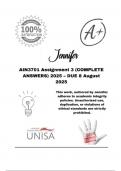
,MIP1502 Assignment 2 (COMPLETE ANSWERS)
2025 (720991) - DUE 30 June 2025; 100%
TRUSTED Complete, trusted solutions and
explanations.
MULTIPLE CHOICE,ASSURED EXCELLENCE
Question 1 1.1 Algebra is often introduced in primary school
through patterns, number sentences, and symbolic reasoning.
Critically evaluate the rationale for introducing algebraic
thinking in the Foundation and Intermediate Phases. In your
response: 1.1.1 Discuss at least two pedagogical benefits of
early algebra exposure. (4) 1.1.2 Identify one common
misconception learners may develop and explain how it can be
addressed. (3) 1.1.3 Justify how early algebra supports
progression into formal algebra in later grades. (3) 1.2 Many
learners struggle with the concept of multiplying negative
numbers. Design a mini-lesson (not just explanations) that
includes: 1.2.1 A real-world context (2) 1.2.2 A visual model (2)
1.2.3 A pattern-based reasoning approach (2) 1.2.4 Explain how
each method supports conceptual understanding. (4) [20]
Question 2 2.1 Translate the following real-world scenarios into
algebraic expressions or equations. Then solve them. 2.1.1 A
machine depreciates in value by 15% annually. If it was worth
R120,000 initially, what is its value after 3 years? (4) 2.1.2 A
recipe calls for 2 parts flour, 3 parts sugar, and 5 parts water. If
you have 1.2 kg of sugar, how much flour and water are needed
, to maintain the ratio?. (4) 2.1.3 A plumber charges a call-out fee
and an hourly rate. A 3-hour job costs R870, and a 5-hour job
costs R1,250. Determine the call-out fee and hourly rate. (6) 2.2
Create a real-world context for the equation: 0.75
Question 1
1.1 Algebra in the Foundation and Intermediate Phases
1.1.1 Two Pedagogical Benefits of Early Algebra Exposure (4)
1. Development of Generalisation Skills: Early exposure to
algebra helps learners recognise patterns and
relationships, promoting generalisation. This encourages
logical thinking and the ability to express mathematical
rules symbolically.
2. Bridging Arithmetic and Algebra: Introducing algebra early
creates a natural transition from arithmetic to algebraic
thinking. Learners begin to understand unknowns,
variables, and the structure of mathematical sentences,
which supports future abstract reasoning.
1.1.2 One Common Misconception and How to Address It (3)
2025 (720991) - DUE 30 June 2025; 100%
TRUSTED Complete, trusted solutions and
explanations.
MULTIPLE CHOICE,ASSURED EXCELLENCE
Question 1 1.1 Algebra is often introduced in primary school
through patterns, number sentences, and symbolic reasoning.
Critically evaluate the rationale for introducing algebraic
thinking in the Foundation and Intermediate Phases. In your
response: 1.1.1 Discuss at least two pedagogical benefits of
early algebra exposure. (4) 1.1.2 Identify one common
misconception learners may develop and explain how it can be
addressed. (3) 1.1.3 Justify how early algebra supports
progression into formal algebra in later grades. (3) 1.2 Many
learners struggle with the concept of multiplying negative
numbers. Design a mini-lesson (not just explanations) that
includes: 1.2.1 A real-world context (2) 1.2.2 A visual model (2)
1.2.3 A pattern-based reasoning approach (2) 1.2.4 Explain how
each method supports conceptual understanding. (4) [20]
Question 2 2.1 Translate the following real-world scenarios into
algebraic expressions or equations. Then solve them. 2.1.1 A
machine depreciates in value by 15% annually. If it was worth
R120,000 initially, what is its value after 3 years? (4) 2.1.2 A
recipe calls for 2 parts flour, 3 parts sugar, and 5 parts water. If
you have 1.2 kg of sugar, how much flour and water are needed
, to maintain the ratio?. (4) 2.1.3 A plumber charges a call-out fee
and an hourly rate. A 3-hour job costs R870, and a 5-hour job
costs R1,250. Determine the call-out fee and hourly rate. (6) 2.2
Create a real-world context for the equation: 0.75
Question 1
1.1 Algebra in the Foundation and Intermediate Phases
1.1.1 Two Pedagogical Benefits of Early Algebra Exposure (4)
1. Development of Generalisation Skills: Early exposure to
algebra helps learners recognise patterns and
relationships, promoting generalisation. This encourages
logical thinking and the ability to express mathematical
rules symbolically.
2. Bridging Arithmetic and Algebra: Introducing algebra early
creates a natural transition from arithmetic to algebraic
thinking. Learners begin to understand unknowns,
variables, and the structure of mathematical sentences,
which supports future abstract reasoning.
1.1.2 One Common Misconception and How to Address It (3)