ATI - Mental Health
Study online at https://quizlet.com/_9jm55b
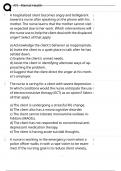
1. A hospitalized client becomes angry and belligerent a
toward a nurse after speaking on the phone with his b
mother. The nurse learns that the mother cannot visit c
as expected due to her work. Which interventions will d
the nurse use to help the client deal with the displaced
anger? Select all that apply
a) Acknowledge the client's behavior as inappropriate.
b) Invite the client to a quiet place to talk after he has
settled down.
c) Explore the client's unmet needs.
d) Assist the client in identifying alternate ways of ap-
proaching the problem.
e) Suggest that the client direct the anger at his moth-
er's employer.
2. The nurse is caring for a client with severe depression. c
In which conditions would the nurse anticipate the use d
of electroconvulsive therapy (ECT) as an option? Select e
all that apply
a) The client is undergoing a stressful life change.
b) The client also has a neurocognitive disorder.
c) The client cannot tolerate monoamine oxidase in-
hibitors (MAOIs).
d) The client has not responded to conventional anti-
depressant medication therapy.
e) The client is having acute suicidal thoughts.
3. A nurse is working in the emergency room when a b
police officer walks in with a rape victim to be exam- c
ined. If the nursing goal is to reduce client anxiety,
, ATI - Mental Health
Study online at https://quizlet.com/_9jm55b
which interventions would be appropriate? Select all d
that apply e
a) Begin the examination immediately in order to get
it behind her.
b) Allow a third party to be present if the client requests
it.
c) Assure the client of safety in the examination room.
d) Ask factual questions to determine the type of as-
sault.
e) Admit the client to the treatment area right away.
f) Touch the client early on demonstrating the nurse is
supportive.
4. The nurse is meeting a client on the mental health unit. d
When beginning a therapeutic relationship, which f
nursing actions are appropriate? Select all that apply
a) Discuss the client's feelings with family members.
b) Meet the needs and specific desires of the client.
c) Provide health advice to the client.
d) Help the client explore different problem-solving
techniques.
e) Exchange social media information with the client.
f) Encourage the practice of new coping skills.
5. A nurse is explaining client rights for psychiatric pa- a
tients to a client who has voluntarily sought admission b
to an inpatient psychiatric facility. Which rights would c
the nurse include in the discussion? Select all that ap- d
ply
a) Right to refuse treatment
, ATI - Mental Health
Study online at https://quizlet.com/_9jm55b
b) Right to a written treatment plan
c) Right to personal mail
d) Right to confidentiality
e) Right to obtain disability benefits
f) Right to select health care team members
6. In the emergency department, a client reveals to the a
nurse a lethal plan for dying by suicide and agrees to c
a voluntary admission to the psychiatric unit. Which e
information would the nurse discuss with the client to
answer the question "How long do I have to stay here?"
Select all that apply
a) "Let's talk more after the health care team has as-
sessed you."
b) "You need legal representation to help you make an
informed decision."
c) "You may leave the hospital at any time unless you're
suicidal or homicidal or unable to meet your basic
needs."
d) "Once you've signed the papers, you are required to
follow the treatment plan."
e) "Because you have stated that you want to hurt
yourself, you must be safe before being discharged."
f) "All clients need a court hearing before leaving the
hospital."
7. A nurse has developed a therapeutic relationship with b
a client who has an addiction disorder. Which client be- c
haviors would indicate that the therapeutic interaction e
is in the working phase? Select all that apply f
Study online at https://quizlet.com/_9jm55b
1. A hospitalized client becomes angry and belligerent a
toward a nurse after speaking on the phone with his b
mother. The nurse learns that the mother cannot visit c
as expected due to her work. Which interventions will d
the nurse use to help the client deal with the displaced
anger? Select all that apply
a) Acknowledge the client's behavior as inappropriate.
b) Invite the client to a quiet place to talk after he has
settled down.
c) Explore the client's unmet needs.
d) Assist the client in identifying alternate ways of ap-
proaching the problem.
e) Suggest that the client direct the anger at his moth-
er's employer.
2. The nurse is caring for a client with severe depression. c
In which conditions would the nurse anticipate the use d
of electroconvulsive therapy (ECT) as an option? Select e
all that apply
a) The client is undergoing a stressful life change.
b) The client also has a neurocognitive disorder.
c) The client cannot tolerate monoamine oxidase in-
hibitors (MAOIs).
d) The client has not responded to conventional anti-
depressant medication therapy.
e) The client is having acute suicidal thoughts.
3. A nurse is working in the emergency room when a b
police officer walks in with a rape victim to be exam- c
ined. If the nursing goal is to reduce client anxiety,
, ATI - Mental Health
Study online at https://quizlet.com/_9jm55b
which interventions would be appropriate? Select all d
that apply e
a) Begin the examination immediately in order to get
it behind her.
b) Allow a third party to be present if the client requests
it.
c) Assure the client of safety in the examination room.
d) Ask factual questions to determine the type of as-
sault.
e) Admit the client to the treatment area right away.
f) Touch the client early on demonstrating the nurse is
supportive.
4. The nurse is meeting a client on the mental health unit. d
When beginning a therapeutic relationship, which f
nursing actions are appropriate? Select all that apply
a) Discuss the client's feelings with family members.
b) Meet the needs and specific desires of the client.
c) Provide health advice to the client.
d) Help the client explore different problem-solving
techniques.
e) Exchange social media information with the client.
f) Encourage the practice of new coping skills.
5. A nurse is explaining client rights for psychiatric pa- a
tients to a client who has voluntarily sought admission b
to an inpatient psychiatric facility. Which rights would c
the nurse include in the discussion? Select all that ap- d
ply
a) Right to refuse treatment
, ATI - Mental Health
Study online at https://quizlet.com/_9jm55b
b) Right to a written treatment plan
c) Right to personal mail
d) Right to confidentiality
e) Right to obtain disability benefits
f) Right to select health care team members
6. In the emergency department, a client reveals to the a
nurse a lethal plan for dying by suicide and agrees to c
a voluntary admission to the psychiatric unit. Which e
information would the nurse discuss with the client to
answer the question "How long do I have to stay here?"
Select all that apply
a) "Let's talk more after the health care team has as-
sessed you."
b) "You need legal representation to help you make an
informed decision."
c) "You may leave the hospital at any time unless you're
suicidal or homicidal or unable to meet your basic
needs."
d) "Once you've signed the papers, you are required to
follow the treatment plan."
e) "Because you have stated that you want to hurt
yourself, you must be safe before being discharged."
f) "All clients need a court hearing before leaving the
hospital."
7. A nurse has developed a therapeutic relationship with b
a client who has an addiction disorder. Which client be- c
haviors would indicate that the therapeutic interaction e
is in the working phase? Select all that apply f