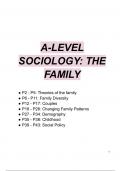
A-LEVEL
SOCIOLOGY: THE
FAMILY
●P2 - P5: Theories of the family
●P6 - P11: Family Diversity
●P12 - P17: Couples
●P18 - P26: Changing Family Patterns
●P27 - P34: Demography
●P35 - P38: Childhood
●P39 - P43: Social Policy
1
, THEORIES OF THE FAMILY
❖ Functionalist
- CONSENSUS THEORY: Believe society is based on value consensus and made up
of separate institutions that all work together → family meets some of society’s
essential needs
- Murdock (1949): family provides 4 essential functions:
1. Stable satisfaction of the sex drive
2. Reproduction of the next generation
3. Socialisation of the young into society’s shared norms and values
4. Meeting its members economic needs
➔ AO3: could be performed equally well by other institutions + Feminists, Marxists +
Personal life reject his ‘rose-tinted’ harmonious consensus view
- Parsons (1955): functional fit theory - the functions that the family performs will
depend on the kind of society in which it is found:
● The extended family fits the functions of pre-industrial society and the
nuclear family fits the functions of industrial society:
● Industrial society requires a geographically mobile workforce to supply
industries - it is easy for the compact nuclear family to move
● Industrial society requires a socially mobile workforce as workers require
more skills - there could be tensions in the extended family if a son had
higher status than a father, so the adult son should leave home and form
a nuclear family which can be ‘structurally isolated’ from its extended kin
● When society industrialises, the family not only changes its structure but
also loses many of its functions - the pre-industrial family was a
multi-functional unit whereas the industrial family ceases to be a unit of
production
● The modern family comes to specialise in just 2 essential or ‘irreducible’
functions:
1. Primary socialisation of children
2. Stabilisation of adult personalities
➔ AO3: Young and Willmott (1973) - pre-industrial family was nuclear but not extended as
grandparents were unlikely to be alive for their first grandchild, but agrees that the
nuclear family emerged in industrial society as a result of social changes that made the
extended family less important as a source of support
➔ AO3: Anderson (1980) - exchange theory: the working-class extended family continues
to be important in industrial society as the harsh conditions of the times meant that the
benefits of maintaining extended family ties eg childcare greatly outweighed the costs
2
, ❖ Marxist
- CONFLICT THEORY: capitalist society is based on unequal conflict between the
capitalist class and the working class + all of society's institutions help to
maintain class inequality and capitalism
- Functions of the family that fulfil capitalism:
1. Inheritance of property
● Engels: the development of private property means society had to
shift from being a ‘promiscuous horde’ to a patriarchal
monogamous nuclear family. This was essential due to the
inheritance of private property - men had to be certain of the
paternity of their children in order to ensure that their legitimate
heirs inherited from them
● This turned women into a “mere instrument for the production of
childhood” - only the overthrow of capitalism will liberate women
2. Ideological functions
● The family helps to justify inequality and maintain the capitalist
system by persuading people to accept it as natural, fair and
unchangeable
● EG: socialises children into the idea that hierarchy and inequality
are inevitable - parental power over children accustoms them to
the idea that there always has to be someone in charge →
prepares them for workplace
● Zaretsky (1976): the family offers an apparent ‘haven’ from the
harsh and exploitative world of capitalism outside, but this is
largely an illusion and the family cannot meet its members needs -
eg based on the domestic servitude of women
3. A unit of consumption
● Capitalism makes a profit by selling the workers the profits of their
labour for more than it pays them to produce these commodities
● Important market for the sale of consumer goods - eg media
targets children who use ‘pester power’ to persuade parents to
spend more
➔ AO3: ignores family diversity, Feminists - underestimates the importance of gender
inequalities, Functionalists - ignore very real benefits that family provide for its members
❖ Feminist
- CONFLICT THEORY: the family upholds patriarchy by oppressing women
1. Liberal feminism
● Women’s oppression is being gradually overcome through
changing people’s attitudes and changes in the law eg Sex
Discrimination Act (1975), more equal division of labour within the
family
3
SOCIOLOGY: THE
FAMILY
●P2 - P5: Theories of the family
●P6 - P11: Family Diversity
●P12 - P17: Couples
●P18 - P26: Changing Family Patterns
●P27 - P34: Demography
●P35 - P38: Childhood
●P39 - P43: Social Policy
1
, THEORIES OF THE FAMILY
❖ Functionalist
- CONSENSUS THEORY: Believe society is based on value consensus and made up
of separate institutions that all work together → family meets some of society’s
essential needs
- Murdock (1949): family provides 4 essential functions:
1. Stable satisfaction of the sex drive
2. Reproduction of the next generation
3. Socialisation of the young into society’s shared norms and values
4. Meeting its members economic needs
➔ AO3: could be performed equally well by other institutions + Feminists, Marxists +
Personal life reject his ‘rose-tinted’ harmonious consensus view
- Parsons (1955): functional fit theory - the functions that the family performs will
depend on the kind of society in which it is found:
● The extended family fits the functions of pre-industrial society and the
nuclear family fits the functions of industrial society:
● Industrial society requires a geographically mobile workforce to supply
industries - it is easy for the compact nuclear family to move
● Industrial society requires a socially mobile workforce as workers require
more skills - there could be tensions in the extended family if a son had
higher status than a father, so the adult son should leave home and form
a nuclear family which can be ‘structurally isolated’ from its extended kin
● When society industrialises, the family not only changes its structure but
also loses many of its functions - the pre-industrial family was a
multi-functional unit whereas the industrial family ceases to be a unit of
production
● The modern family comes to specialise in just 2 essential or ‘irreducible’
functions:
1. Primary socialisation of children
2. Stabilisation of adult personalities
➔ AO3: Young and Willmott (1973) - pre-industrial family was nuclear but not extended as
grandparents were unlikely to be alive for their first grandchild, but agrees that the
nuclear family emerged in industrial society as a result of social changes that made the
extended family less important as a source of support
➔ AO3: Anderson (1980) - exchange theory: the working-class extended family continues
to be important in industrial society as the harsh conditions of the times meant that the
benefits of maintaining extended family ties eg childcare greatly outweighed the costs
2
, ❖ Marxist
- CONFLICT THEORY: capitalist society is based on unequal conflict between the
capitalist class and the working class + all of society's institutions help to
maintain class inequality and capitalism
- Functions of the family that fulfil capitalism:
1. Inheritance of property
● Engels: the development of private property means society had to
shift from being a ‘promiscuous horde’ to a patriarchal
monogamous nuclear family. This was essential due to the
inheritance of private property - men had to be certain of the
paternity of their children in order to ensure that their legitimate
heirs inherited from them
● This turned women into a “mere instrument for the production of
childhood” - only the overthrow of capitalism will liberate women
2. Ideological functions
● The family helps to justify inequality and maintain the capitalist
system by persuading people to accept it as natural, fair and
unchangeable
● EG: socialises children into the idea that hierarchy and inequality
are inevitable - parental power over children accustoms them to
the idea that there always has to be someone in charge →
prepares them for workplace
● Zaretsky (1976): the family offers an apparent ‘haven’ from the
harsh and exploitative world of capitalism outside, but this is
largely an illusion and the family cannot meet its members needs -
eg based on the domestic servitude of women
3. A unit of consumption
● Capitalism makes a profit by selling the workers the profits of their
labour for more than it pays them to produce these commodities
● Important market for the sale of consumer goods - eg media
targets children who use ‘pester power’ to persuade parents to
spend more
➔ AO3: ignores family diversity, Feminists - underestimates the importance of gender
inequalities, Functionalists - ignore very real benefits that family provide for its members
❖ Feminist
- CONFLICT THEORY: the family upholds patriarchy by oppressing women
1. Liberal feminism
● Women’s oppression is being gradually overcome through
changing people’s attitudes and changes in the law eg Sex
Discrimination Act (1975), more equal division of labour within the
family
3