Hoodstuk 1
Why study pharmaceutical Biotechnology?
Human growth hormone (hGH): first; extracted from human cadavers (GH from pigs and
cows were not sufficiently close). But for therapeutic doses we need 45 mg per day so we
would need a big amount of cadavers impossible to treat people that way.
Somatrem (brand name: protropin) = analogue of GH. Somatrem is a recombinant hGH.
It’s a bacteria-synthesised hGH released in 1986 (2nd biological to enter the market).
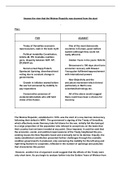
Differences between chemical and biological drugs:
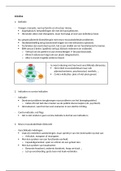
Definition of a biopharmaceutical: an active
drug substance made by a living organism
(natural or engineered) or from a chemical
reaction involving biological parts.
Proteins are not as stable as chemicals as
they depend on the structure, on the
folding of the protein to remain intact
very narrow range of stability.
Biological drugs – some considerations:
Most proteins have a narrow chemical range of stability:
- unfolded proteins generally do not refold correctly
- protein structure matters for function and drug safety.
Some proteins have post-translational modifications:
- host-species (may extend to cell type) specific
- can affect folding, bioavailability, activity, elimination rate and immunogenicity
- these modifications can be heterogeneous
processing:
- dependent on expression strategy
- dependent on biological host
- strategies for purification
- viable/desired formulations
- the process determines the product!!
1
,DNA basic tools
Nucleobase: source of information in DNA and RNA. Eigenlijk zorgen alle 3 delen (phosphate,
nucleobase en de suiker) voor de informatie. Maar omdat de suiker en phosphate
geconserveerd zijn in elk stuk (nucleotide) refereren we vaak naar de nucleobase.
Reverse complement (= antisense, minus, template) onderdeel dat een helix gaat vormen
met een given sequence of DNA (= sense, plus, non-template).
DNA can be represented as a string of text. Usually only one strand is given (we can figure
out the second one on the basis of the first one).
DNA can also be represented graphically. Choice of representation has to minimize
ambiguity.
EcoRI = a restriction endonuclease enzyme isolated from species E.coli. (restriction
endonucleases = enzymes that recognize a specific DNA sequence, called a restriction site,
and cleave the DNA double helices into fragments within or adjacent to that site.)
2
,“Classic” molecular biology: “cut and paste” molecular biology nucleases = cutting tools
and ligases = pasting tools.
Restriction endonucleases (cut) nucleases are paired with methylases, which
protect the host by marking its DNA with methyl groups. Endonucleases attack any
unmethylated DNA, like viral DNA.
Example: Orthodox type 2 endonucleases recognize short specific DNA sequences
and always cut within those sequences. This precise cutting at the recognition site is
their key feature. This endonuclease is a dimer and it recognizes palindromic
sequences of 4-8 bp.
The type IIS restriction endonucleases differ from the other type II endonucleases
because they don’t cut within their recognition site. Instead, they cleave the DNA at a
defined distance away from the recognition sequence.
Restriction enzymes that don’t cut right in the middle overhang or cohesive end =
sticky end (example: EcoRI). Some enzymes cut right in the middle no overhangs =
blunt ends (example: SmaI). You cannot make a double helix with a sticky end and a
blunt end without distortion. To bind a blunt end, you need a blunt end. = ligation.
DNA ligases (paste) = enzymes that join DNA ends. Activated with ATP or NAD
transfer AMP to itself then to DNA (to the 5’ phosphate). The activated 5’ phosphate-
end attacks free 3’-hydroxyl inside the enzyme.
Ligases are very sensitive to any distortion in the helix around the ligation site. You
can only ligate things without distortion. You can ligate 2 molecules that are both cut
by EcoRI by example bc they have the same sticky ends and they will ligate perfectly.
Hoofdstuk 2:
From gene to protein.
pUC system: generated by classic methods. Multiple cloning sites (MCS) within a LacZ
reporter. High copy number.
The pUC system is a plasmid used to insert DNA into bacteria. It has a special area called the
multiple cloning site (MCS) inside a gene called LacZα. This gene helps the bacteria make a
blue color when a chemical is added.
When scientists put new DNA into the MCS, it breaks the lacZα gene. If the gene is broken,
the bacteria can’t make the blue color, so the colonies stay white. If the DNA isn’t inserted,
the gene works, and the colonies turn blue. This makes it easy to see which bacteria have
the DNA you want (the white ones).
3
, The pUC plasmid includes an antibiotic resistance gene When you grow the bacteria on a
plate with the antibiotic, only the bacteria that have taken up the plasmid (pUC) will survive.
This ensures you're working only with bacteria that carry the plasmid (whether or not the
DNA insert is present in the MCS, to ensure that colonies must be white).
Biobrick assembly: rather than findig a case by case scenario, this is a standardized method
with only 4 reactions.
Biobricks = genetic parts that follow a standardized format. Each biobrick has specific “sticky
ends” that enable it to be easily combined with other biobricks. The standardized ends of
biobricks are designed to be compatible with specific restriction enzymes. These enzymes
cut DNA at specific recognition sequences, generating sticky ends that are complementary to
each other. (Even between different cutting enzymes there will be matching parts so they
can ligate.)
Both classic molecular cloning and biobricks use orthodox type II endonucleases (which cut
within their palindromic recognition sequence)
PCR
DNA polymerases = template-dependent DNA synthesis: verschillende soorten: replication,
repair, reverse transcription (DNA maken van RNA bv covid testen).
Arranged into 7 different families but they all have common mechanism. They also have
common elements 3 sub domains (fingers, palm, thumb right hand). The structure of
the sub-domains is different between the 7 families, the palm subdomain is the most
conserved structure between polymerases.
General mechanism of all polymerases:
4
Why study pharmaceutical Biotechnology?
Human growth hormone (hGH): first; extracted from human cadavers (GH from pigs and
cows were not sufficiently close). But for therapeutic doses we need 45 mg per day so we
would need a big amount of cadavers impossible to treat people that way.
Somatrem (brand name: protropin) = analogue of GH. Somatrem is a recombinant hGH.
It’s a bacteria-synthesised hGH released in 1986 (2nd biological to enter the market).
Differences between chemical and biological drugs:
Definition of a biopharmaceutical: an active
drug substance made by a living organism
(natural or engineered) or from a chemical
reaction involving biological parts.
Proteins are not as stable as chemicals as
they depend on the structure, on the
folding of the protein to remain intact
very narrow range of stability.
Biological drugs – some considerations:
Most proteins have a narrow chemical range of stability:
- unfolded proteins generally do not refold correctly
- protein structure matters for function and drug safety.
Some proteins have post-translational modifications:
- host-species (may extend to cell type) specific
- can affect folding, bioavailability, activity, elimination rate and immunogenicity
- these modifications can be heterogeneous
processing:
- dependent on expression strategy
- dependent on biological host
- strategies for purification
- viable/desired formulations
- the process determines the product!!
1
,DNA basic tools
Nucleobase: source of information in DNA and RNA. Eigenlijk zorgen alle 3 delen (phosphate,
nucleobase en de suiker) voor de informatie. Maar omdat de suiker en phosphate
geconserveerd zijn in elk stuk (nucleotide) refereren we vaak naar de nucleobase.
Reverse complement (= antisense, minus, template) onderdeel dat een helix gaat vormen
met een given sequence of DNA (= sense, plus, non-template).
DNA can be represented as a string of text. Usually only one strand is given (we can figure
out the second one on the basis of the first one).
DNA can also be represented graphically. Choice of representation has to minimize
ambiguity.
EcoRI = a restriction endonuclease enzyme isolated from species E.coli. (restriction
endonucleases = enzymes that recognize a specific DNA sequence, called a restriction site,
and cleave the DNA double helices into fragments within or adjacent to that site.)
2
,“Classic” molecular biology: “cut and paste” molecular biology nucleases = cutting tools
and ligases = pasting tools.
Restriction endonucleases (cut) nucleases are paired with methylases, which
protect the host by marking its DNA with methyl groups. Endonucleases attack any
unmethylated DNA, like viral DNA.
Example: Orthodox type 2 endonucleases recognize short specific DNA sequences
and always cut within those sequences. This precise cutting at the recognition site is
their key feature. This endonuclease is a dimer and it recognizes palindromic
sequences of 4-8 bp.
The type IIS restriction endonucleases differ from the other type II endonucleases
because they don’t cut within their recognition site. Instead, they cleave the DNA at a
defined distance away from the recognition sequence.
Restriction enzymes that don’t cut right in the middle overhang or cohesive end =
sticky end (example: EcoRI). Some enzymes cut right in the middle no overhangs =
blunt ends (example: SmaI). You cannot make a double helix with a sticky end and a
blunt end without distortion. To bind a blunt end, you need a blunt end. = ligation.
DNA ligases (paste) = enzymes that join DNA ends. Activated with ATP or NAD
transfer AMP to itself then to DNA (to the 5’ phosphate). The activated 5’ phosphate-
end attacks free 3’-hydroxyl inside the enzyme.
Ligases are very sensitive to any distortion in the helix around the ligation site. You
can only ligate things without distortion. You can ligate 2 molecules that are both cut
by EcoRI by example bc they have the same sticky ends and they will ligate perfectly.
Hoofdstuk 2:
From gene to protein.
pUC system: generated by classic methods. Multiple cloning sites (MCS) within a LacZ
reporter. High copy number.
The pUC system is a plasmid used to insert DNA into bacteria. It has a special area called the
multiple cloning site (MCS) inside a gene called LacZα. This gene helps the bacteria make a
blue color when a chemical is added.
When scientists put new DNA into the MCS, it breaks the lacZα gene. If the gene is broken,
the bacteria can’t make the blue color, so the colonies stay white. If the DNA isn’t inserted,
the gene works, and the colonies turn blue. This makes it easy to see which bacteria have
the DNA you want (the white ones).
3
, The pUC plasmid includes an antibiotic resistance gene When you grow the bacteria on a
plate with the antibiotic, only the bacteria that have taken up the plasmid (pUC) will survive.
This ensures you're working only with bacteria that carry the plasmid (whether or not the
DNA insert is present in the MCS, to ensure that colonies must be white).
Biobrick assembly: rather than findig a case by case scenario, this is a standardized method
with only 4 reactions.
Biobricks = genetic parts that follow a standardized format. Each biobrick has specific “sticky
ends” that enable it to be easily combined with other biobricks. The standardized ends of
biobricks are designed to be compatible with specific restriction enzymes. These enzymes
cut DNA at specific recognition sequences, generating sticky ends that are complementary to
each other. (Even between different cutting enzymes there will be matching parts so they
can ligate.)
Both classic molecular cloning and biobricks use orthodox type II endonucleases (which cut
within their palindromic recognition sequence)
PCR
DNA polymerases = template-dependent DNA synthesis: verschillende soorten: replication,
repair, reverse transcription (DNA maken van RNA bv covid testen).
Arranged into 7 different families but they all have common mechanism. They also have
common elements 3 sub domains (fingers, palm, thumb right hand). The structure of
the sub-domains is different between the 7 families, the palm subdomain is the most
conserved structure between polymerases.
General mechanism of all polymerases:
4