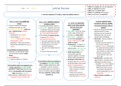
1. What is the power given by the legislation?
Case Act Phrase Judicial Review 2. Who can exercise the power?
3. When does the power arise?
4. What is the purpose of the power?
1. Can the claimant (‘C’) make a claim for judicial review? 5. How should power be operated?
Does C’s claim raise public law Does C have ‘sufficient interest’ Is court’s judicial review
issues? Is C within the time limit jurisdiction affect by ‘ouster’
to make a claim?
Concerns relationship between under or any other specific provisions/statutory right of
Personally affected by a decision
individual and state e.g. CPO SCA s.31(3) - Applicant must have statutory time limit appeal?
‘Procedural exclusivity’ – public law “a sufficient interest in the matter applicable? Ouster clauses grant the public
case > judicial review (O’Reilly v to which the application relates” SCA s.36(6) - Court can refuse body the power to make
Mackman) (ex p The National Federation) a claim where it feels there decisions and are inserted by
o Confirmed in Trim v DDCN The standing of pressure groups – has been an ‘undue delay’ Parliament into such acts to
o The principle of ‘collateral 5 elements (ex p World CPR r 54.5(1) – claim form exclude right of challenge.
challenge’ (Wandsworth v Winder Development Movement): must be filled promptly (Finn- Full ouster = allows no right of
& Boddington v BTP) 1. the need to uphold the rule of law; Kelcey v Milton Keynes) and challenge at all
o Exceptions = where case involves 2. the importance of the issue raised; within 3 months o Excludes courts from playing any
both private and public law e.g. Roy 3. the likely absence of any other Planning Acts – 6 weeks (CPR role in review of decision
v KFPC responsible challenger; r. 54.5(5) 2013 amendments; o Example = Anisminic (found that):
4. the nature of the alleged breach of defined within s.336 Town and If a public body steps outside its
Is D amenable to judicial review? duty; permitted area, its decisions are
Country Planning Act 1990)
Claimants can seek judicial review 5. the role of the pressure group. not covered by an ouster clause
Public procurement (i.e.
Full ouster clauses will not
only of decisions made by public where public authority protect decisions which were
bodies acquires supplies or services) – never valid
ex p Datafin test 30 days (2013 amendments) Partial ouster = provides some
1. Source of power (i.e. statute) Extension of time limit only opportunity for a decision to be
If Convention rights are engaged, is for good reason (ex p Jackson) challenged by judicial review
C a ‘victim’ (s.7(1) HRA 1998)? and by discretion of the courts o Example = ex p Ostler (right to
If Convention rights are engaged is D a Where a public authority has acted (Hardy v Pembrokeshire) challenge within time limit)
‘public authority’ (s.6 HRA 1998)? unlawfully, a person can bring o delay in obtaining legal aid no Where time limit in ouster,
Unlawful for a public body to act in a way proceedings against an authority or longer accepted as complete
court had no discretion to
rely on Convention rights but only if answer (Kigen)
which is incompatible with Convention grant an extension e.g. Smith
he is (or would be) a victim of this o remedy can be refused if
rights. Exceptions = (s.6(2)) v East Elloe
unlawful act application made outside of 3-
Public authority = public body (R (Beer) v Other statutory remedies e.g.
month time limit (ex p Caswell)
Hampshire Farmers Market Ltd) Goldstraw
, 2. If so, what are C’s likely grounds of challenge?
Apply (where relevant) Lord Diplock’s grounds in CCSU
Illegality and irrationality = substantive grounds for judicial review (they focus on the ‘substance’ of the decision under review). Procedural impropriety = procedural grounds (focuses
on the procedure followed in arriving at the decision). 2 further ‘European’ grounds = 1) breach of ECHR; 2) breach of EU law
ILLEGALITY PROCEDURAL IMPROPRIETY
An action is illegal/ultra vires if it is beyond the powers of the Procedural (un)fairness
public body in question Concerns rules of natural justice (common law rules created by
the judiciary) – see Fairmount Investments Ltd – do not apply
1. Acting without legal authority – ex p McCarthy IRRATIONALITY
where decision-maker has a legislative rather than a judicial
Challenges under the function (Bates v Lord Hailsham)
2. Wrongful/unlawful delegation
irrationality ground of
General rule that decision-making powers, once given by There are 2 rules of natural justice:
review require proof of a
Parliament, cannot be further delegated or sub-delegated (Vine 1. The rule against bias = a decision maker should have no
very high degree of
v National Dock Labour Board). 2 exceptions: personal interest in the outcome of his decision. Application of
unreasonableness
1) Carltona principle – when discretion is conferred on a this rule depends on whether the interest of the decision maker
Minster, he can delegate to officials within his department 1. The ‘Wednesbury’ is direct or indirect:
2) s.101 LGA 1972 – local authorities may delegate decision- principle = is the decision Direct interest – direct financial interest/ proprietary interest
making powers to committees (or to an individual officer), challenged ‘so i.e. Dimes, and non-pecuniary interest (where decision-maker
provided they make a formal resolution to do so. unreasonable’ that no involved in promoting same cause as the party in the case) i.e.
reasonable decision-maker ex p Pinochet
3. Fettering of discretion would have come to it? Indirect interest – investigation of relationship between
If Parliament provides a public body with a discretionary power, indirect interest/bias and decision needed. Test for indirect
the courts will not permit that body to restrict or ‘fetter’ such 2. CCSU = Is the decision bias = would a fair-minded and impartial observer conclude
discretion. Occurs in 2 ways: challenged so ‘outrageous that there had been a real possibility of bias? (Porter v Magill)
1) acting under the dictation of another – public authorities in its defiance of logic’? – test used in ex p Hook
cannot act under the dictation of another person or body i.e. 2. The right to a fair hearing = act in good faith and listen fairly
Case examples = Wheeler
Lavender & Sons to both sides (Rice).
v Leicester City Council
2) applying a general policy as to the exercise of discretion in Won’t apply to ‘preliminary decision’ i.e. Lewis v Heffer
and R v Parole Board
too strict a manner (strict guidelines) – fairness requires that Right to know case against you but not right of reasons for
like cases should be decided in like ways, and so public decisions i.e. Hasan and ex p Doody (exception = where a
authorities may formulate their own policies to help them take decision taken in the absence of reasons looks aberrant ex p
consistent decisions i.e. British Oxygen Cunningham)
Case Act Phrase Judicial Review 2. Who can exercise the power?
3. When does the power arise?
4. What is the purpose of the power?
1. Can the claimant (‘C’) make a claim for judicial review? 5. How should power be operated?
Does C’s claim raise public law Does C have ‘sufficient interest’ Is court’s judicial review
issues? Is C within the time limit jurisdiction affect by ‘ouster’
to make a claim?
Concerns relationship between under or any other specific provisions/statutory right of
Personally affected by a decision
individual and state e.g. CPO SCA s.31(3) - Applicant must have statutory time limit appeal?
‘Procedural exclusivity’ – public law “a sufficient interest in the matter applicable? Ouster clauses grant the public
case > judicial review (O’Reilly v to which the application relates” SCA s.36(6) - Court can refuse body the power to make
Mackman) (ex p The National Federation) a claim where it feels there decisions and are inserted by
o Confirmed in Trim v DDCN The standing of pressure groups – has been an ‘undue delay’ Parliament into such acts to
o The principle of ‘collateral 5 elements (ex p World CPR r 54.5(1) – claim form exclude right of challenge.
challenge’ (Wandsworth v Winder Development Movement): must be filled promptly (Finn- Full ouster = allows no right of
& Boddington v BTP) 1. the need to uphold the rule of law; Kelcey v Milton Keynes) and challenge at all
o Exceptions = where case involves 2. the importance of the issue raised; within 3 months o Excludes courts from playing any
both private and public law e.g. Roy 3. the likely absence of any other Planning Acts – 6 weeks (CPR role in review of decision
v KFPC responsible challenger; r. 54.5(5) 2013 amendments; o Example = Anisminic (found that):
4. the nature of the alleged breach of defined within s.336 Town and If a public body steps outside its
Is D amenable to judicial review? duty; permitted area, its decisions are
Country Planning Act 1990)
Claimants can seek judicial review 5. the role of the pressure group. not covered by an ouster clause
Public procurement (i.e.
Full ouster clauses will not
only of decisions made by public where public authority protect decisions which were
bodies acquires supplies or services) – never valid
ex p Datafin test 30 days (2013 amendments) Partial ouster = provides some
1. Source of power (i.e. statute) Extension of time limit only opportunity for a decision to be
If Convention rights are engaged, is for good reason (ex p Jackson) challenged by judicial review
C a ‘victim’ (s.7(1) HRA 1998)? and by discretion of the courts o Example = ex p Ostler (right to
If Convention rights are engaged is D a Where a public authority has acted (Hardy v Pembrokeshire) challenge within time limit)
‘public authority’ (s.6 HRA 1998)? unlawfully, a person can bring o delay in obtaining legal aid no Where time limit in ouster,
Unlawful for a public body to act in a way proceedings against an authority or longer accepted as complete
court had no discretion to
rely on Convention rights but only if answer (Kigen)
which is incompatible with Convention grant an extension e.g. Smith
he is (or would be) a victim of this o remedy can be refused if
rights. Exceptions = (s.6(2)) v East Elloe
unlawful act application made outside of 3-
Public authority = public body (R (Beer) v Other statutory remedies e.g.
month time limit (ex p Caswell)
Hampshire Farmers Market Ltd) Goldstraw
, 2. If so, what are C’s likely grounds of challenge?
Apply (where relevant) Lord Diplock’s grounds in CCSU
Illegality and irrationality = substantive grounds for judicial review (they focus on the ‘substance’ of the decision under review). Procedural impropriety = procedural grounds (focuses
on the procedure followed in arriving at the decision). 2 further ‘European’ grounds = 1) breach of ECHR; 2) breach of EU law
ILLEGALITY PROCEDURAL IMPROPRIETY
An action is illegal/ultra vires if it is beyond the powers of the Procedural (un)fairness
public body in question Concerns rules of natural justice (common law rules created by
the judiciary) – see Fairmount Investments Ltd – do not apply
1. Acting without legal authority – ex p McCarthy IRRATIONALITY
where decision-maker has a legislative rather than a judicial
Challenges under the function (Bates v Lord Hailsham)
2. Wrongful/unlawful delegation
irrationality ground of
General rule that decision-making powers, once given by There are 2 rules of natural justice:
review require proof of a
Parliament, cannot be further delegated or sub-delegated (Vine 1. The rule against bias = a decision maker should have no
very high degree of
v National Dock Labour Board). 2 exceptions: personal interest in the outcome of his decision. Application of
unreasonableness
1) Carltona principle – when discretion is conferred on a this rule depends on whether the interest of the decision maker
Minster, he can delegate to officials within his department 1. The ‘Wednesbury’ is direct or indirect:
2) s.101 LGA 1972 – local authorities may delegate decision- principle = is the decision Direct interest – direct financial interest/ proprietary interest
making powers to committees (or to an individual officer), challenged ‘so i.e. Dimes, and non-pecuniary interest (where decision-maker
provided they make a formal resolution to do so. unreasonable’ that no involved in promoting same cause as the party in the case) i.e.
reasonable decision-maker ex p Pinochet
3. Fettering of discretion would have come to it? Indirect interest – investigation of relationship between
If Parliament provides a public body with a discretionary power, indirect interest/bias and decision needed. Test for indirect
the courts will not permit that body to restrict or ‘fetter’ such 2. CCSU = Is the decision bias = would a fair-minded and impartial observer conclude
discretion. Occurs in 2 ways: challenged so ‘outrageous that there had been a real possibility of bias? (Porter v Magill)
1) acting under the dictation of another – public authorities in its defiance of logic’? – test used in ex p Hook
cannot act under the dictation of another person or body i.e. 2. The right to a fair hearing = act in good faith and listen fairly
Case examples = Wheeler
Lavender & Sons to both sides (Rice).
v Leicester City Council
2) applying a general policy as to the exercise of discretion in Won’t apply to ‘preliminary decision’ i.e. Lewis v Heffer
and R v Parole Board
too strict a manner (strict guidelines) – fairness requires that Right to know case against you but not right of reasons for
like cases should be decided in like ways, and so public decisions i.e. Hasan and ex p Doody (exception = where a
authorities may formulate their own policies to help them take decision taken in the absence of reasons looks aberrant ex p
consistent decisions i.e. British Oxygen Cunningham)