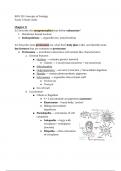
BIOL 211 Concepts of Zoology
Exam 3 Study Guide
Chapter 11
11.1 Describe the synapomorphies that define eukaryotes?
1. Membrane bound nucleus
2. Endosymbiosis → organelles (ex. mitochondria)
11.2 Describe what protozoans are, what their body plan is like, and identify some
key features that are common to protozoans.
● Protozoans → unicellular eukaryotes with animal-like characteristics
a. General features:
■ Nucleus → contains genetic material
● Ciliates → 2 nuclei (macronucleus + micronucleus)
■ Mitochondria
■ Golgi apparatus → secretory function / intracellular digestion
■ Plastids → contain photosynthetic pigments
■ Extrusomes → organelles that extrude stuff
● Trichocyst
● Toxicyst
■ No cell wall
b. Locomotion
■ Cilium or flagellum
● 9 + 2 microtubule arrangement (axoneme)
● Kinetosome → basal body; ‘anchor’
● Sliding microtubule
hypothesis
■ Pseudopodia → extensions of cell
cytoplasm
● Lobopodia → large with
ectoplasm + endoplasm
(Amoeba)
● Filopodia → thin extensions
of ectoplasm
, ● Axopodia → thin, supported by axial rods of microtubules
(Actinosphaerium)
c. Nutrition
■ Autotrophic
■ Heterotrophic (most)
● Engulf food particles via phagocytosis to form food
vacuole
● Some have cytostome → “mouth”
■ Mutualistic, commensalistic, parasitic
d. Excretion + Osmoregulation
■ Excretion via diffusion or cytopyge/cytoproct
■ Contractile vacuole → osmoregulation
■ Uses proton pump; actively transport H+
e. Reproduction
■ Asexual
● Binary fission
● Budding
● Multiple fission (schizogeny/sporogeny) → form
multiple individuals by multiple nuclear division
preceding division of cytoplasm
■ Sexual → form haploid gamete cells or gamete nuclei
● Autogamy → single organism undergoes self-fertilization,
gametes arise and fuse within parent
● Syngamy (fertilization) → one gamete fertilizes another,
permanently
● Conjugation → two organisms exchange genetic matter,
temporarily (ex. Paramecium)
11.3 Describe how ameboid movement occurs
● Crawling-like type of movement accomplished by protrusion of cytoplasm
involving the formation of pseudopodia that pull the cell forward (ex. Amoeba)
11.4 Describe the sliding filament hypothesis
● Myosin filaments use energy from ATP to “walk” along the actin filaments
with their cross bridges
, 11.5 Define the following:
1. Protozoans -
1. Trichocyst → eject threads
2. Toxicyst → eject toxic filaments
1. Heterotrophic protozoans
a. Phagocytosis → engulf food particles
2. Osmoregulation
a. Contractile vacuole → carries on osmoregulation (maintenance
of water balance)
3. Phylum Euglenozoa
a. Pellicle → flexible proteinaceous strip under cell membrane
b. Stigma → light sensitive eyespot
11.6 Describe the following forms of asexual reproduction that occurs in
protozoans:
1. Binary fission → 2 identical individuals
2. Budding → progeny smaller than adult
3. Multiple fission / schizogeny / sporogeny (form spores) → form multiple
individuals by multiple nuclear division preceding division of cytoplasm
(Phylum Apicomplexa + Amoebas)
11.7 Describe ways in which sexual reproduction occurs in protozoans.
1. Syngamy → one gamete fertilizes another
2. Autogamy → gametes arise and fuse within parent
3. Conjugation → exchange genetic nuclei
11.8 For each of the following groups in bold:
A) name the synapomorphy(ies) that define the group (if one exists)
B) describe the features of the group
C) name an example or examples of organisms in that group.
Phylum Euglenozoa
Exam 3 Study Guide
Chapter 11
11.1 Describe the synapomorphies that define eukaryotes?
1. Membrane bound nucleus
2. Endosymbiosis → organelles (ex. mitochondria)
11.2 Describe what protozoans are, what their body plan is like, and identify some
key features that are common to protozoans.
● Protozoans → unicellular eukaryotes with animal-like characteristics
a. General features:
■ Nucleus → contains genetic material
● Ciliates → 2 nuclei (macronucleus + micronucleus)
■ Mitochondria
■ Golgi apparatus → secretory function / intracellular digestion
■ Plastids → contain photosynthetic pigments
■ Extrusomes → organelles that extrude stuff
● Trichocyst
● Toxicyst
■ No cell wall
b. Locomotion
■ Cilium or flagellum
● 9 + 2 microtubule arrangement (axoneme)
● Kinetosome → basal body; ‘anchor’
● Sliding microtubule
hypothesis
■ Pseudopodia → extensions of cell
cytoplasm
● Lobopodia → large with
ectoplasm + endoplasm
(Amoeba)
● Filopodia → thin extensions
of ectoplasm
, ● Axopodia → thin, supported by axial rods of microtubules
(Actinosphaerium)
c. Nutrition
■ Autotrophic
■ Heterotrophic (most)
● Engulf food particles via phagocytosis to form food
vacuole
● Some have cytostome → “mouth”
■ Mutualistic, commensalistic, parasitic
d. Excretion + Osmoregulation
■ Excretion via diffusion or cytopyge/cytoproct
■ Contractile vacuole → osmoregulation
■ Uses proton pump; actively transport H+
e. Reproduction
■ Asexual
● Binary fission
● Budding
● Multiple fission (schizogeny/sporogeny) → form
multiple individuals by multiple nuclear division
preceding division of cytoplasm
■ Sexual → form haploid gamete cells or gamete nuclei
● Autogamy → single organism undergoes self-fertilization,
gametes arise and fuse within parent
● Syngamy (fertilization) → one gamete fertilizes another,
permanently
● Conjugation → two organisms exchange genetic matter,
temporarily (ex. Paramecium)
11.3 Describe how ameboid movement occurs
● Crawling-like type of movement accomplished by protrusion of cytoplasm
involving the formation of pseudopodia that pull the cell forward (ex. Amoeba)
11.4 Describe the sliding filament hypothesis
● Myosin filaments use energy from ATP to “walk” along the actin filaments
with their cross bridges
, 11.5 Define the following:
1. Protozoans -
1. Trichocyst → eject threads
2. Toxicyst → eject toxic filaments
1. Heterotrophic protozoans
a. Phagocytosis → engulf food particles
2. Osmoregulation
a. Contractile vacuole → carries on osmoregulation (maintenance
of water balance)
3. Phylum Euglenozoa
a. Pellicle → flexible proteinaceous strip under cell membrane
b. Stigma → light sensitive eyespot
11.6 Describe the following forms of asexual reproduction that occurs in
protozoans:
1. Binary fission → 2 identical individuals
2. Budding → progeny smaller than adult
3. Multiple fission / schizogeny / sporogeny (form spores) → form multiple
individuals by multiple nuclear division preceding division of cytoplasm
(Phylum Apicomplexa + Amoebas)
11.7 Describe ways in which sexual reproduction occurs in protozoans.
1. Syngamy → one gamete fertilizes another
2. Autogamy → gametes arise and fuse within parent
3. Conjugation → exchange genetic nuclei
11.8 For each of the following groups in bold:
A) name the synapomorphy(ies) that define the group (if one exists)
B) describe the features of the group
C) name an example or examples of organisms in that group.
Phylum Euglenozoa