WILLIAMS - TOLERATION
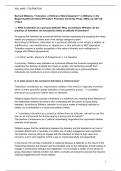
Bernard Williams, “Toleration, a Political or Moral Question?” in Williams, In the
Beginning Was the Deed (Princeton: Princeton University Press, 2005), pp.128-138.
[11pp.]
a. What is toleration as a personal attitude? Why, according to Williams, do the
practices of toleration not necessarily reflect an attitude of toleration?
He argues that toleration as a personal attitude involves respecting and accepting the views,
beliefs and practices of others even if we strongly disapprove them.
According to Williams, toleration as a personal attitude is not simply a matter of
indifference, non-interference or skepticism → this attitude is NOT toleration.
Toleration requires a positive recognition of the value of diversity and a willingness to
engage with different perspectives.
→ In other words, absence of disapproval = not toleration
In summary, Williams sees toleration as a personal attitude that involves recognizing and
respecting the diversity of beliefs and values in society, and restraining oneself from
imposing one's own beliefs on others. By cultivating toleration as a personal attitude,
individuals can contribute to a more vibrant and inclusive society.
b. In what sense is the concept of toleration a relational one?
Toleration constitutes an “asymmetric relation: the notion is typically involved
when a more powerful group tolerates a less powerful group”. → considers
toleration as a practice rather than an attitude.
Williams argues that the concept of toleration is a relational one, meaning that it depends on
the relationship between the person who is tolerating and the person or group being
tolerated. According to Williams, toleration is not just a matter of individual attitudes or
beliefs, but is embedded in a social and political context.
→ “considers toleration as a practice rather than an attitude: refusal to use the
law as an instrument for discouraging a group and its beliefs”.
The practice of intolerance as a “political undertaking” engenders this asymmetric relation
between social groups.
Williams argues that the relationship between the tolerator and the tolerated is not one of
complete detachment or neutrality, but rather one of active engagement and negotiation.
The tolerator must be willing to engage with the tolerated, to listen to their views and
concerns, and to work together to find a way to coexist peacefully and respectfully.
In this sense, the concept of toleration is relational because it depends on the nature of the
relationship between the tolerator and the tolerated, and on the willingness of both parties to
engage in constructive dialogue and negotiation. It is not simply a matter of one person or
group choosing to tolerate another, but rather a complex and dynamic process that requires
ongoing engagement and mutual respect.
1
Bernard Williams, “Toleration, a Political or Moral Question?” in Williams, In the
Beginning Was the Deed (Princeton: Princeton University Press, 2005), pp.128-138.
[11pp.]
a. What is toleration as a personal attitude? Why, according to Williams, do the
practices of toleration not necessarily reflect an attitude of toleration?
He argues that toleration as a personal attitude involves respecting and accepting the views,
beliefs and practices of others even if we strongly disapprove them.
According to Williams, toleration as a personal attitude is not simply a matter of
indifference, non-interference or skepticism → this attitude is NOT toleration.
Toleration requires a positive recognition of the value of diversity and a willingness to
engage with different perspectives.
→ In other words, absence of disapproval = not toleration
In summary, Williams sees toleration as a personal attitude that involves recognizing and
respecting the diversity of beliefs and values in society, and restraining oneself from
imposing one's own beliefs on others. By cultivating toleration as a personal attitude,
individuals can contribute to a more vibrant and inclusive society.
b. In what sense is the concept of toleration a relational one?
Toleration constitutes an “asymmetric relation: the notion is typically involved
when a more powerful group tolerates a less powerful group”. → considers
toleration as a practice rather than an attitude.
Williams argues that the concept of toleration is a relational one, meaning that it depends on
the relationship between the person who is tolerating and the person or group being
tolerated. According to Williams, toleration is not just a matter of individual attitudes or
beliefs, but is embedded in a social and political context.
→ “considers toleration as a practice rather than an attitude: refusal to use the
law as an instrument for discouraging a group and its beliefs”.
The practice of intolerance as a “political undertaking” engenders this asymmetric relation
between social groups.
Williams argues that the relationship between the tolerator and the tolerated is not one of
complete detachment or neutrality, but rather one of active engagement and negotiation.
The tolerator must be willing to engage with the tolerated, to listen to their views and
concerns, and to work together to find a way to coexist peacefully and respectfully.
In this sense, the concept of toleration is relational because it depends on the nature of the
relationship between the tolerator and the tolerated, and on the willingness of both parties to
engage in constructive dialogue and negotiation. It is not simply a matter of one person or
group choosing to tolerate another, but rather a complex and dynamic process that requires
ongoing engagement and mutual respect.
1