AWMA Exam 3 Questions with Correct Answers
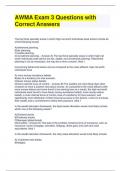
AWMA Exam 3 Questions with Correct Answers The top three specialty areas in which high net worth individuals seek advice include all of the following except A)retirement planning. B)tax planning. C) estate planning. D) investment planning. - Answer-A) The top three specialty areas in which high net worth individuals seek advice are tax, estate, and investment planning. Retirement planning is not as necessary, but may be a minor concern. Mod 1 Concerning behavioral biases and as compared to the mass affluent, high net worth individuals have A) more money-avoidance beliefs. B)less of a tendency for loss aversion. C)fewer money status beliefs. D)more external locus of control. - Answer-B) The wealthy are more likely than other investors to have a positive view about money. As compared to the mass affluent (with more money biases and some found to be earning less as a result), the high net worth individuals were found to have fewer money-avoidance beliefs, more money-status beliefs, a more internal locus of control, less of a tendency for loss aversion, and significantly more attribution of their financial success to two factors: a drive to increase their wealth and a commitment to follow their passions. Mod 1 In the wealth allocation framework, the liquid asset allocation would most likely include which one of the following assets? A)Dividend stocks B)Preferred stocks C)Managed global bonds D)Annuities - Answer-D) This part of the portfolio contains forms of insurance, such as insurance, home mortgage, annuities, hedging, direct gold, and cash and cash equivalents. Mod 1 In the wealth allocation framework, the risky asset allocation would most likely include A) investment real estate. B)hedges. C) large-cap ETFs. D) balanced mutual funds. - Answer-A) Risky assets can include many different vehicles, such as investment real estate, a small business, concentrated stock and stock options, global small company stocks, some commodities, aggressive inflation protectors, and out of the money calls/puts on currencies or bonds. Mod 1 In the wealth allocation framework, the main diversified asset allocation would most likely include A) annuities. B) hedges. C) managed global bonds. D) home mortgage - Answer-C) The main diversified assets category, the largest portion of the portfolio, is still relatively low risk; it can contain managed income investments like dividend stocks, preferred stocks, own company stock (unless risky), and managed global bonds. Mod 1 Concerning the wealth allocation framework, which one of the following portfolio structures is best recommended for a risk averse high net worth investor? A)20% liquid assets/75% main diversified assets/5% risky assets B)30% liquid assets/50% main diversified assets/20% risky assets C)25% liquid assets/60% main diversified assets/15% risky assets D)45% liquid assets/50% main diversified assets/5% risky assets - Answer-D) In the wealth allocation framework, risky investments for a risk averse high net worth investor are recommended to be only 5% to 10% of the portfolio. A minimum of 20% of liquid assets is recommended for the portfolio allocations of all risk levels. The main portfolio should be only 40%-70% of total assets. Mod 1 In the wealth allocation framework, human capital is in which one of the following portfolio "buckets"? A) Hedging assets B)Main diversified assets C)Liquid assets D)Risky assets - Answer-C) In the wealth allocation framework, human capital is included in the liquid assets "bucket." Mod 1 In the wealth allocation framework, human capital can best be defined as the high net worth individual's ability to leverage A) their children. B) their own skills, talents, connections, and/or notoriety. C) an older business to buy a new business. D)their employees. - Answer-B) Human capital does loom large for high net worth clients, as these clients' education or other skills, talents, and/or connections provide a safety net for assets. Mod 1 Which one of the following statements about the goals-based form of financial planning is correct? A) Goals-based financial planning would be adversely affected by stricter fiduciary standards. B) Taking on greater risk is necessary in goals-based financial planning. C) Goals-based financial planning is not recommended for clients of all income levels; it only works well for a high net worth client. D) To facilitate goals-based financial planning, it is important that an adviser gain trust with a client. - Answer-D) To facilitate goals-based financial planning, it is important that an adviser gain trust with a client in order to learn that client's goals and aspirations. Often, less risk is necessary as the emphasis is not in beating the market return, but in using only the risk necessary to reach the goal. This method can work well with clients of any income level. Mod 1 Which one of the following would best be considered a long-term goal for a high net worth client? A) Paying for a luxury vacation B)Upgrading their home C)Creating an emergency fund D)Setting up trusts for gifting - Answer-D) Setting up trusts for gifting to family and/or a charity would be a long-term goal for a high net worth client. Mod 1 Which one of the following has a direct bearing on which investments are appropriate for achieving a goal? A)The investor's net worth B)The investment's alpha C)The investment's beta D)The investor's time horizon - Answer-D) The time horizon has a direct bearing; net worth does not, and beta and alpha are measures of volatility and performance. Mod2
École, étude et sujet
- Établissement
- AWMA
- Cours
- AWMA
Infos sur le Document
- Publié le
- 22 mai 2024
- Nombre de pages
- 22
- Écrit en
- 2023/2024
- Type
- Examen
- Contenu
- Questions et réponses
Sujets
-
awma
-
awma exam 3 questions
-
awma exam 3 questions with correct answers

Document également disponible en groupe