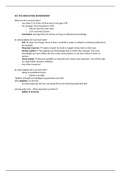
Kaya Borkowski
1
Law of Evidence
Lecture notes, cases and questions
Key
Purple = week numbers
Blue = prescribed cases
Red = answers
Distribution of this document is illegal
, Kaya Borkowski
2
Prescribed cases
1. S v Nkosi 2011
2. AK v Minister of Police 2023 (paras 62-69)
3. S v Van der Westhuizen 2011 (pages 29-52)
4. Holtzhauzen v Roodt 1997
5. R v Vilbro 1957
6. Savoi v NDPP 2014 (must read paras 50-62)
7. S v Thebus 2003
8. Contango Trading SA v Central Energy Fund SOC Ltd 2020
9. Shabalala v Attorney General Transvaal 1995
10. S v Sebejan 1997
11. S v Pillay 2004
12. Hohne v Super Stone Mining 2017
13. S v Ndhlovu 2002 (SCA)
14. S v Kapa 2023 (CC)
15. S v Litako 2014
16. S v Zuma 1995
17. S v Agnew 1996
18. R v Blom 1939
19. S v Van der Meyden 1999
Week 1
Introduction
Prescribed cases
- S v Nkosi 2011
Introduction
- The rules of evidence arise more frequently in criminal trials. This is because there are
different power relations at play in civil and criminal trials.
- in criminal trials the accused are frequently unrepresented
- Even if the accused is represented, the state inevitably has far greater resources and there
may well be an inequality.
- Therefore the courts need to be far more vigilant in upholding the rules in criminal trials
- In civil trials there is greater equality between the parties who almost always have legal
representation. This reduces the need for the courts to be vigilant in ensuring that the rules of
evidence are complied with
What is the law of evidence? (LOE)
Distribution of this document is illegal
, Kaya Borkowski
3
- comprised of those rules that govern the proof of facts in a court eg. what evidence can be
admitted
- The facts in issue (facta probanda) are those which a party must prove in order to win
- Facts relevant to the facts in issue are sometimes referred to as the facta probantia (e.
whether the accused owned the gun that killed the deceased)
- LOE determines the manner in which evidence should be adduced.
- General rule: evidence must be presented orally. But there are exceptions: rules regulating the
admission of documentary, electronic and real evidence
- not all oral presentations in court constitute evidence
- Eg. The argument that a legal representative makes to the court is merely a persuasive
comment.
- LOE determines what evidence should not be considered by the court (eg. hearsay and
unconstitutionally obtained evidence)
- Tells us what degree of proof is required in different situations
- Civil case = prove their case on a balance of probabilities
- Criminal case = the prosecution is required to establish guilt beyond a reasonable
doubt.
Sources of the LOE
1. Criminal Procedure Act 51 of 1977 (CPA)
2. Civil Proceedings Evidence Act 25 of 1965 (CPEA)
3. The Law of Evidence Amendment Act 45 of 1988 (LEAA)
4. Criminal Law (Sexual Offences and Related Matters) Amendment Act 32 of 2007. (SORMA)
5. The Constitution 1996
6. The common law
- On 31 May 1961 South Africa became an Apartheid Republic. Until this date, English rules of
evidence applied
- This means that we have to find out what the English law was on that date by referring to case
law
- we do not follow the English statutory law after that date
- English judgments remain authoritative until overruled by the SCA or struck down by the CC
- the branch of law applicable may determine whether a court is bound by the Roman Dutch
Law or the English law
- Rule of evidence = may be bound by english law
- Substantive law = RDL applies
- it is clear that the South Africa’s law of evidence is deeply embedded in a colonial context
- Eg.The procedural context is adversarial
Distribution of this document is illegal
, Kaya Borkowski
4
- The rules of evidence of civil and criminal procedure are treated as separate
components
- The primary aim of fact-finding is the ascertainment of the truth in using rational
inferential reasoning.
Evidence vs probative material
- Probative material = both evidence that has been proved and material that has not been
proved but nevertheless has probative value
- Probative value = the tendency to increase or diminish probability of the existence of a fact
- Evidence = various materials (usually oral) that are admitted to prove or disprove that
something occurred
Proof
- Evidence will only constitute proof when the court accepts someone’s testimony as true.
- The court will determine whether it is true by evaluating the context of all the other evidence
that has been led
- Conclusive proof = cannot be rebutted
- Prima facie proof = proof on the face of it, but it is subject to contradiction
- (eg. there may be prima facie proof that the assault occurred but other evidence can
contradict it to show that it was self defense)
Burden of proof
- the obligation of a party to persuade the trier of facts by the end of the case of the truth of
certain propositions
- When there is uncertainty whether the standard of proof has been met, the party who bears
the burden of proof will lose
- Criminal trials = the presumption of innocence and the right to remain silent dictate that the
state will always bear the burden of proof and has the duty to begin
- Civil cases = incidence of the burden of proof is determined by substantive law
- the allocation of the burden is going to depend on the particular legal rules that a party seeks
to enforce
Evidentiary burden
- Different from burden of proof
- Definition: one party’s duty to produce sufficient evidence for a judge to call on the other party
to answer. Also encompasses the duty cast upon a litigant to adduce evidence in order to
combat a prima facie case made by their opponent
Distribution of this document is illegal
1
Law of Evidence
Lecture notes, cases and questions
Key
Purple = week numbers
Blue = prescribed cases
Red = answers
Distribution of this document is illegal
, Kaya Borkowski
2
Prescribed cases
1. S v Nkosi 2011
2. AK v Minister of Police 2023 (paras 62-69)
3. S v Van der Westhuizen 2011 (pages 29-52)
4. Holtzhauzen v Roodt 1997
5. R v Vilbro 1957
6. Savoi v NDPP 2014 (must read paras 50-62)
7. S v Thebus 2003
8. Contango Trading SA v Central Energy Fund SOC Ltd 2020
9. Shabalala v Attorney General Transvaal 1995
10. S v Sebejan 1997
11. S v Pillay 2004
12. Hohne v Super Stone Mining 2017
13. S v Ndhlovu 2002 (SCA)
14. S v Kapa 2023 (CC)
15. S v Litako 2014
16. S v Zuma 1995
17. S v Agnew 1996
18. R v Blom 1939
19. S v Van der Meyden 1999
Week 1
Introduction
Prescribed cases
- S v Nkosi 2011
Introduction
- The rules of evidence arise more frequently in criminal trials. This is because there are
different power relations at play in civil and criminal trials.
- in criminal trials the accused are frequently unrepresented
- Even if the accused is represented, the state inevitably has far greater resources and there
may well be an inequality.
- Therefore the courts need to be far more vigilant in upholding the rules in criminal trials
- In civil trials there is greater equality between the parties who almost always have legal
representation. This reduces the need for the courts to be vigilant in ensuring that the rules of
evidence are complied with
What is the law of evidence? (LOE)
Distribution of this document is illegal
, Kaya Borkowski
3
- comprised of those rules that govern the proof of facts in a court eg. what evidence can be
admitted
- The facts in issue (facta probanda) are those which a party must prove in order to win
- Facts relevant to the facts in issue are sometimes referred to as the facta probantia (e.
whether the accused owned the gun that killed the deceased)
- LOE determines the manner in which evidence should be adduced.
- General rule: evidence must be presented orally. But there are exceptions: rules regulating the
admission of documentary, electronic and real evidence
- not all oral presentations in court constitute evidence
- Eg. The argument that a legal representative makes to the court is merely a persuasive
comment.
- LOE determines what evidence should not be considered by the court (eg. hearsay and
unconstitutionally obtained evidence)
- Tells us what degree of proof is required in different situations
- Civil case = prove their case on a balance of probabilities
- Criminal case = the prosecution is required to establish guilt beyond a reasonable
doubt.
Sources of the LOE
1. Criminal Procedure Act 51 of 1977 (CPA)
2. Civil Proceedings Evidence Act 25 of 1965 (CPEA)
3. The Law of Evidence Amendment Act 45 of 1988 (LEAA)
4. Criminal Law (Sexual Offences and Related Matters) Amendment Act 32 of 2007. (SORMA)
5. The Constitution 1996
6. The common law
- On 31 May 1961 South Africa became an Apartheid Republic. Until this date, English rules of
evidence applied
- This means that we have to find out what the English law was on that date by referring to case
law
- we do not follow the English statutory law after that date
- English judgments remain authoritative until overruled by the SCA or struck down by the CC
- the branch of law applicable may determine whether a court is bound by the Roman Dutch
Law or the English law
- Rule of evidence = may be bound by english law
- Substantive law = RDL applies
- it is clear that the South Africa’s law of evidence is deeply embedded in a colonial context
- Eg.The procedural context is adversarial
Distribution of this document is illegal
, Kaya Borkowski
4
- The rules of evidence of civil and criminal procedure are treated as separate
components
- The primary aim of fact-finding is the ascertainment of the truth in using rational
inferential reasoning.
Evidence vs probative material
- Probative material = both evidence that has been proved and material that has not been
proved but nevertheless has probative value
- Probative value = the tendency to increase or diminish probability of the existence of a fact
- Evidence = various materials (usually oral) that are admitted to prove or disprove that
something occurred
Proof
- Evidence will only constitute proof when the court accepts someone’s testimony as true.
- The court will determine whether it is true by evaluating the context of all the other evidence
that has been led
- Conclusive proof = cannot be rebutted
- Prima facie proof = proof on the face of it, but it is subject to contradiction
- (eg. there may be prima facie proof that the assault occurred but other evidence can
contradict it to show that it was self defense)
Burden of proof
- the obligation of a party to persuade the trier of facts by the end of the case of the truth of
certain propositions
- When there is uncertainty whether the standard of proof has been met, the party who bears
the burden of proof will lose
- Criminal trials = the presumption of innocence and the right to remain silent dictate that the
state will always bear the burden of proof and has the duty to begin
- Civil cases = incidence of the burden of proof is determined by substantive law
- the allocation of the burden is going to depend on the particular legal rules that a party seeks
to enforce
Evidentiary burden
- Different from burden of proof
- Definition: one party’s duty to produce sufficient evidence for a judge to call on the other party
to answer. Also encompasses the duty cast upon a litigant to adduce evidence in order to
combat a prima facie case made by their opponent
Distribution of this document is illegal