Anatomy and Physiology II Chapter 26
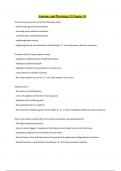
Anatomy and Physiology II Chapter 26 The urinary system does all of the following except - eliminating organic waste products. - excreting excess albumin molecules. - contributing to stabilizing blood pH. - regulating blood volume. - regulating plasma concentrations of electrolytes. ️excreting excess albumin molecules. Functions of the urinary system include - regulation of blood volume and blood pressure. - helping to stabilize blood pH. - regulation of plasma concentration of certain ions. - conservation of valuable nutrients. - All of the answers are correct. ️all of the answers are correct A glomerulus is - the source of erythropoietin. - a knot of capillaries within the renal corpuscle. - attached to the collecting duct. - the expanded end of a nephron. - the horseshoe-shaped segment of the nephron. ️a knot of capillaries within the renal corpuscle. How is the kidney involved with normal bone ossification and development? - The kidney produces calcitriol. - Injury to bone triggers a response in the kidney, which makes more rennin hormone. - Osteoblasts migrate from the kidney into the bone. - Growth factors from the kidney direct the growth the epiphyseal cartilage plate in the bone. - Growth hormone is produced by the kidneys. ️the kidney produces calcitrol Urine is eliminated through the - kidney. - urethra. - urinary bladder. - ureter. - liver. ️urethra The urinary system regulates blood volume and pressure by - releasing erythropoietin. - adjusting the volume of water lost in urine. - regulating NaCl levels in the blood. - releasing renin. - All of the answers are correct. ️all of the answers are correct Urine is carried to the urinary bladder by - the urethra. - blood vessels. - lymphatics. - the ureters. - the calyces. ️the ureters Urine passes, in the order given, through which of the following structures? - collecting duct, ureter, renal pelvis, urethra, bladder - renal pelvis, urethra, bladder, ureter, collecting duct - collecting duct, renal pelvis, ureter, bladder, urethra - renal pelvis, collecting duct, bladder, ureter, urethra - collecting duct, renal pelvis, urethra, bladder, ureter ️collecting duct, renal pelvis, ureter, bladder, urethra All of the following are true of the kidneys except that they are - surrounded by a fibrous capsule. - located in a position that is retroperitoneal. - located partly within the pelvic cavity. - held in place by the renal fascia. - covered by peritoneum. ️located partly within the pelvic cavity. The prominent indentation on the medial surface of the kidney is the - pyramid. - ureter. - pelvis. - hilum. - calyx. ️hilum The renal sinus is - an internal cavity lined by the fibrous capsule. - a renal corpuscle. - the innermost layer of kidney tissue. - a large branch of the renal pelvis. - part of a renal pyramid. ️an internal cavity lined by the fibrous capsule. The outermost layer of the kidney is the - renal medulla. - renal pelvis. - fibrous capsule. - renal cortex. - major calyx. ️fibrous capsule The cavity of the kidney that receives urine from the calyces is called the - renal pelvis. - renal medulla. - renal sinus. - renal cortex. - renal papilla. ️renal pelvis Triangular or conical structures located in the renal medulla are called - renal pelvises. - nephrons. - pyramids. - renal columns. - calyces. ️pyramids Blood leaves the glomerulus through a blood vessel called the - renal vein. - efferent arteriole. - afferent arteriole. - vasa recta. - interlobular arteriole. ️efferent arteriole The left kidney lies ________ to the right kidney. - posterior - superior - inferior - anterior - transverse ️superior The position of the kidneys in the abdominal cavity is stabilized by - the overlying peritoneum. - contact with adjacent visceral organs. - the renal fascia. - supporting connective tissues. - All of the answers are correct. ️all of the answers are correct The condition called ________ is especially dangerous because the ureters or renal blood vessels can become twisted or kinked during movement. - polycystic kidney disease - floating kidney - pyelonephritis - renal failure - renal calculi ️floating kidney Which of the following descriptions best matches the term calyx? - It releases renin. - Initial filtrate enters here. - It creates high interstitial NaCl concentration. - Final urine enters here. ️final urine enters here The ________ delivers urine to a minor calyx. - distal convoluted tubule - renal corpuscle - ureter - papillary duct - nephron loop (loop of Henle) ️papillary duct
École, étude et sujet
- Établissement
- Anatomy and Physiology II Chapter 26
- Cours
- Anatomy and Physiology II Chapter 26
Infos sur le Document
- Publié le
- 25 avril 2024
- Nombre de pages
- 20
- Écrit en
- 2023/2024
- Type
- Examen
- Contenu
- Questions et réponses
Sujets
-
anatomy and physiology ii chapter 26

Document également disponible en groupe