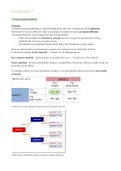
- Storage involves maintaining encoded information in memory over time.
- Retrieval involves recovering information from memory stores.
7.1
ENCODING: GETTING INFORMATION INTO MEMORY
ROLE OF ATTENTION
- Attention involves focusing awareness on a narrowed range of stimuli or
events→selective attention
- Attention: selection of input
LEVELS OF PROCESSING
- Attention is critical to the encoding of memories
- Structural encoding is relatively shallow processing that emphasizes the physical
structure of the stimulus.
- Phonemic encoding: emphasizes what a word sounds like.
- Semantic encoding: emphasizes the meaning of verbal input (the object and
actions the words represent
- Levels-of-processing theory proposes that deeper levels of processing result
in longer lasting memory codes.
- Levels-of-processing theory has been enormously influential; it has shown that
memory involves more than just storage and has inspired a great deal of
research on how processing considerations affect memory
, ENRICHING ENCODING
- ELABORATION (enhance the process of semantic encoding)
- the linking of a stimulus to other information at the time of encoding
- VISUAL IMAGERY
- Imagery: the creation of visual images to represent the words to be
remembered
- imagery facilitates memory because it provides a second kind of memory
code, and two codes are better than one
- memory is enhanced by forming both semantic and visual codes since
either can lead to recall
- SELF REFERENT ENCODING
- Deciding how or whether information is personally relevant
7.2
STORAGE: MAINTAINING INFORMATION IN MEMORY
SENSORY MEMORY
- Sensory memory preserves information in its original sensory form for a brief
time, usually only a fraction of a second
- The memory trace in the visual sensory store decays in about one-quarter of a
second.
SHORT TERM MEMORY
- Short-term memory (STM) is a limited-capacity store that can maintain
unrehearsed information for up to about 20 seconds.
- To maintain information in your short-term store longer, by engaging in
rehearsal the process of repetitively verbalizing or thinking about
information
- SMALL CAPACITY & SHORT STORAGE DURATION
DURABILITY OF STORAGE
- the loss of information from short-term memory was attributable purely to
time-related decay of memory traces, but follow-up research showed that
interference from competing material may be more important
CAPACITY OF STORAGE
- Short term memory has limited number of items it can hold (small capacity)
- A chunk is a group of familiar stimuli stored as a single unit.
- Retrieval involves recovering information from memory stores.
7.1
ENCODING: GETTING INFORMATION INTO MEMORY
ROLE OF ATTENTION
- Attention involves focusing awareness on a narrowed range of stimuli or
events→selective attention
- Attention: selection of input
LEVELS OF PROCESSING
- Attention is critical to the encoding of memories
- Structural encoding is relatively shallow processing that emphasizes the physical
structure of the stimulus.
- Phonemic encoding: emphasizes what a word sounds like.
- Semantic encoding: emphasizes the meaning of verbal input (the object and
actions the words represent
- Levels-of-processing theory proposes that deeper levels of processing result
in longer lasting memory codes.
- Levels-of-processing theory has been enormously influential; it has shown that
memory involves more than just storage and has inspired a great deal of
research on how processing considerations affect memory
, ENRICHING ENCODING
- ELABORATION (enhance the process of semantic encoding)
- the linking of a stimulus to other information at the time of encoding
- VISUAL IMAGERY
- Imagery: the creation of visual images to represent the words to be
remembered
- imagery facilitates memory because it provides a second kind of memory
code, and two codes are better than one
- memory is enhanced by forming both semantic and visual codes since
either can lead to recall
- SELF REFERENT ENCODING
- Deciding how or whether information is personally relevant
7.2
STORAGE: MAINTAINING INFORMATION IN MEMORY
SENSORY MEMORY
- Sensory memory preserves information in its original sensory form for a brief
time, usually only a fraction of a second
- The memory trace in the visual sensory store decays in about one-quarter of a
second.
SHORT TERM MEMORY
- Short-term memory (STM) is a limited-capacity store that can maintain
unrehearsed information for up to about 20 seconds.
- To maintain information in your short-term store longer, by engaging in
rehearsal the process of repetitively verbalizing or thinking about
information
- SMALL CAPACITY & SHORT STORAGE DURATION
DURABILITY OF STORAGE
- the loss of information from short-term memory was attributable purely to
time-related decay of memory traces, but follow-up research showed that
interference from competing material may be more important
CAPACITY OF STORAGE
- Short term memory has limited number of items it can hold (small capacity)
- A chunk is a group of familiar stimuli stored as a single unit.