B1
The characteristics of living things are :
- Movement : an action by an organism causing a change of position or place.
- Respiration : The chemical reactions in cells that break down nutrient molecules and release energy.
- Sensitivity : The ability to detectband respond to changes in the environment.
- Growth : a permanent increase in size
- Reproduction : The processes that make more of a same kind of organisms.
- Excretion : Removal from organisms of toxic materials and substances in excess of requirement.
- Nutrition : Taking in of materials for energy, growth and development.
Cells are made of :
- Nucleus (the centre)
- Small vacuoles
- Nuclear envelope (around the nucleus)
- Cytoplasm (material outside the nucleus)
- Cell membrane (wall around the cell)
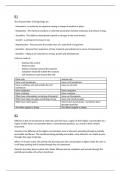
Plant cells Animal cells
Have a cell membrane Have a cell membrane
Have a cellulose cell wall outside the cell Have no cell wall
membrane
Have cytoplasm Have cytoplasm
Have a nucleus Have a nucleus
Often have chloroplasts containing chlorophyll Have no chloroplasts
Often have large vacuoles containing cell sap Have only small vacuoles
Often have starch grains Never have starch grains ; sometimes have
glycogen granules
Are often regular in shape Are often irregular in shape
B2
Diffusion is the net movement of molecules and ions from a region of their higher concentration to a
region of their lower concentration down a concentration gradient, as a result of their random
movement.
Osmosis is the diffusion of the higher concentration zone of elements spreading through a partially
permeable membrane. The membrane being partially permeable, some éléments are unable to pass
through, like sugar molecules.
When it is in pure water, the animal cells burst because the concentration is higher inside the cell, so
it will keep pushing until it breaks through the cell membrane.
Osmosis also takes place in plant cells. Water diffuses into the cytoplasm and vacuole through the
partially permeable cell surface membrane.
The characteristics of living things are :
- Movement : an action by an organism causing a change of position or place.
- Respiration : The chemical reactions in cells that break down nutrient molecules and release energy.
- Sensitivity : The ability to detectband respond to changes in the environment.
- Growth : a permanent increase in size
- Reproduction : The processes that make more of a same kind of organisms.
- Excretion : Removal from organisms of toxic materials and substances in excess of requirement.
- Nutrition : Taking in of materials for energy, growth and development.
Cells are made of :
- Nucleus (the centre)
- Small vacuoles
- Nuclear envelope (around the nucleus)
- Cytoplasm (material outside the nucleus)
- Cell membrane (wall around the cell)
Plant cells Animal cells
Have a cell membrane Have a cell membrane
Have a cellulose cell wall outside the cell Have no cell wall
membrane
Have cytoplasm Have cytoplasm
Have a nucleus Have a nucleus
Often have chloroplasts containing chlorophyll Have no chloroplasts
Often have large vacuoles containing cell sap Have only small vacuoles
Often have starch grains Never have starch grains ; sometimes have
glycogen granules
Are often regular in shape Are often irregular in shape
B2
Diffusion is the net movement of molecules and ions from a region of their higher concentration to a
region of their lower concentration down a concentration gradient, as a result of their random
movement.
Osmosis is the diffusion of the higher concentration zone of elements spreading through a partially
permeable membrane. The membrane being partially permeable, some éléments are unable to pass
through, like sugar molecules.
When it is in pure water, the animal cells burst because the concentration is higher inside the cell, so
it will keep pushing until it breaks through the cell membrane.
Osmosis also takes place in plant cells. Water diffuses into the cytoplasm and vacuole through the
partially permeable cell surface membrane.