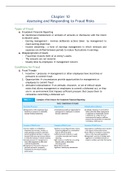
Chapter 10
Assessing and Responding to Fraud Risks
Types of Fraud
Fraudulent Financial Reporting
An intentional misstatement or omission of amounts or disclosures with the intent
to deceive users.
- Earning management : involves deliberate actions taken by management to
meet earning objectives
- Income smoothing : a form of earnings management in which revenues and
expenses are shifted between periods to reduce fluctuations in earnings.
Misappropriation of Assets
- Fraud that involves theft of an entity’s assets
- The amounts are not material
- Usually done by employees → management concern
Conditions for Fraud
Fraud Triangle
1. Incentive / pressures → management or other employees have incentives or
pressures to commit fraud.
2. Opportunities → circumstances provide opportunities for management or
employees to commit fraud
3. Attitudes/rationalization → an attitude, character, or set of ethical values
exists that allows management or employees to commit a dishonest act, or they
are in an environment that imposes sufficient pressure that causes them to
rationalize committing a dishonest act.
, Assessing Risk of Fraud
Professional Skepticism
- Questioning mind : to identify fraud risk and evaluate evidence
- Critical evaluation of audit evidence
Sources of Information to Assess Fraud Risks
✓ Communications Among Management Team
Conduct discussions to share insights and to brainstorm:
1. How and where they believe the entity’s financial statements might be
susceptible to material misstatement due to fraud. This should include
consideration of known external and internal factors affecting the entity
that might:
▪ Create an incentive/pressure for management to commit fraud
▪ Provide the opportunity for fraud to be perpetrated, including
the risk of management override of internal controls
▪ Indicate a culture or environment that enables management to
rationalize fraudulent acts.
2. How management could perpetrate and conceal fraudulent financial
reporting.
3. How anyone might misappropriate assets of the entity.
4. How the auditor might respond to the susceptibility of material
misstatement due to fraud.
✓ Inquiries of Management
Inquiries of management and others within the company provide employees
with an opportunity to tell the auditor information that otherwise might
not be communicated. Moreover, their responses to the auditor’s questions
often reveal information on the likelihood of fraud.
Assessing and Responding to Fraud Risks
Types of Fraud
Fraudulent Financial Reporting
An intentional misstatement or omission of amounts or disclosures with the intent
to deceive users.
- Earning management : involves deliberate actions taken by management to
meet earning objectives
- Income smoothing : a form of earnings management in which revenues and
expenses are shifted between periods to reduce fluctuations in earnings.
Misappropriation of Assets
- Fraud that involves theft of an entity’s assets
- The amounts are not material
- Usually done by employees → management concern
Conditions for Fraud
Fraud Triangle
1. Incentive / pressures → management or other employees have incentives or
pressures to commit fraud.
2. Opportunities → circumstances provide opportunities for management or
employees to commit fraud
3. Attitudes/rationalization → an attitude, character, or set of ethical values
exists that allows management or employees to commit a dishonest act, or they
are in an environment that imposes sufficient pressure that causes them to
rationalize committing a dishonest act.
, Assessing Risk of Fraud
Professional Skepticism
- Questioning mind : to identify fraud risk and evaluate evidence
- Critical evaluation of audit evidence
Sources of Information to Assess Fraud Risks
✓ Communications Among Management Team
Conduct discussions to share insights and to brainstorm:
1. How and where they believe the entity’s financial statements might be
susceptible to material misstatement due to fraud. This should include
consideration of known external and internal factors affecting the entity
that might:
▪ Create an incentive/pressure for management to commit fraud
▪ Provide the opportunity for fraud to be perpetrated, including
the risk of management override of internal controls
▪ Indicate a culture or environment that enables management to
rationalize fraudulent acts.
2. How management could perpetrate and conceal fraudulent financial
reporting.
3. How anyone might misappropriate assets of the entity.
4. How the auditor might respond to the susceptibility of material
misstatement due to fraud.
✓ Inquiries of Management
Inquiries of management and others within the company provide employees
with an opportunity to tell the auditor information that otherwise might
not be communicated. Moreover, their responses to the auditor’s questions
often reveal information on the likelihood of fraud.