Lives of citizens
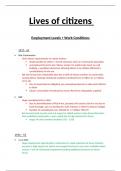
Employment Levels + Work Conditions
1917– 24
War Communism
- Strict labour requirements for urban workers
death penalty for strikes + forced voluntary work on ‘Communist Saturdays’
unemployed forced to join ‘labour armies’ for public tasks (such as road
building + woodland clearance) allowing labour to be utilised efficiently +
coordinatively to win war
- Ppl also forced into undesirable jobs due to drift of factory workers to countryside,
causing labour shortage (industrial workforce declined from 3 million to 1.2 million
1917-22)
Gov to issued decree obligating any unemployed person to take work offered
to them
Labour conscription introduced to ensure Red Army adequately supplied
NEP
- Huge unemployment in cities
Due to demobilisation of Red Army, peasants left country side for city due to
food shortages, gov cut funding for state industry in effort to balance budget
Number of unemployed rose 150,000 to 1.7 million 1922-29
- But increased job security and real wages for skilled workers (who demanded more
than unskilled counterparts + were ceded due to high demand for them)
wages of urban workers doubled 1921 - 1928
1924 – 53
1,2,3 FYPs
- Huge employment opportunities created due to rapid expansion of heavy industry,
esp due to high targets set (which encouraged factories to use every available labour
source) + lack of mechanised equipment (putting additional pressure on labour
force)
, No of hired workers rose from 11.5 million to 27 million 1928-37
1930, Soviet gov announced it was the first country to achieve full
employment in peacetime + by 1932 there were labour shortages
- High employment levels continued throughout WW2 + Fourth and Fifth Five Year
Plans
Women employed in greater numbers during war to make up for shortage of
men caused by conscription
- However terrible working conditions throughout whole period
Working conditions very poor
o Little attention given by gov to basic health + safety
o Work often difficult + monotonous
o To meet production targets, managers also introduced uninterrupted
work (day + night shifts)
o Shifts very long (12-18 hours a day during WW2 without a single day’s
leave)
Very low morale of workforce
o Contributed to poor productivity 1927, average Soviet worker
produced only half of average British worker + even after mechanised
equipment used after five year plans, worker productivity still lagged
behind that of Western workers
o Also shown by workers constantly changing occupation in search of
better employment
Eg at Magnitogorsk avrg worker stayed for only 80 days
Made worse by restrictions on movement of workers to
prevent labour shortages (eg internal passports issued 1932) +
harsh punishments introduced for absenteeism during early
1930s)
War economy
- Very poor working conditions
Soviet workers worked seven days a week for entirety of war + shifts lasted
12-18 hrs
Long hours, low pay, food rationing + strict discipline and penalties for
workers (death penalty for strikes)
Women forced to work to fill labour shortage (men fighting in war) AND huge
gulag population utilised as slave labour
4 + 5 FYPs
- Long hours, low pay, food rationing + strict discipline and penalties for workers
- Wages for peasants 1/6 wages for workers
, - But from 1948, living standards in towns began to recover + 1952, real wages for
urban workers reached level in 1928 (end of relatively prosperous NEP period)
1953 – 64
6,7 FYPs
- Improvement in wages + working conditions for urban workers
real wages increased average household income grew 3% 1960-65 + per
capita consumption increased by four precent under Krushchev
working week reduced from 48 hours / week to 41 hours / week
Working week reduced 1957 + no of days paid holiday increased
harsh Stalinist labour laws removed
full employment continued
- Improvement in wages + working conditions for peasants
According to official claim, average real incomes for peasant rose by 68%
1952-58 (probably exaggerated but suggests there was a definite
improvement)
savage exploitation of countryside permanently ended (lower tax burdens +
higher procurement prices)
- Labour turnover still very high, indicative of lack of job satisfaction (esp as many jobs
undemanding + repetitive) often 30% throughout period
- Not all good for peasants
Farms unable to pay workers for months as comes out of residual income
which may be depleted
Unable to provide pensions for elderly former collective farm workers
Employment Levels + Work Conditions
1917– 24
War Communism
- Strict labour requirements for urban workers
death penalty for strikes + forced voluntary work on ‘Communist Saturdays’
unemployed forced to join ‘labour armies’ for public tasks (such as road
building + woodland clearance) allowing labour to be utilised efficiently +
coordinatively to win war
- Ppl also forced into undesirable jobs due to drift of factory workers to countryside,
causing labour shortage (industrial workforce declined from 3 million to 1.2 million
1917-22)
Gov to issued decree obligating any unemployed person to take work offered
to them
Labour conscription introduced to ensure Red Army adequately supplied
NEP
- Huge unemployment in cities
Due to demobilisation of Red Army, peasants left country side for city due to
food shortages, gov cut funding for state industry in effort to balance budget
Number of unemployed rose 150,000 to 1.7 million 1922-29
- But increased job security and real wages for skilled workers (who demanded more
than unskilled counterparts + were ceded due to high demand for them)
wages of urban workers doubled 1921 - 1928
1924 – 53
1,2,3 FYPs
- Huge employment opportunities created due to rapid expansion of heavy industry,
esp due to high targets set (which encouraged factories to use every available labour
source) + lack of mechanised equipment (putting additional pressure on labour
force)
, No of hired workers rose from 11.5 million to 27 million 1928-37
1930, Soviet gov announced it was the first country to achieve full
employment in peacetime + by 1932 there were labour shortages
- High employment levels continued throughout WW2 + Fourth and Fifth Five Year
Plans
Women employed in greater numbers during war to make up for shortage of
men caused by conscription
- However terrible working conditions throughout whole period
Working conditions very poor
o Little attention given by gov to basic health + safety
o Work often difficult + monotonous
o To meet production targets, managers also introduced uninterrupted
work (day + night shifts)
o Shifts very long (12-18 hours a day during WW2 without a single day’s
leave)
Very low morale of workforce
o Contributed to poor productivity 1927, average Soviet worker
produced only half of average British worker + even after mechanised
equipment used after five year plans, worker productivity still lagged
behind that of Western workers
o Also shown by workers constantly changing occupation in search of
better employment
Eg at Magnitogorsk avrg worker stayed for only 80 days
Made worse by restrictions on movement of workers to
prevent labour shortages (eg internal passports issued 1932) +
harsh punishments introduced for absenteeism during early
1930s)
War economy
- Very poor working conditions
Soviet workers worked seven days a week for entirety of war + shifts lasted
12-18 hrs
Long hours, low pay, food rationing + strict discipline and penalties for
workers (death penalty for strikes)
Women forced to work to fill labour shortage (men fighting in war) AND huge
gulag population utilised as slave labour
4 + 5 FYPs
- Long hours, low pay, food rationing + strict discipline and penalties for workers
- Wages for peasants 1/6 wages for workers
, - But from 1948, living standards in towns began to recover + 1952, real wages for
urban workers reached level in 1928 (end of relatively prosperous NEP period)
1953 – 64
6,7 FYPs
- Improvement in wages + working conditions for urban workers
real wages increased average household income grew 3% 1960-65 + per
capita consumption increased by four precent under Krushchev
working week reduced from 48 hours / week to 41 hours / week
Working week reduced 1957 + no of days paid holiday increased
harsh Stalinist labour laws removed
full employment continued
- Improvement in wages + working conditions for peasants
According to official claim, average real incomes for peasant rose by 68%
1952-58 (probably exaggerated but suggests there was a definite
improvement)
savage exploitation of countryside permanently ended (lower tax burdens +
higher procurement prices)
- Labour turnover still very high, indicative of lack of job satisfaction (esp as many jobs
undemanding + repetitive) often 30% throughout period
- Not all good for peasants
Farms unable to pay workers for months as comes out of residual income
which may be depleted
Unable to provide pensions for elderly former collective farm workers