CAT REVISION GRADE 11
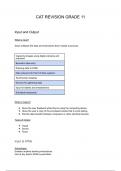
Input and Output
What is Input?
Gives software the data and instructions that it needs to process.
Capturing images using digital cameras and
scanners
Biometric data entry
Entering data at ATMs
Data entered into Point of Sale systems
Touchscreen displays
Devices for gathering data
Input for tablets and smartphones
Substitute keyboards
What is Output?
❖ Gives the user feedback while they're using the computing device.
❖ Gives the user a copy of the processed results that is more lasting.
❖ Permits data transfer between computers or other electrical devices
Types of Output
❖ Visual
❖ Sound
❖ Touch
Input at ATMs
Advantages:
Enables anytime banking transactions
Use of any bank's ATMs is permitted.
, Disadvantages
Dangerous, you are likely a target because you have money.
People can place a skimmer and a camera over an ATM's card reader.
Input into POS Systems
When incorporated into a retail POS system, barcodes and RFID tags offer a quick and
dependable method of identifying an item.
They accomplish two primary objectives, which are:
❖ Quicker handling at payment locations
❖ Improved inventory management
How does this work?
When stock is brought into a store, scanners are used to record it.
Prices are assigned for each item, and data is instantly saved in a database.
Each item you purchase is recorded at the till using a scanner.
Advantages
❖ Far quicker than using a keyboard to enter pricing
❖ Increased precision in updating and inputting pricing
❖ Companies are able to track how much stock they have left and precisely track how
many things they are selling.
Disadvantages
❖ It is challenging for the system to operate offline
❖ It is necessary to use costly hardware and software.
Input into Touch Screens
ADVANTAGES DISADVANTAGES
❖ Gives a device additional screen ❖ Typing is not as simple or quick
area
❖ It is easier to utilise. ❖ A touch screen may get smeared,
greasy, or unclean.
❖ It accepts input in the form of
motions and drawings.
Input and Output
What is Input?
Gives software the data and instructions that it needs to process.
Capturing images using digital cameras and
scanners
Biometric data entry
Entering data at ATMs
Data entered into Point of Sale systems
Touchscreen displays
Devices for gathering data
Input for tablets and smartphones
Substitute keyboards
What is Output?
❖ Gives the user feedback while they're using the computing device.
❖ Gives the user a copy of the processed results that is more lasting.
❖ Permits data transfer between computers or other electrical devices
Types of Output
❖ Visual
❖ Sound
❖ Touch
Input at ATMs
Advantages:
Enables anytime banking transactions
Use of any bank's ATMs is permitted.
, Disadvantages
Dangerous, you are likely a target because you have money.
People can place a skimmer and a camera over an ATM's card reader.
Input into POS Systems
When incorporated into a retail POS system, barcodes and RFID tags offer a quick and
dependable method of identifying an item.
They accomplish two primary objectives, which are:
❖ Quicker handling at payment locations
❖ Improved inventory management
How does this work?
When stock is brought into a store, scanners are used to record it.
Prices are assigned for each item, and data is instantly saved in a database.
Each item you purchase is recorded at the till using a scanner.
Advantages
❖ Far quicker than using a keyboard to enter pricing
❖ Increased precision in updating and inputting pricing
❖ Companies are able to track how much stock they have left and precisely track how
many things they are selling.
Disadvantages
❖ It is challenging for the system to operate offline
❖ It is necessary to use costly hardware and software.
Input into Touch Screens
ADVANTAGES DISADVANTAGES
❖ Gives a device additional screen ❖ Typing is not as simple or quick
area
❖ It is easier to utilise. ❖ A touch screen may get smeared,
greasy, or unclean.
❖ It accepts input in the form of
motions and drawings.