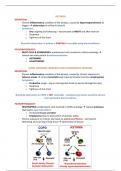
ASTHMA
DEFINITION:
- Chronic inflammatory condition of the airways, caused by hyperresponsiveness to
triggers obstruction in airflow in bronchi
- Symptoms:
o Dry coughing and wheezing – exacerbated at NIGHT and after exercise
o Dyspnoea
o Tightness of the chest
Bronchial obstruction in asthma is PARTIALLY reversible using bronchodilators
PATHOPHYSIOLOGY:
- MAST CELLS & EOSINOPHILS: predominant cells involved in asthma aetiology
release two main potent bronchoconstrictors:
o HISTAMINE
o LEUKOTRIENES
COPD (CHRONIC OBSTRUCTIVE PULMONARY DISEASE)
DEFINITION:
- Chronic inflammatory condition of the airways, caused by chronic exposure to
tobacco smoke chronic bronchitis and impaired alveolar function (emphysema)
- Symptoms:
o Productive cough – esp in morning (but tends to persist through the day)
o Dyspnoea
o Tightness of the chest
Bronchial obstruction in COPD is NOT reversible – symptoms get worse overtime and are
more persistent than in asthma.
PATHOPHYSIOLOGY:
- NEUTROPHILS: predominant cells involved in COPD aetiology release proteases
that lead to two main effects:
o Increased mucus secretion
o Emphysema (due to destruction of alveolar walls)
- Chronic exposure to irritants also leads to pulmonary fibrosis – permanent
thickening and scarring of lung tissue dysfunction of tissues
, BETA-2 RECEPTOR AGONISTS (SABAs & LABAs)
MOA:
- Bind to Beta-2 receptors lining bronchial smooth muscle smooth muscle
relaxation bronchodilation
- SABAs: cause bronchodilation for about 4-6 hours: (so MAX frequency = QDS)
o Salbutamol, Terbutaline (Bricanyl)
- LABAs: cause bronchodilation for about 12 hours:
o Salmeterol, Formoterol
LABAs are NEVER given as MONOTHERAPY – always COMBINE with ICS (or other
bronchodilators)
SIDE EFFECTS: (more common at high doses/overuse)
- HAND TREMOR (aka fine tremor)
- PALPITATIONS/TACHYCARDIA: activation of beta-1 receptors
- HYPOKALAEMIA: stimulates the Na+/K+ ATPase more K+ pumped into cells - can
elongate QT-interval predispose to arrythmias e.g. Torsade de Pointes
- HYPERGLYCEMIA: increased sympathetic activity reduced insulin secretion
increased glucose availability for the body more glucose in blood (caution in DM)
COMMON INTERACTIONS – Other HYPOkalaemic drugs
- LOOP & THIAZIDE DIURETICS: Non-K+-sparing diuretics
- XANTHINES (theophylline): Stimulate the Na+/K+ ATPase more intracellular K+
- CORTICOSTEROIDS: Have mineralocorticoid effects (like aldosterone)
IMPORTANT POINTS:
- SABAs dose: ONE-TWO puffs up to QDS (PRN)
- Formoterol works more quickly than salmeterol – so is licensed as a reliver therapy
(only when combined with ICS in MART inhalers)
- Beta-agonists used evenly in both asthma and COPD
MUSCARANIC ANTAGONISTS (SAMAs & LAMAs)
MOA:
- Competes with ACh for the M3 receptors lining bronchial smooth muscle
antagonism of M3 receptor reduced PS innervation bronchodilation
- SAMAs:
o Ipratropium (Atrovent)
- LAMAs:
o Tiotropium (Braltus and Spiriva), Aclidinium, Umeclidinium
SIDE EFFECTS: (more common at high doses/overuse)
- ANTIMUSCARINIC EFFECTS: dry mouth, urinary retention (avoid in BPH),
constipation, blurred vision (seek CAG below)
- PARADOXICAL BRONCHOSPASM: worsening of bronchoconstriction despite using
bronchodilators – SEEK URGENT MEDICAL ATTENTION
- CLOSED-ANGLE GLAUCOMA (CAG): antimuscarinics reduce aqueous humour
outflow rapid build-up of fluid in eye (avoid in pts susceptible to CAG).
DEFINITION:
- Chronic inflammatory condition of the airways, caused by hyperresponsiveness to
triggers obstruction in airflow in bronchi
- Symptoms:
o Dry coughing and wheezing – exacerbated at NIGHT and after exercise
o Dyspnoea
o Tightness of the chest
Bronchial obstruction in asthma is PARTIALLY reversible using bronchodilators
PATHOPHYSIOLOGY:
- MAST CELLS & EOSINOPHILS: predominant cells involved in asthma aetiology
release two main potent bronchoconstrictors:
o HISTAMINE
o LEUKOTRIENES
COPD (CHRONIC OBSTRUCTIVE PULMONARY DISEASE)
DEFINITION:
- Chronic inflammatory condition of the airways, caused by chronic exposure to
tobacco smoke chronic bronchitis and impaired alveolar function (emphysema)
- Symptoms:
o Productive cough – esp in morning (but tends to persist through the day)
o Dyspnoea
o Tightness of the chest
Bronchial obstruction in COPD is NOT reversible – symptoms get worse overtime and are
more persistent than in asthma.
PATHOPHYSIOLOGY:
- NEUTROPHILS: predominant cells involved in COPD aetiology release proteases
that lead to two main effects:
o Increased mucus secretion
o Emphysema (due to destruction of alveolar walls)
- Chronic exposure to irritants also leads to pulmonary fibrosis – permanent
thickening and scarring of lung tissue dysfunction of tissues
, BETA-2 RECEPTOR AGONISTS (SABAs & LABAs)
MOA:
- Bind to Beta-2 receptors lining bronchial smooth muscle smooth muscle
relaxation bronchodilation
- SABAs: cause bronchodilation for about 4-6 hours: (so MAX frequency = QDS)
o Salbutamol, Terbutaline (Bricanyl)
- LABAs: cause bronchodilation for about 12 hours:
o Salmeterol, Formoterol
LABAs are NEVER given as MONOTHERAPY – always COMBINE with ICS (or other
bronchodilators)
SIDE EFFECTS: (more common at high doses/overuse)
- HAND TREMOR (aka fine tremor)
- PALPITATIONS/TACHYCARDIA: activation of beta-1 receptors
- HYPOKALAEMIA: stimulates the Na+/K+ ATPase more K+ pumped into cells - can
elongate QT-interval predispose to arrythmias e.g. Torsade de Pointes
- HYPERGLYCEMIA: increased sympathetic activity reduced insulin secretion
increased glucose availability for the body more glucose in blood (caution in DM)
COMMON INTERACTIONS – Other HYPOkalaemic drugs
- LOOP & THIAZIDE DIURETICS: Non-K+-sparing diuretics
- XANTHINES (theophylline): Stimulate the Na+/K+ ATPase more intracellular K+
- CORTICOSTEROIDS: Have mineralocorticoid effects (like aldosterone)
IMPORTANT POINTS:
- SABAs dose: ONE-TWO puffs up to QDS (PRN)
- Formoterol works more quickly than salmeterol – so is licensed as a reliver therapy
(only when combined with ICS in MART inhalers)
- Beta-agonists used evenly in both asthma and COPD
MUSCARANIC ANTAGONISTS (SAMAs & LAMAs)
MOA:
- Competes with ACh for the M3 receptors lining bronchial smooth muscle
antagonism of M3 receptor reduced PS innervation bronchodilation
- SAMAs:
o Ipratropium (Atrovent)
- LAMAs:
o Tiotropium (Braltus and Spiriva), Aclidinium, Umeclidinium
SIDE EFFECTS: (more common at high doses/overuse)
- ANTIMUSCARINIC EFFECTS: dry mouth, urinary retention (avoid in BPH),
constipation, blurred vision (seek CAG below)
- PARADOXICAL BRONCHOSPASM: worsening of bronchoconstriction despite using
bronchodilators – SEEK URGENT MEDICAL ATTENTION
- CLOSED-ANGLE GLAUCOMA (CAG): antimuscarinics reduce aqueous humour
outflow rapid build-up of fluid in eye (avoid in pts susceptible to CAG).