Summary CSS 133 INTRODUCTION TO CRIMINOLOGY I
INTRODUCTION Welcome to CSS133: Introduction to Criminology 1. This course is a two-credit unit course for all students of Criminology and Security Studies. The course is suitable for beginners as a foundation course on the subject matter of knowing the relationship between crime and society; treatment of offenders and prevention and control of crimes. This course guide gives you an overview of the course. It also provides you with information on the organisation and requirements of the course. In other words, it enables you to know what the course is all about, what you ought to know in each unit, what course material one needs to use and how you can work your way through this course. COURSE AIM The basic aim of CSS133: Introduction to Criminology 1 is to expose the learner to the rudiments of criminal explanations. This broad aim will be consummated through the: (i) dimensions of criminology (ii) classical and contemporary theories of criminology (iii) constitutional factors that cause crimes (iv) reason some people commit crime and others do not (v) treatment of offenders and victims of crime and measurement of crimes. COURSE OBJECTIVES In each of the units, we have specific objectives. It is advisable for students to go through these objectives before reading through the unit. In doing this, you are sure that you have covered the prerequisites of that unit. To achieve the aims set out in CSS 133: Introduction to Criminology 1, the objectives for the course as a whole would be emphasised. On successful completion of the course, the learner should be able to: a. define criminology b. establish the dimensions of criminology c. distinguish the different schools of thought • discuss the classical schools • explain the positivist ideology CSS133 COURSE GUIDE v • explain the critical school of thought • discuss the sociological model of reasoning and • explain the new criminology (d) state the theoretical explanation of crimes (e) define the relevant terms (f) identify the etiology of crimes (g) outline the elements and classifications of crime (h) discuss crime as a societal phenomenon (i) distinguish between conformity and deviance; and the impact of labeling (j) evaluate the measurement of crimes (k) critique the juridical approach to crimes, and the treatment of offenders and victims.
Livre connecté
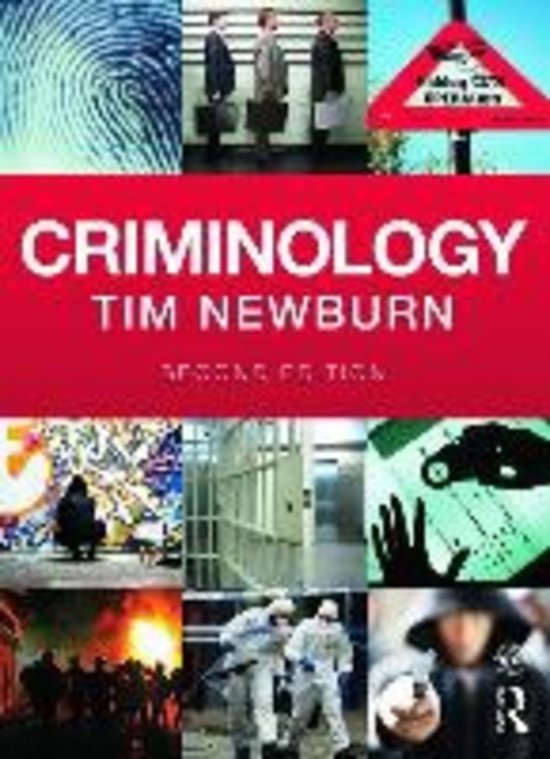
- december 2012
- 9780415628945
- 1
École, étude et sujet
- Établissement
- California School Of Law
- Cours
- LAW
Infos sur le Document
- Livre entier ?
- Oui
- Publié le
- 29 octobre 2023
- Nombre de pages
- 94
- Écrit en
- 2023/2024
- Type
- Resume
Sujets
-
this course is a two credit unit course for all st
-
this course guide gives you an overview of the cou